
.png)
The Short Answer: Search engine visibility comes from seven things working together. Publish content worth ranking, target the right keywords, fix the technical problems holding your site back, earn links, promote off-site, claim your Google Business Profile, and audit what you have. No single one of them moves the needle alone.
Everybody wants to be at the top of page one of Google search. The top few results get the overwhelming majority of clicks. Improving your search engine ranking starts with taking proactive steps to increase your online presence, and these are the seven that matter most.
1. Publish Content Worth Ranking
The job of a search engine is to provide the most relevant content that matches the searcher's intent. It will not do you any good to reach the top of the rankings if the content is weak. Content that offers no value for visitors creates a negative impression and does more harm than good.
High-quality content is where visibility starts. Google's SEO Starter Guide says creating content people find compelling and useful will likely influence your presence in search results more than any other suggestion in that guide. Google lists four attributes of quality content. The text reads easily and is well organized. The content is original rather than a rehash of what is already published. It stays current, and it is written for people first.
That last point rules out a lot of what passes for content marketing. Publishing blog posts on a schedule to hit a quota produces pages nobody reads and Google has no reason to rank. Our guide to writing blog posts that convert covers how to make content creation earn its place.
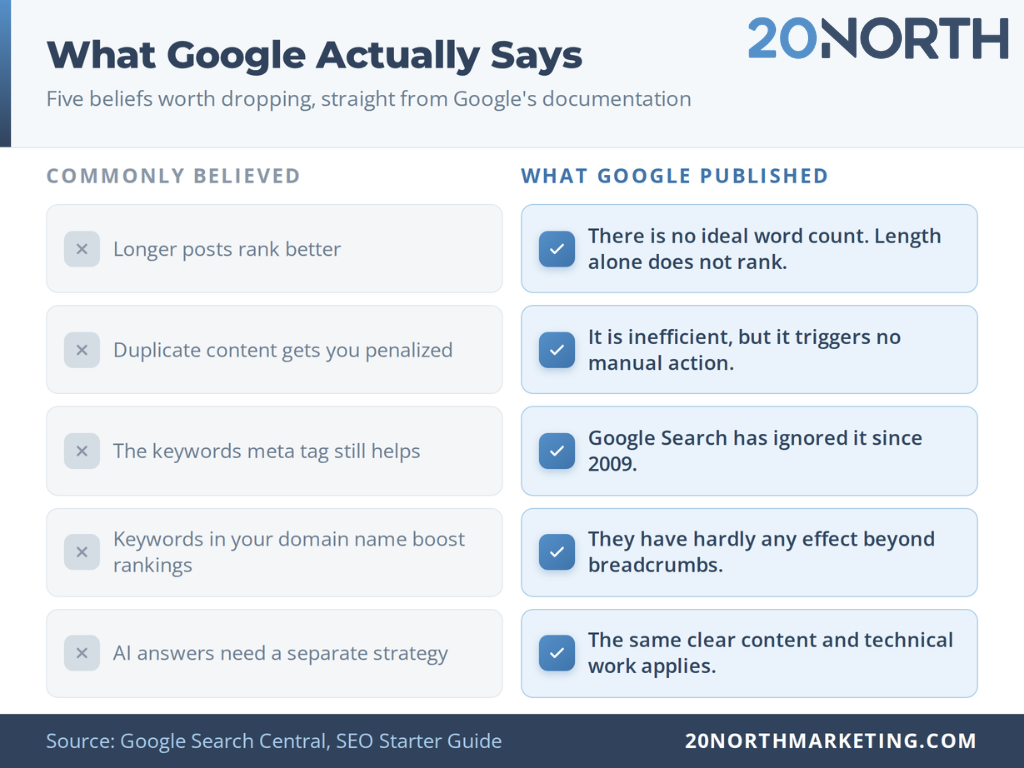
Google also states there is no ideal word count. Length by itself is not a ranking factor.
2. Target the Right Keywords
Keywords tell search engines what your web pages are about, and the ones you target shape the kind of traffic you get.
Good keyword research pairs high-volume terms that reflect your content with long-tail terms for specific searches. A wine store might target "buy wines online" for category traffic and a specific bottle name for the shopper who already knows what they want. The broad term brings volume. The specific term brings people who are ready to buy.
Google Keyword Planner is free inside Google Ads and a reasonable place to start. Paid platforms give you competitor data and content gaps, which we cover in our roundup of the best SEO tools.
Map one primary term to each page rather than chasing the same keyword across your whole site. Two pages competing for one query split your own authority, and Google picks one of them for you.
Two warnings from Google. Repeating the same term over and over is keyword stuffing and violates their spam policies, and the keywords meta tag has been ignored by Google Search since 2009.
3. Fix Your Technical SEO
Google uses many ranking signals, and a large share of them are technical. These include:
- Site and page load speed
- Mobile optimization and responsive design
- Optimized URL structure
- Structured data markup
- Robots.txt and XML sitemap
- Website security (HTTPS)
These items help Google and other search engines evaluate the quality of the experience a visitor will have on your website. If website visitors have a poor experience when they arrive, it reflects poorly on the search engine that sent them. Weak technical SEO efforts mean no top ranking.
Page speed and user experience carry the most weight here for most sites. Our breakdown of what kills website speed covers the common culprits, and structured data is the piece most sites skip entirely.
Core Web Vitals are Google's published measurements for load speed, interactivity, and visual stability. They will not rescue thin content, but a slow site with good content loses to a fast competitor with equal content. E-commerce sites feel this hardest, since every extra second costs conversions as well as rankings.
4. Earn Links
Three types of links play a role in search rankings.
Internal links connect one page on your website to another. Outbound links point from your web pages to external sites. Inbound links, also called backlinks, come from other websites to yours.
Inbound links provide the greatest boost. When a high-authority website links to your content, it sends a quality signal to Google. They are also the hardest to get. Guest posts and guest blogging remain a workable route for small businesses, provided the site is relevant and the content is worth reading. Google penalizes link schemes, so buying links or trading them at scale creates risk without building authority.
Internal linking is the part most sites control and ignore. Google finds the vast majority of new pages through links, so connecting related web pages helps both readers and crawlers. Write the anchor text so it describes the destination. "Read more" tells Google nothing about the page you are pointing at.
5. Promote Off-Site
Google says traffic counts do not affect search rankings directly, but promotion still matters because it is how people and search engines find new content in the first place.
Google's own guidance lists social media promotion, community engagement, online advertising, and word of mouth as ways to get content discovered. Word of mouth lasts the longest of the four, and it also takes the longest.
Social media platforms put your content in front of a wider audience and build brand awareness that compounds. Our post on social media strategies for small business covers picking the right platforms. Google Ads and other online marketing channels buy online visibility while your organic rankings develop, which is why most growing brands run both.
6. Claim Your Google Business Profile
If you have not claimed and filled out your Google Business Profile, do that next. It is free, and for a local business it is the highest-return hour of SEO work available.
A complete profile can put you in Google's map pack, which sits above the organic results, and it feeds your listing in Google Maps. Hours, address, phone number, services, photos, and positive reviews all pull weight.
Reviews are the piece owners tend to neglect. Ask satisfied customers directly, respond to every review, including the unhappy ones, and keep your hours accurate through holidays. We covered the full case in our post on why Google Business Profile matters.
The listing was called Google My Business until Google renamed it. If your internal documentation still says GMB, it is describing the same product.
7. Run an SEO Audit
If your search rankings are not where you want them, audit before you tinker. Guessing at fixes wastes months. An SEO audit tells you what is actually broken: broken links, canonical errors, 404 errors, sitemap errors, thin or unhelpful pages, and pages accidentally set to noindex.
One correction worth making here is that duplicate content is not a penalty. Google states that content accessible under multiple URLs is inefficient but will not trigger a manual action. Copying other sites is a different matter. Fix canonicals for crawl efficiency.
Where AI-Generated Answers Fit
Search results now include AI-generated answers, and plenty of agencies will sell you a separate strategy for them. Google published official guidance on optimizing for generative AI features, and the summary is that the work is the same work. Clear content, sound technical setup, and unique information are what get pages surfaced in AI answers. We go deeper in will AI replace SEO and optimizing product pages for AI Overviews.
What changes is measurement. Impressions inside an AI answer do not behave like a blue link, so track brand mentions alongside rankings. We cover the tooling in our guide to tracking brand visibility in AI search.
Measure What You Changed
Visibility work is invisible without measurement. Google Search Console shows which queries you rank for and which pages lost impressions. Google Analytics shows what visitors did after they arrived.
Check monthly rather than daily. Google says some changes register in hours and others take months, so a week of flat data means nothing. Our guide to the SEO KPIs that matter covers which numbers deserve attention.
Pick one metric per goal before you start. Impressions measure how often you are seen. Clicks measure how often the result was worth choosing. Conversions measure how much of that traffic was the right traffic. Watching all three at once with no target turns reporting into a hobby.
Improve Your Search Engine Visibility With 20North
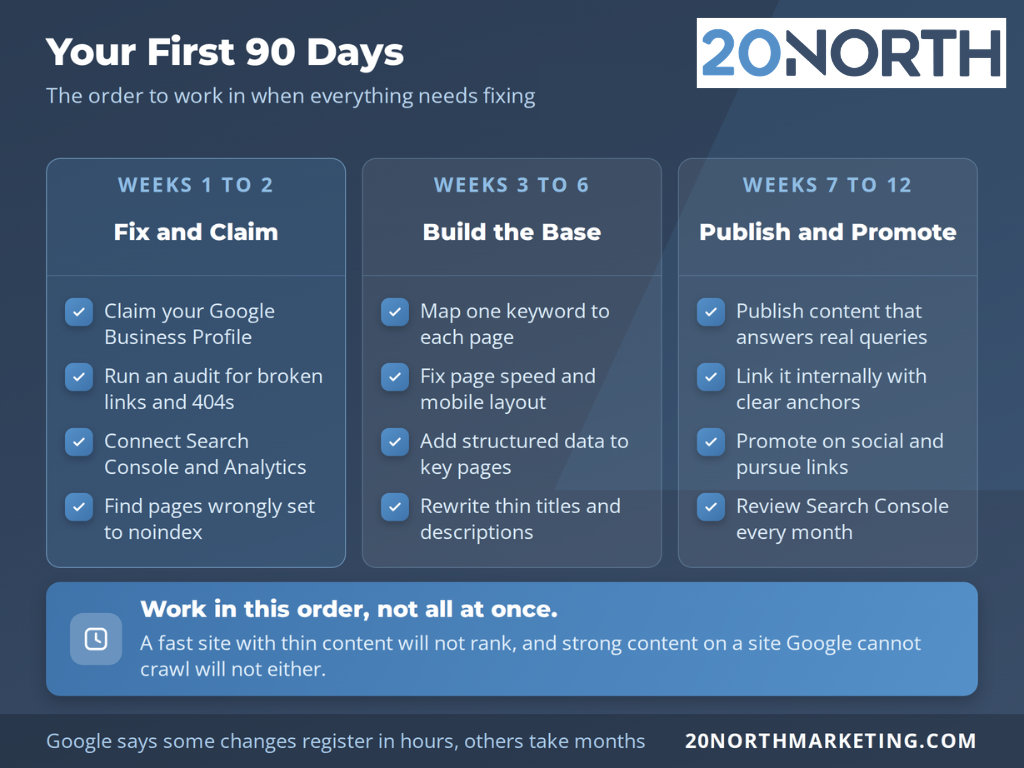
These seven items work together. A fast site with thin content will not rank, and excellent content on a site Google cannot crawl will not either.
20North is a full-service digital marketing agency in Atlanta. Our team pairs search engine optimization with keyword research, on-page optimization, paid advertising, and web development so your digital presence works across organic results, maps, and AI answers. See it in our case studies, including how Roam grew its page-one keyword footprint by 130%.
Start with a free SEO audit or contact us to talk through where your site stands.
.png)
.png)
.png)