
.png)
The Short Answer: The best content management system depends on your goals, but for most businesses building an online store, Shopify is our top recommendation, and as a Shopify Premier Partner it is where 20North builds the majority of its sites. WordPress is the most flexible all‑rounder, while Drupal, Joomla, Magento, and BigCommerce each fit specific needs. This guide covers what a CMS is, the factors that matter, and which platform fits your website.
What Is a Content Management System?
A content management system (CMS) is a software application that helps you create, manage, and modify all of your digital content. In simpler terms, a CMS does exactly what the name says. It helps you manage your website content in a systemized and organized way. Content management systems are great options for people who are not tech-savvy. Instead of coding every time you want to add a piece of content to your site, the CMS gives you an easy content editor, so you can upload web content without touching code. A good content editor keeps a clean user interface, supports version control so you can roll back changes, and lets a content manager publish updates in real time. Many platforms now add AI capabilities to speed up content creation.
Types of Content Management Systems
Not every content management platform works the same way. A few common types:
- Hosted (SaaS): The company hosts everything for you, like Shopify and BigCommerce. Less technical knowledge is needed, and the platform handles security, updates, and uptime so your team can focus on selling.
- Open source: Free to download and highly customizable, like WordPress, Drupal, Joomla, and Magento. You control the source code and can extend the platform, though you host it yourself.
- Headless CMS platforms: These separate your content from how it is displayed and deliver it through an API to a website, mobile app, or video platform. Headless suits a development team that wants greater flexibility across channels.
- Enterprise content management: Built for large enterprises that need digital asset management, document management, and workflow control over huge libraries of digital files.
Factors to Consider When Choosing a CMS
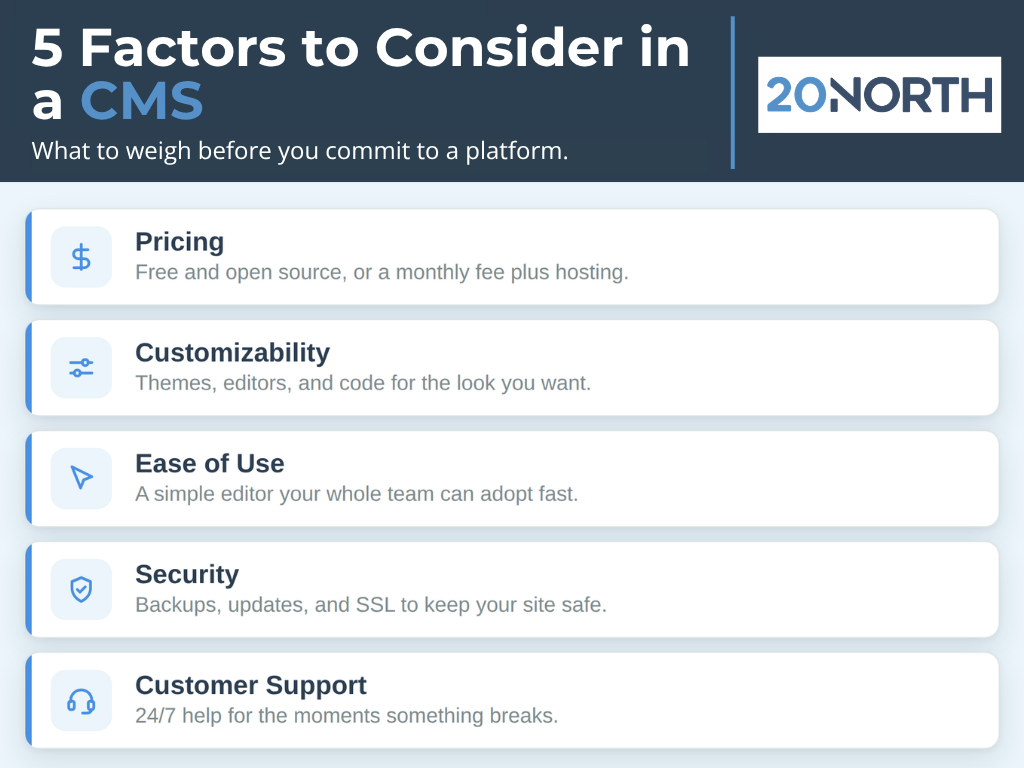
Pricing
Some content management tools are free and open source, while others charge a monthly fee, and you will still need to pay to host your site. Make sure what you pay for meets both your needs and your visitors' expectations.
Customizability
The more personalization, the better. Most platforms include pre-built themes for the foundation of your site, frontend editors to adjust it, and coding options if you hire a developer. A customized site gives visitors a more unique experience, which can improve your conversion rates.
Ease of Use
Ease of use is one of the most important factors. If you are not tech-savvy, a platform with a WYSIWYG editor makes creating and editing content fast, while still giving developers an easy way to add custom code. A clean user experience raises your team's adoption rate.
Security
Keeping your content and visitors safe matters. If you do not know the best security practices, choose a website platform with strong, built-in features for security. Look for easy backups, software updates, and SSL support.
Customer Support
Confirm you have 24/7 support options. Most CMS platforms offer round-the-clock customer service, but a few do not, which can be a problem when something breaks.
The Best Content Management Systems
1. Shopify (Our Top Pick)
Shopify is our top recommendation for most online stores, and as a Shopify Premier Partner it is where 20North builds the majority of its sites. Shopify is a hosted platform, so it handles hosting, security, updates, and uptime while you focus on selling. Ease of use is one of its biggest strengths, with a clean content editor, hundreds of themes, and thousands of apps that let you customize your store's features with a click. Pricing starts at a monthly fee that includes web hosting, an SSL certificate, and built-in features for payments, shipping, and inventory. It also handles content well, with a built-in blog and pages for your website content alongside your products. For a business that wants to launch quickly and scale without managing servers, Shopify is hard to beat, and our team can build, migrate, or optimize your store end to end.
2. WordPress
Powering over 40% of all websites, WordPress is by far one of the most popular website platforms. It started as blogging software but has grown into much more. WordPress makes publishing blog posts easy, and its interface helps you build a site with a theme builder even if you are new to web design. It also offers thousands of plugins that make frontend and backend development simple for beginners and advanced content creators alike. WordPress caters to online stores too, through its WooCommerce extension, though for a dedicated store we still point most clients to Shopify.
3. Drupal
Drupal is a popular, free, open source CMS aimed at a development team, marketers, and agencies. Drupal was designed to manage sites with large amounts of data and content, which makes it great for a marketing team that wants a clean template and for developers running a high-traffic site that stores tons of data. It is not our first pick for beginners, since you will want a basic understanding of code such as HTML, PHP, and CSS. For customization, Drupal offers a large selection of add-ons.
4. Joomla
Joomla is another popular open source CMS that ships with templates and extensions that make it easy to customize your website. Think of Joomla as a mix of Drupal and WordPress. It combines the flexibility of Drupal with the ease of use of WordPress, and it is free to download.
5. Magento
Magento is an open source E-Commerce platform owned by Adobe. It suits more technical users and a development team. It is not the easiest for beginners, but it is great for building a store that looks and works exactly how you want. Magento has thousands of apps and extensions for deep customization options, and it rolls out regular security updates to address issues found in its source code. Like WordPress, Magento is free to download, though you may need a developer for setup.
6. BigCommerce
BigCommerce is a hosted E-Commerce platform built for stores that are scaling. Like Shopify, it handles hosting, security, and updates for you, but it leans toward larger catalogs, B2B selling, and multi-channel sales across social media and online marketplaces. BigCommerce ships with a deep set of built-in features, so you can grow without adding as many apps, and it supports headless setups for teams that want greater flexibility. It is one of the platforms we build on when a store's needs point that way rather than to Shopify.
Which CMS Is Right for You?
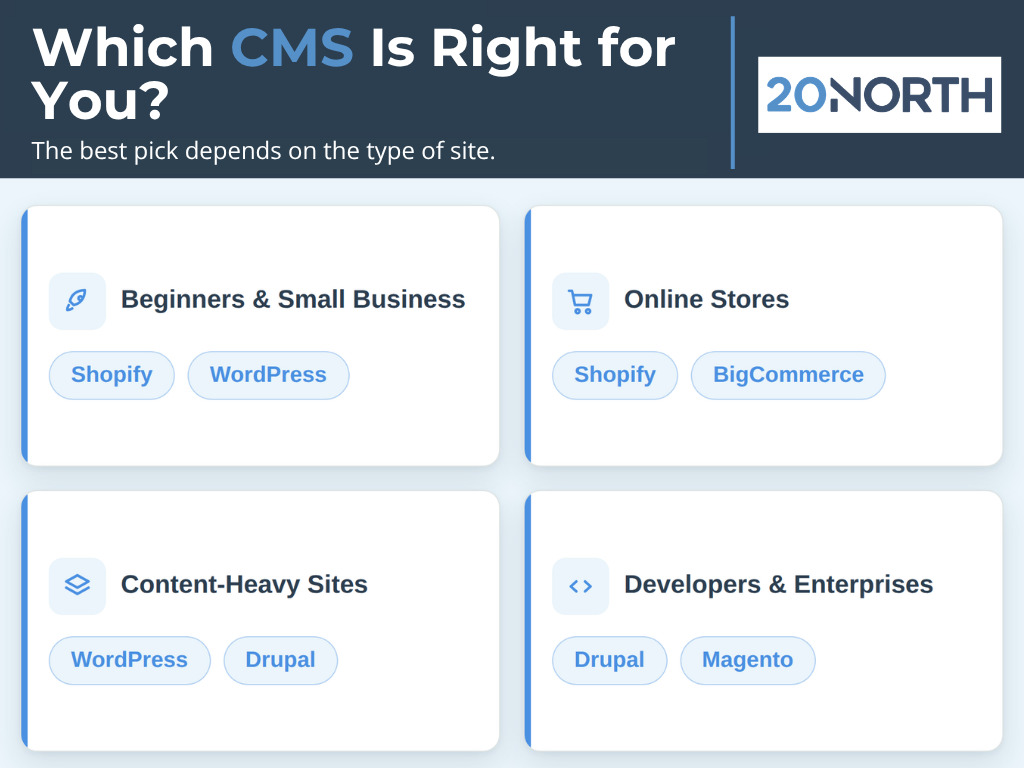
The best content management system comes down to who is building and running the site:
- Beginners and small business owners: Shopify for a store, or WordPress for a content site, both give you the smoothest setup with little technical knowledge required.
- Online stores: Shopify is our go-to for a hosted, ready-to-sell experience, with BigCommerce as an option when you need to scale into larger catalogs and B2B.
- Content-heavy sites: WordPress and Drupal handle large volumes of web pages, blog posts, and video content with room to grow.
- Developers and large enterprises: Drupal and Magento offer the technical expertise and scale to manage complex sites and heavy traffic.
Your CMS is the foundation of your online presence, so match it to your content strategy, your team, and how much you want to customize. Overall, Shopify is the safest bet for most stores.
Work With 20North
Picking a platform is only the start. Turning it into a site that ranks and converts is where a digital marketing agency helps. As a Shopify Premier Partner that also builds on WordPress and BigCommerce, 20North designs and optimizes sites through our web development and SEO teams, and we shape the content strategy that fills them. If you are ready to build, migrate, or grow a Shopify store, see our case studies and client reviews, then contact 20North to talk through your website.
.png)
.png)
.png)