
.png)
The Short Answer: Buy now, pay later lets a provider like Affirm, Klarna, or Afterpay pay you the full purchase price upfront while the shopper repays in installments, usually four interest-free payments. You pay a merchant fee per sale in exchange for higher conversions and larger orders. To add it, pick a provider that fits your margins and price points, show the repayment terms clearly on product pages before checkout, promote it across your ads and email, and track order value and conversion to prove the lift.
Buy now, pay later has moved into the checkout of most major online stores, and shoppers now look for it before they commit. About 16% of U.S. adults used a BNPL service in the past year, up from 10% in 2021. This option is gaining popularity because it can lift conversions and order values while giving budget-minded customers a way to buy without reaching for a credit card. Adding the option to your checkout is straightforward, and the payoff comes from how you present it, promote it, and measure it. This guide explains how BNPL works for retailers, how it compares to credit cards, what the current rules require, and how to add it to your store in a way that protects your margins and your customers.
What is Buy Now, Pay Later?
Buy now, pay later is a short-term financing option offered at the point of sale. A BNPL provider covers the purchase amount, the shopper takes the product home, and the shopper repays the provider in a set number of installments. The most common BNPL product is the "pay in four" plan: four equal, interest-free payments spread over about six weeks. Longer installment loans are also available for larger purchases, and those plans often carry a finance charge.
Well-known BNPL providers include Affirm, Klarna, Afterpay, PayPal, and Zip. Each BNPL lender handles the loan, the repayment terms, and collection. For the retailer, the mechanics look the same no matter which BNPL company you choose, and the option sits inside a broader set of financial services offered at checkout. The part you control is how clearly you explain it to shoppers, which comes down to your on-site content and product page copy.
How BNPL Works for a Retailer
Here is the basic flow at checkout:
- A shopper selects a BNPL option at the payment step.
- The BNPL lender approves the shopper in seconds, usually with a soft check, not a full credit pull
- The provider pays you the full purchase price upfront, minus a merchant fee.
- The shopper repays the provider over the agreed installments.
- The provider carries the collection risk if the shopper stops paying.
Because the lender takes on the repayment risk, you get paid in full even when a customer falls behind. In exchange, you pay a merchant fee on each BNPL transaction, usually a percentage of the sale plus a small fixed amount. That fee is the trade-off for the higher conversion and larger orders the option tends to bring in. Treat it like any other marketing cost: track what BNPL adds to average order value and conversion so you can see the return, the same way you would judge a paid media channel.
Why Retailers Add BNPL at Checkout
Retailers offer BNPL because it changes how shoppers behave at the moment of purchase. The main reasons:
- Higher average order value. Splitting a purchase into smaller payments makes a bigger cart feel manageable, so shoppers add more.
- Fewer abandoned carts. A sticker price is easier to accept as four smaller payments, which reduces drop-off at the payment step.
- Access to younger and credit-thin shoppers. BNPL use skews toward adults under 45 and toward shoppers with lower credit scores or no credit history who prefer not to use a credit card.
- A stronger holiday season. Shoppers lean on installment payments during peak gifting months, and stores that display BNPL early tend to capture more of that spend.
BNPL providers originated close to $160 billion in consumer credit in 2025, with pay-in-four plans making up about half of that volume. Those gains only show up if shoppers see the option and understand it. That means surfacing BNPL on product pages, not just at the final step, and testing that placement through conversion rate optimization so the message is seen and understood.
BNPL vs. Credit Cards: How They Differ
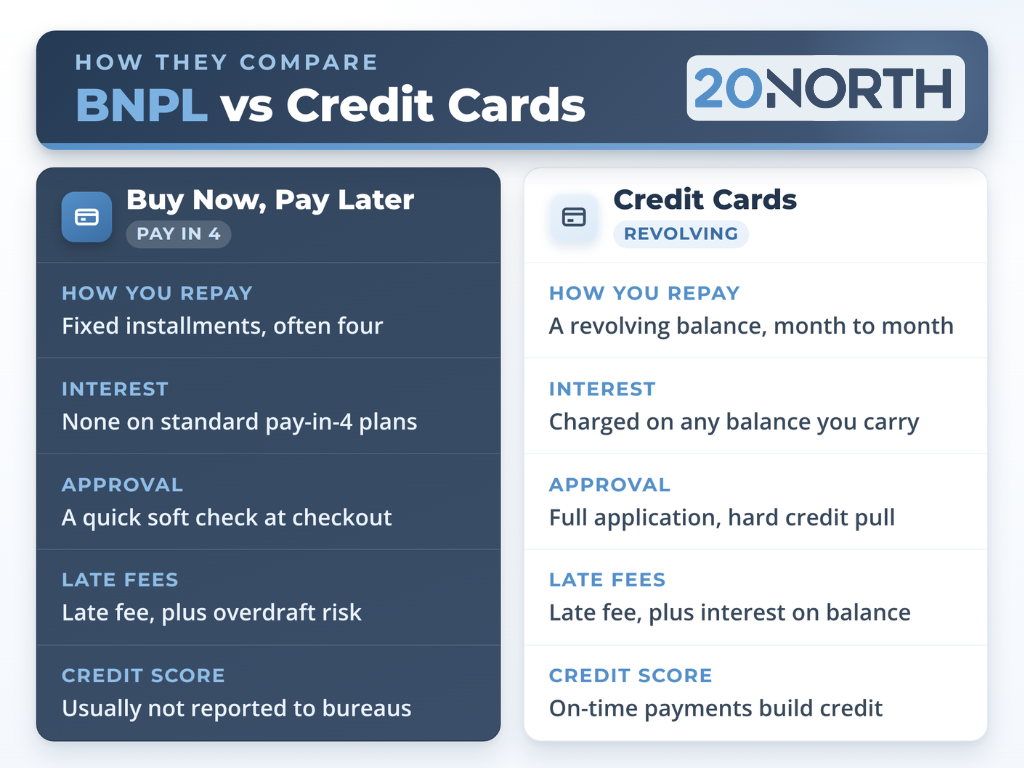
Shoppers often treat BNPL and credit cards as interchangeable. In practice they work differently, and those differences matter for your customers:
- How you repay. BNPL splits a single purchase into a fixed number of installments. A credit card gives you a revolving line you can carry month to month.
- Interest. The standard pay-in-four plan charges no interest. Credit cards charge interest on any balance you carry, and longer BNPL installment loans can carry a finance charge too.
- Approval. BNPL approval is usually a quick soft check tied to the purchase. A credit card requires a full application and a hard credit pull.
- Late fees. Miss a BNPL payment and you may owe a late fee, and the autopay setup can trigger overdraft fees at your bank. Credit cards charge late fees and interest on missed payments.
- Credit score. At the time of the Federal Reserve's 2025 survey, BNPL purchases and on-time payments did not affect credit histories or credit scores at any of the three major credit bureaus, while on-time credit card payments help build credit history. More than half of BNPL users wrongly believed their on-time BNPL payments were raising their credit score.
For a retailer, the takeaway is simple. BNPL gives shoppers convenience at checkout and does nothing for their credit. How you word that at checkout matters. Clear, honest microcopy keeps customer trust intact, and it is exactly the kind of detail worth testing as part of your conversion rate optimization work.
What the Rules Say for Retailers
The regulatory picture shifted in 2025. In 2024, the Consumer Financial Protection Bureau issued an interpretive rule that treated BNPL lenders with digital user accounts as credit card issuers under Regulation Z and the Truth in Lending Act. That reading would have required BNPL providers to give clear disclosures, handle billing disputes, and offer refund rights similar to credit card companies.
Under the Trump administration, the CFPB reversed course. The Bureau said it would not prioritize enforcement, then withdrew the 2024 BNPL interpretive rule in May 2025, and later said it did not plan to reissue a revised version. The credit-card-style requirements the rule would have imposed are not being enforced.
That does not mean BNPL sits outside the law. General consumer protection rules still apply, and several states are drafting their own BNPL rules. Consumer advocates are continuing to press for clearer terms. For retailers, the practical guidance holds no matter where the rules land:
- Show the full repayment terms, fees, and payment schedule before checkout, not after.
- Use clear disclosures your customers can read at a glance.
- Choose a BNPL provider that handles compliance and customer support well, since problems with the loan reflect on your brand.
Displaying those terms cleanly on product and checkout pages is a build detail, so loop in your web development team early. Getting it right protects your customers and keeps your store on solid ground if the rules tighten again.
What to Look for in a BNPL Provider
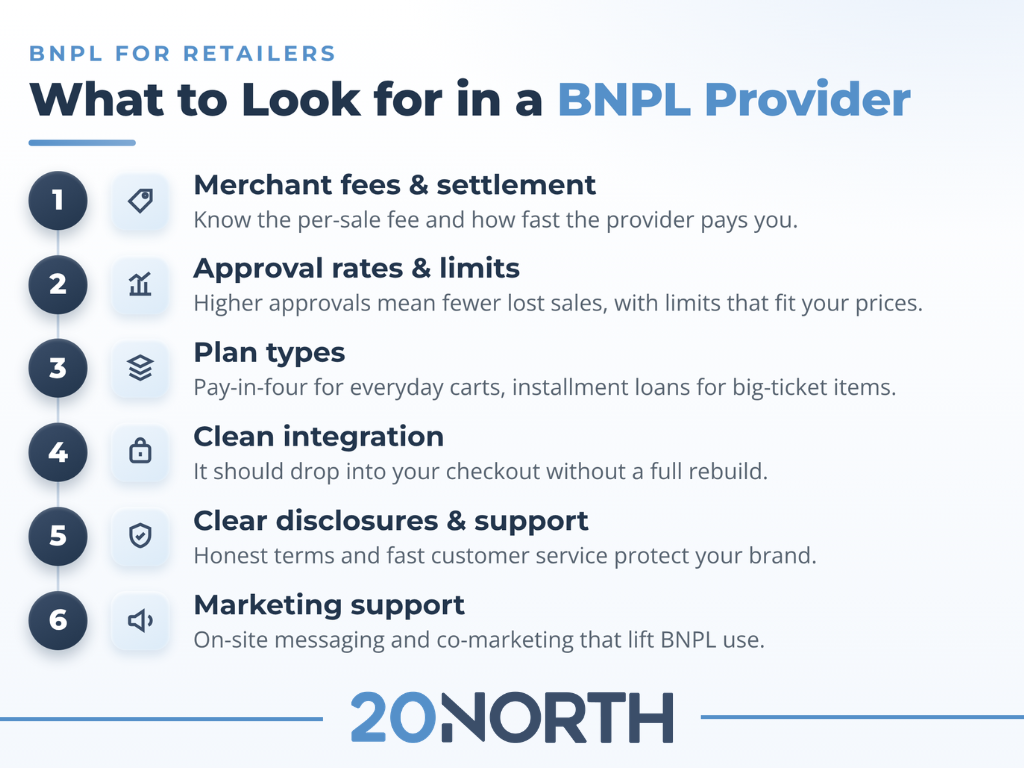
Not every BNPL company fits every store. Compare providers on the points that affect your margin, your customers, and your checkout.
- Merchant fees and settlement. Know the per-sale fee and how fast the provider pays you.
- Approval rates and limits. Higher approval rates mean fewer lost sales, and purchase limits should match your price points.
- Plan types. Pay-in-four suits everyday carts, while longer installment loans suit higher-ticket items.
- Integration. The option should drop into your platform cleanly, so your web team is not rebuilding checkout from scratch.
- Disclosures and support. Clear terms and responsive service protect your reputation.
- Marketing support. Some providers supply on-site messaging, banners, and co-marketing budgets. Put those to work in your paid media and email marketing so the option reaches shoppers before they finish shopping.
Is BNPL a Good Fit for Your Store?
BNPL pays off in some catalogs more than others. A few things to weigh before you turn it on:
- Product price and margin. Mid-to-higher-ticket items benefit most, since the installment framing does the heavy lifting. On thin-margin products, the merchant fee can eat the gain.
- Return behavior. Refunds on BNPL orders take extra steps, so factor your return rate into the math.
- Your customers' financial picture. BNPL data shows the product is used heavily by younger shoppers and by people who report financial difficulty. Some BNPL borrowers turn to it in place of a payday loan or personal loan, and because most providers and financial institutions involved do not report to credit bureaus, responsible use will not raise a thin file. If a customer raises concerns about repayment, point them to the provider's terms and to independent debt advice. Presenting the option honestly, without implying it builds credit, keeps you on the right side of consumer advocates and customers alike.
The only way to know if BNPL earns its keep in your store is to measure it. Watch order value, conversion rate, and return rate before and after launch, and hold BNPL to the same standard as every other channel. Our post on SEO KPIs that matter shows how to pick the metrics that map to your goals and track them over time.
How to Add BNPL to Your Store the Right Way
Adding a BNPL option is a checkout change and a marketing opportunity at the same time. Here is the playbook we run with retailers:
- Place messaging early. Show the pay-in-four breakdown on the product page, well before the final payment step. Our guide to product page optimization covers how to make those pages clear and easy to trust.
- Keep checkout clean. Add the option without cluttering the flow. This is where conversion rate optimization earns its keep, since every extra field costs you conversions.
- Build it to last. A web development team can integrate the provider so it loads fast and works on mobile. If you run on Shopify, our Shopify Plus migration guide covers what to weigh before moving to their enterprise platform.
- Promote it. Feature BNPL in your paid advertising and Google Ads creative, mention it in your email marketing, and work the keywords into your e-commerce SEO so shoppers searching for flexible payment options land on you.
- Measure the lift. Track order value, conversion rate, and return rate before and after launch so you can prove the option is pulling its weight.
Bring BNPL into a Bigger E-Commerce Plan
Buy now, pay later delivers the most when you treat it as one piece of a full e-commerce strategy and build the rest of the experience around it. The stores that get the most from it pair the payment option with strong product pages, fast checkout, and marketing that drives qualified traffic ready to buy.
20North is a full-service digital marketing agency that helps growing retailers connect those pieces through search engine optimization, paid media, email marketing, AEO, and web development.
Ready to turn more browsers into buyers? Contact our team for a free audit of your store.
.png)
.png)
.png)