
.png)
The Short Answer: Local SEO earns your business visibility in local search results, the Google Maps local pack, and location-based searches happening near you. The work comes down to a complete Google Business Profile, local keyword research, location-specific landing pages, a steady stream of customer reviews, and local backlinks. Done consistently, it drives foot traffic, qualified leads, and website traffic without paying for every click.
When running a business, Google is your best friend, but only if you learn to speak its language. If you are not using SEO strategies and taking advantage of the digital landscape, you could be missing out on a large amount of traffic and revenue. As a society, we are increasingly reliant on digital information, and a growing share of that behavior is local. Someone looks for a coffee shop, a dentist, or a contractor with a specific geographic area in mind, and they act on what they find fast.
Local search engine optimization is how a local business earns a place in those moments. This guide covers what to build first, what to fix next, and how the pieces work together to grow your online presence in your local market.
What Local SEO Actually Covers
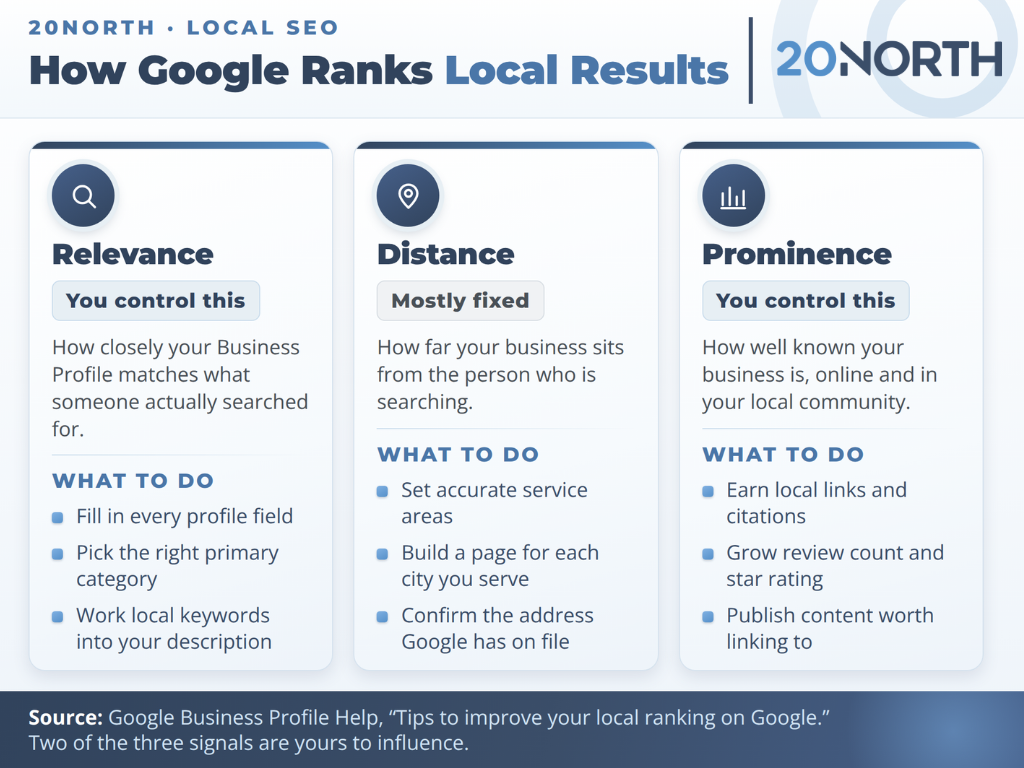
Local SEO is the practice of getting your business in front of nearby customers searching with local intent. It overlaps with standard search engine optimization, but the ranking signals are different. Google's own documentation explains that local results are based mainly on relevance, distance, and prominence. Relevance is how well your business matches what someone typed. Distance is how close you are to the searcher. Prominence is how well known you are, which Google ties to things like how many websites link to your business and how many reviews you have.
You cannot move your building closer to every potential customer. You can influence the other two directly, and that is where a local SEO strategy comes in.
Your Google Business Profile Is the Foundation
Having an active, optimized, and verified Google Business Profile, formerly Google My Business, is the most important thing you can do for your local business, especially if there is a physical location attached to it. Showing up as one of the top options on Google for the right keywords makes a difference in your traffic and conversions.
Ideally, you want to be featured in the local pack, sometimes called the local three pack. These three results appear on the Google map when someone searches for a local business. If you want a chance at showing up there, your profile needs to be filled out entirely and correctly. When completing fields like your business description, take note of local keywords that describe everything you do. That shows Google you are the most relevant choice and raises your odds of being featured.
Accurate information matters as much as complete information. Your business name, address, phone number, hours, categories, and service areas should match what appears on your website and in every directory listing. A wrong phone number or an outdated address quietly costs you calls every week.
A high-functioning profile also builds your brand reputation through relevant content and customer reviews. Setting up a process for requesting and responding to reviews builds trust and loyalty, and reviews feed straight back into the prominence signal Google described above. Profile optimization is a standing part of our local AI SEO services, because it is the single asset that shows up in Google Search, Google Maps, and increasingly in AI-generated answers.
Local Keyword Research Comes First
Everything downstream depends on knowing which search terms your target audience actually uses. Keyword research for a local market looks different from national research. Volume is lower, intent is higher, and modifiers carry weight. "Emergency plumber Sandy Springs" and "plumber near me" return different results and deserve different pages.
Build your list around the local services you sell, the cities and neighborhoods you cover, and the questions local customers ask right before they call. Then map each term to one page so your own pages are not competing with each other. This step determines what every page on your site should say, so it belongs at the start of the project rather than halfway through.
Website Content Built for a Local Audience
Just like any other website, creating relevant content is extremely important for local SEO. You will want landing pages dedicated to each service you provide or each category of goods you sell. Another effective local SEO strategy is to build pages dedicated to each location or sub-location that you serve. This helps you show up for more specific searches related to your business.
Location-specific landing pages work when they are genuinely different from one another. Include the services offered at that location, the neighborhoods covered, team or project details tied to that area, directions, and contact information. A page that swaps one city name for another and changes nothing else gives a search engine no reason to rank it. When we built out 21 unique location pages for Roam, a multi-market coworking brand, page-one keyword coverage grew 130%.
Another content strategy lives in the blog. Posting a blog post regularly boosts your traffic by ranking for additional keywords that work in parallel with your business objectives. The more relevant, informational content you publish, the more Google treats you as a good resource for the public. Choose topics based on what your company does or provides, answer common questions, and pay attention to local keywords.
Local events, sponsorships, and community involvement give you material no competitor can copy. A recap of an event you hosted or a guide to something happening in your local community earns links, gives your social media accounts something worth sharing, and signals to search engines that you are genuinely part of the local area. Our SEO guide for event marketing breaks down how to build content around a specific date and place.
Backlinks and Local Citations
Backlinks are also very important for local SEO. A backlink is simply a link from one site to another. When a lot of other sites link to yours, it tells Google to look at your site for good information. However, backlinks are not all about quantity. Bad backlinks can be very toxic to your site. The goal is to find the balance between quality and quantity.
Quality backlinks come from sites with higher domain authority, sites that serve as good informational resources, or sites that are very relevant to your business. You will want to be featured in business directories and other local informational resources and blogs, both to drive brand awareness and to assist your SEO. Next, try to build relationships with other local businesses in order to gather additional links. Backlinks are another way to tell Google you are a good resource for a specific product or service, and in turn they help you rise in the rankings.
Local citations are a close cousin. A citation is any mention of your business name, address, and phone number on another site, including directories, chambers of commerce, and industry associations. They do not always pass link value, but consistent contact information across the web reinforces the prominence signal Google uses to sort local search results.
What Reviews Are Actually Worth
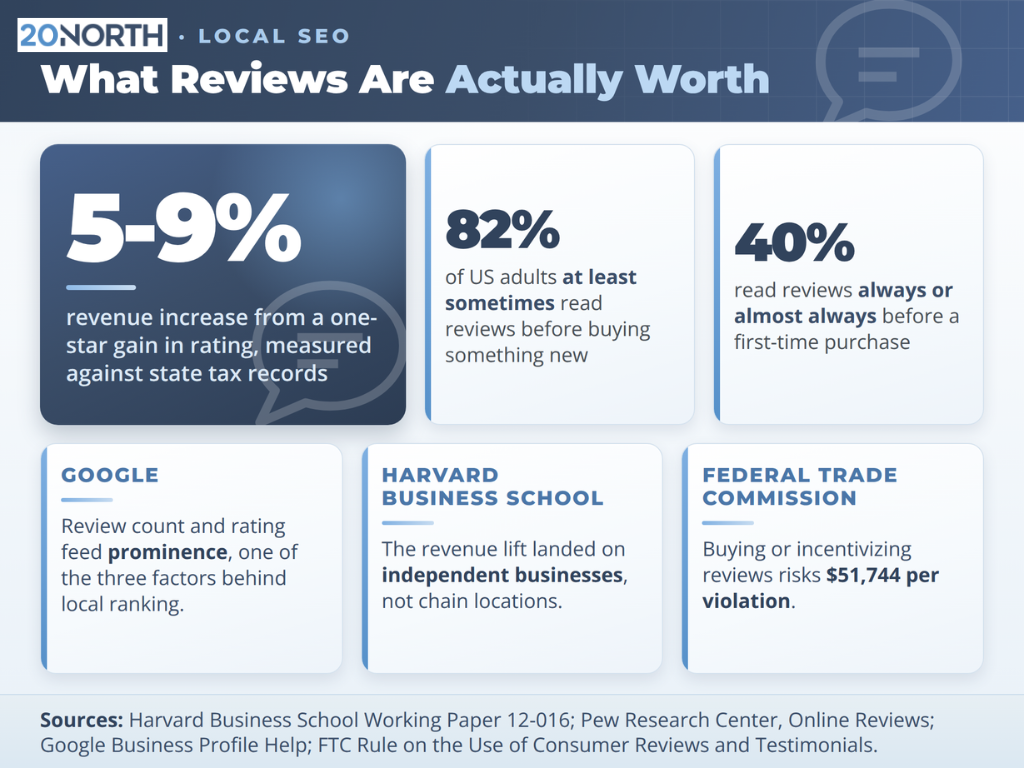
When searching for a local business, most people read reviews long before they reach your website. Pew Research Center found that 82% of US adults at least sometimes read online customer ratings or reviews before buying something for the first time, and 40% do so always or almost always.
Reviews are not only a trust signal. Google lists review count and rating as part of prominence, one of the three factors behind local ranking, so the same reviews that persuade a reader also move you up the local pack.
The revenue side has been measured directly. A Harvard Business School study matched Yelp ratings against Washington State revenue records and found that a one-star increase in rating produced a 5% to 9% increase in revenue, an effect that landed on independent businesses rather than chains. For a local business without a national brand behind it, your rating does work that advertising would otherwise have to pay for.
Responding is the part most businesses skip. Reply to positive reviews with something specific to that customer. Reply to negative reviews calmly, publicly, and with a clear path to resolution. A complaint handled well reads better to the next person than a profile with no complaints at all.
Ask for customer reviews as part of your normal process, at the moment the customer is happiest. Never buy them, and never offer anything in exchange for a positive one. Since October 2024, the FTC's rule on consumer reviews has made buying, selling, or incentivizing reviews that express a particular sentiment illegal, with civil penalties currently reaching $51,744 per violation.
Mobile Users Decide Fast
A large share of local search happens on a phone, often while the person is already in the car. Mobile search changes what your site needs to do. A mobile user who taps through from Google Search wants your phone number, your address, your hours, and a way to book, and they want it without pinching and zooming.
Check the basics on a phone rather than a desktop. Is your phone number a tappable link? Does your address open in Google Maps with one tap? Does the page load quickly on a cellular connection? Is your contact information visible without scrolling to the footer? Every small friction point here costs you a conversion your local SEO already paid to earn, which is why local search and conversion rate optimization belong in the same conversation. Site speed, layout, and mobile usability sit at the intersection of user experience and rankings, and our web development team treats them as one job.
The Benefits of Local SEO
Implementing local SEO strategies can do a lot for the success of your business. Aside from the obvious increase in website traffic that comes with appearing higher in relevant Google searches, there are many other benefits that are harder to see on a report.
By increasing your online visibility and providing great in-person service, your customer or client community can be expected to grow. Not only are repeat customers one of the largest factors in a growing business, but they also help grow your business through word of mouth and referral traffic. Building your online presence and increasing traffic from organic search results will also help you save money on other costs, such as ad spend. When you show up first for a search term, you own that real estate. Ads work, but you have to pay to rent the space, and you can save a lot of money by owning that number one spot.
There is a competitive advantage in it as well. Most local markets have a handful of businesses doing local SEO well and a long tail doing nothing at all. Steady work on your Google Business Profile, your location pages, and your reviews puts you in the first group, and the gap widens every month you keep at it. Small business owners often assume they cannot compete with larger brands in search results. In local search they can, because distance and prominence within a specific geographic area count for more than national brand size.
Tracking Your Local SEO Results
Local SEO is measurable, and the reporting is more concrete than most channels. Google Business Profile performance shows calls, direction requests, and website clicks. Google Search Console shows which local keywords earn impressions and clicks. Google Analytics shows what those visitors do once they land.
Watch a few numbers instead of all of them. Our guide to SEO KPIs that matter covers how to connect metrics back to revenue. For local work specifically, the short list is:
- Local pack visibility for your priority terms
- Calls and direction requests from your Google Business Profile
- Form fills and calls from each location page
- Review count and average star rating over time
Local Search Is Still Changing
One more shift worth planning for. A growing number of people ask an AI assistant for a local recommendation instead of scrolling a results page. Those tools pull from the same signals local SEO already strengthens, including your business listings, your reviews, and the structured data on your site. If you want to go deeper, start with what GEO is, the difference between AEO and SEO, and how to use schema markup for AI search. The businesses that keep accurate information everywhere are the ones showing up in both places.
Work With a Local SEO Team
At 20North, we have worked with many different types of local businesses to increase traffic and conversions through local SEO. That includes doctors' offices, vets, and clinics. For Coastal Veterinary Care, non-branded local visibility grew organic users 577% and lifted form submissions 167%. It also includes large-scale franchises like Enviro-Master, with microsites in 88 markets. You can browse more of our case studies or read what clients say in our reviews.
Our SEO services cover local keyword research, Google Business Profile optimization, location page buildouts, and content production, and our local AI SEO services carry that work into AI-powered results. As an Atlanta agency, we also work with home services, healthcare, professional services, and franchise brands across the country. Contact us to learn more about how we can help your business grow and compete for the customers closest to you.
.png)
.png)
.png)