
.png)
The Short Answer: A successful Google Ads campaign starts with a clear goal, the right keywords, and ad copy that matches what people are searching for. Choose the campaign type that fits your goal (search, shopping, display, or video), point every ad at a strong landing page, and let a smart bidding strategy manage bids toward conversions. Track results with conversion tracking and Google Analytics, then refine the account over time.
Google processes close to 90% of the world's searches, which makes Google Ads one of the most direct ways to put your business in front of potential customers the moment they are looking to buy. A well-built Google Ads campaign reaches high-intent traffic, delivers measurable results, and can start driving website traffic within days of launch.
What Is a Google Ads Campaign?
A Google Ads campaign is a set of ad groups, keywords, and ads organized around a single goal inside Google's online advertising platform. When someone types a query into Google search, the platform runs an auction and shows ads based on bid, relevance, and landing page quality. You only pay when someone clicks, which is why this model is called pay-per-click.
Google Ads spans several formats: search ads on the search results page, shopping ads that show product images and prices, display ads across millions of websites, and video ads on YouTube. Each one reaches your target audience at a different stage, and a strong Google Ads strategy often combines more than one.
Start With a Clear Campaign Goal
Every campaign decision flows from the goal, so define it before you write a single ad. A clear goal tells you which campaign type to use, how to write your ad copy, and which metric counts as success. Common goals include:
- Driving sales or leads, or conversions
- Increasing website traffic and qualified traffic
- Building brand awareness and brand visibility
Once you know the action you want, set up conversion tracking so you can tie every click back to a result. Tracking makes Google Ads a measurable investment rather than an estimated guess.
Know Your Target Audience
The better you understand your target audience, the more relevant your ad copy and keyword targeting become, which lifts click-through rate and conversion rate. Think about what your potential customers are searching for, what problem they want solved, and what would make them click at the right time. Google Ads also lets you narrow reach by location, device, demographics, and search intent, so your budget goes toward the people most likely to convert.
Do Your Keyword Research
Keywords decide when and where your ads appear, so keyword research is the foundation of any search campaign. Start with Google's Keyword Planner, a free keyword research tool that shows search volume, competition, and cost estimates for each target keyword. Look for relevant keywords with clear buying intent, since high-intent traffic converts better than broad, generic searches.
20North’s paid media team pairs this with the same keyword research discipline we use for search engine optimization, so your paid and organic efforts target the right keywords together. As the campaign runs, use search term reports to find new relevant keywords to add.
Use the Right Keyword Match Types
Match types control how closely a search has to match your keyword before your Google ad shows:
- Broad match: reaches the widest audience, including related searches. Good for discovery, but watch it closely.
- Phrase match: shows your ad for searches that include the meaning of your phrase.
- Exact match: shows your ad only for your specific target keyword and close variants, giving you the tightest control.
Add negative keywords to block searches that waste budget. Filtering out irrelevant terms is one of the fastest ways to protect spend and lift your conversion rate.
Choose the Right Campaign Type
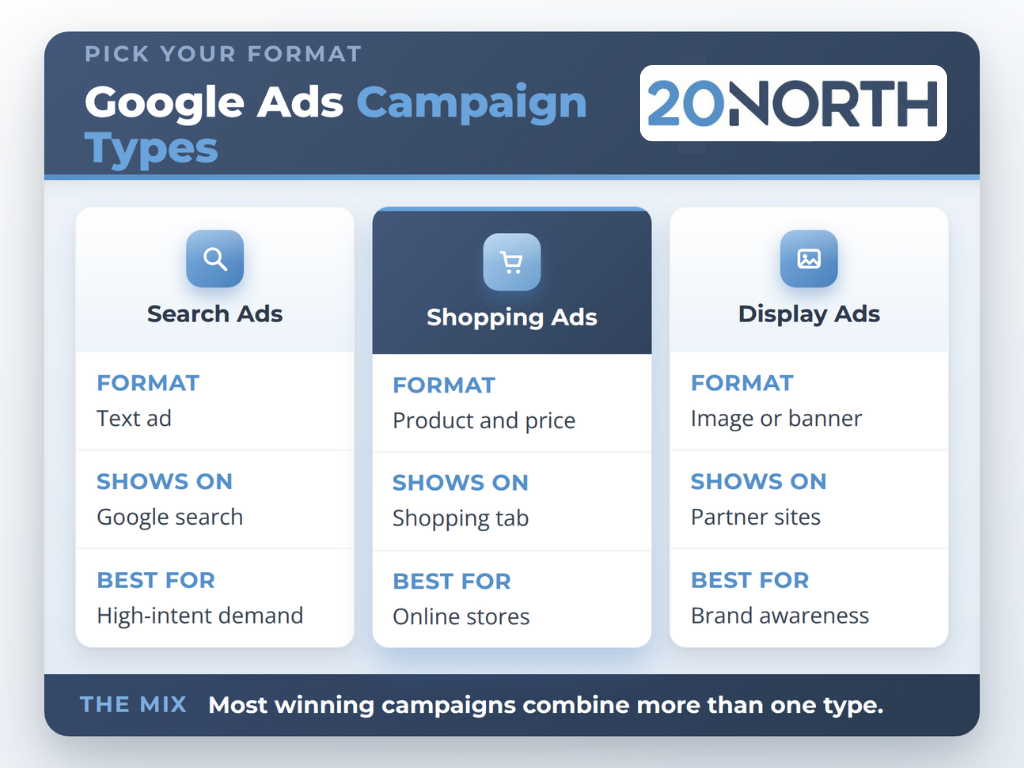
Match the campaign type to your goal:
- Search campaign: text ads on Google search for high-intent queries. Best for capturing demand.
- Shopping ads: product image, price, and store name for e-commerce. Best for online stores.
- Display ads: image ads across Google's partner sites. Best for brand awareness and reach.
- Video ads: ads on YouTube. Best for engaging audiences and building brand visibility.
Many advertisers run more than one type at once so they reach potential customers at different stages of the buying journey. To decide where to invest, our guide to choosing digital advertising platforms breaks down the options.
Write Ad Copy That Converts
Your ad copy is the first impression, and it has one job: earn the click from the right person. Strong ad copy speaks to your target audience, includes your target keyword, and states a clear benefit and next step. Keep it accurate, because misleading ads send people to the wrong place, hurt your conversion rate, and waste spend. Group tightly related keywords into each ad group so your ads stay relevant to what someone searched. This improves quality and lowers cost.
Optimize Your Landing Pages
Where you send the click matters as much as the ad itself. Each landing page should load quickly, match the promise in your ad, and make the next step obvious. A strong ad pointing to a weak page still loses the sale. Because so many searches happen on phones, make sure every landing page works on mobile.
This is where conversion rate optimization comes in. Small improvements to layout, copy, and speed lift the conversion rate on the website traffic you already pay for. If your pages need work, 20North’s web development team builds responsive landing pages designed to convert website visitors into customers.
Pick a Smart Bidding Strategy
Google Ads offers several bidding strategy options, and the right one depends on your goal. Manual bidding gives you direct control, while smart bidding uses Google's machine learning to set bids in real time for each auction. Smart bidding strategies like Target CPA, Target ROAS, and Maximize Conversions use artificial intelligence and first-party data to push toward better results without hands-on adjustments for every keyword.
Test a bidding strategy against your goals, give it enough data to learn, and compare results before you commit. As the campaign gathers conversion data, smart bidding tends to deliver higher conversion rates than manual control alone.
The Google Ads Funnel: Track Conversions and Measure Results
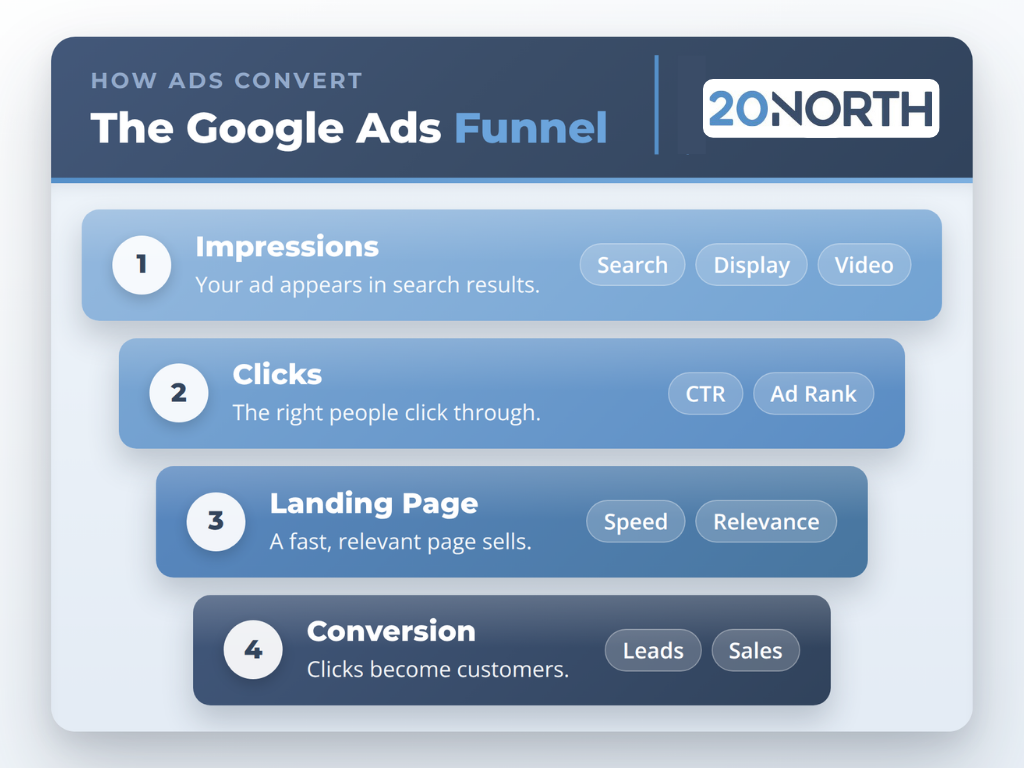
You cannot improve what you cannot measure. Set up conversion tracking to record the actions that matter, such as purchases, calls, and form fills. Connect Google Analytics to see what people do after they click, which keywords bring qualified traffic, and where the drop-offs happen. These measurable results tell you where to shift budget for better results, and they feed the first-party data that makes bidding smarter. If you want a framework for the numbers worth watching, our post on the KPIs that matter is a useful guide.
Retarget with Remarketing
Most people do not convert on the first visit. Remarketing re-engages website visitors who already showed interest, and dynamic remarketing takes it further by showing them the exact products or services they viewed. Because it runs on your own first-party data, remarketing reaches a warm audience that is more likely to convert, which lifts the conversion rate and keeps your brand visible while they decide.
Monitor and Optimize Continuously
A Google Ads campaign is never finished. Review performance on a regular schedule, read your search term reports, pause the keywords and ads that underperform, and put more budget behind what works. Small, steady adjustments to keywords, ad copy, and bids compound into better results over time and protect your advertising efforts from wasted spend.
Pair Google Ads with SEO
Paid and organic search work best together. Google Ads delivers traffic and conversions almost immediately, while search engine optimization builds compounding value over time. Running both means you own more of the search results page and keep showing up after the ad budget pauses. Our breakdown of SEO versus SEM explains how the two fit into one plan.
Run Your Google Ads Campaign with 20North
A successful Google Ads campaign takes ongoing keyword research, ad copy, bidding, landing page work, and reporting. 20North is a full-service digital marketing agency in Atlanta that helps growing businesses turn Google Ads into measurable revenue. Our team manages paid advertising, SEO, AEO, email marketing, and web development under one strategy, so every channel supports the same goals.
Contact 20North for a free PPC audit and a plan built around your goals.
.png)
.png)
.png)