
Hyper Local SEO: The Key to Boosting Your Online Presence & Finding New Customers
.png)
The Short Answer: A successful hyper-local SEO strategy starts with keyword and competitor research to find the local terms worth targeting. Then optimize your website pages and Google Business Profile around those terms, and keep your name, address, and phone number consistent across local directories like Yelp. Build reviews from happy customers and publish local content that signals relevance. Track your rankings and organic traffic, then refine the strategy over time.
Google is one of the most valuable digital marketing platforms for any business, but especially for those with a local focus. Consumers turn to Google search every day to find a coffee shop nearby, book a contractor, or discover a service in their specific neighborhood, which means every local business owner has to answer the same three questions:
- Am I showing up when my local market is searching for what I offer?
- If not, how do I start showing up?
- If I already show up, how do I move higher in local search results?
The answer to all three is search engine optimization, and more specifically, hyper-local SEO. Roughly 46% of all Google searches have local intent, which represents billions of high-value queries from nearby customers ready to buy.
What is SEO?
Search engines use complex algorithms to determine the relevance and authority of a website in relation to a particular search query. Search engine optimization aligns your site's content, structure, and user experience with those algorithms so your web pages rank higher in search results. Higher rankings bring in more organic search results traffic, which translates into brand awareness, leads, sales, and revenue.
An SEO strategy is built around a specific business and the market it competes in. Keyword research uncovers what buyers actually type into Google. Then, content creation and technical website changes signal to Google that your site is relevant and worth ranking higher. Backlinks reinforce the message by showing other sites trust yours.
What is Hyper-Local SEO?
Hyper-local SEO focuses on capturing local search from people who live, work, visit, or shop in a specific location. This narrower focus brings in qualified users who are more likely to convert, buying a product, booking a service, or walking through the door.
The goal of a hyper-local SEO strategy is to improve your visibility in a defined service area. Hyper-local search queries often include "near me" or a location name, but Google increasingly identifies local intent automatically based on the user's device location and search history. That is why someone typing "coffee shop" or "plumber" without a location still sees localized options tied to their zip code or neighborhood.
Google Business Profile: A Key Player in Hyper-Local SEO
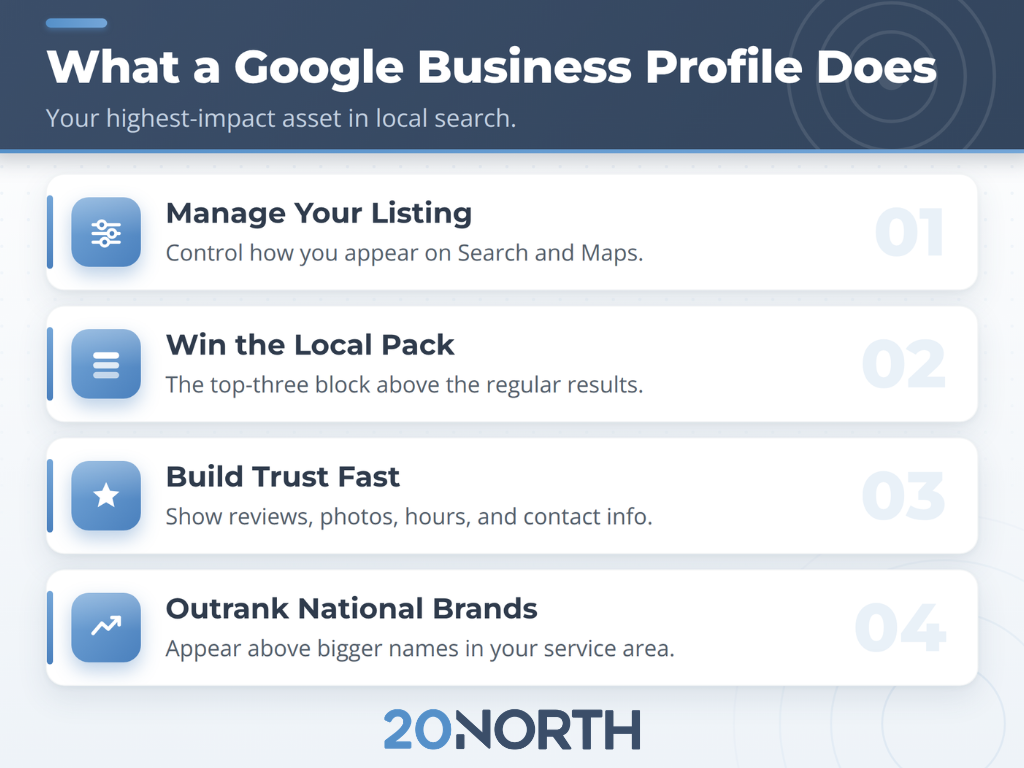
Google Business Profile, formerly Google My Business, is a free tool that lets you manage how your business appears across Google search and Google Maps. It is one of the highest-impact assets in any hyper-local marketing plan.
A Google Business Profile lets you publish the information customers use to make a decision, including your address, phone number, business hours, website, and photos of your location or offerings. You can also respond to online reviews, post updates about local events or promotions, and share other relevant content that keeps your profile fresh.
The main payoff is visibility in the "local pack," the three-business block at the top of local search results and Google Maps. Ranking in the local pack is one of the fastest ways to drive foot traffic, phone calls, and website visits from people already searching for what you sell.
A well-managed profile also strengthens your online reputation. Responding to online reviews, adding new photos, and keeping business information current signals to potential customers that you are engaged and reliable. Positive reviews then feed back into local rankings, since Google factors review quantity, quality, and recency into local search results.
Why Hyper-Local SEO Matters for Small Businesses
Outside of word of mouth, most small businesses rely on Google to build online presence and grow. A focused hyper-local SEO strategy is how a local business competes against larger corporations with bigger budgets and more established digital footprints.
Google Business Profile in particular gives a small business the opportunity to appear above national brands in local search results, displaying value propositions, positive reviews, and local relevance right at the top of the page. Combined with a well-optimized website, this creates a steady stream of local traffic from people already looking to buy.
Hyper-Local SEO for Franchise Businesses
For franchises, no matter the size, local search is how each location establishes its own presence. By optimizing every location's landing pages and Google Business Profile, franchises make each individual location visible when people search relevant keywords in that market.
Beyond visibility, hyper-local SEO helps franchises build brand awareness and loyalty inside each community. Publishing local content about local events, promotions, and news lets each franchisee connect with local customers on a personal level and become a familiar name in the community.
Building a Hyper-Local SEO Strategy
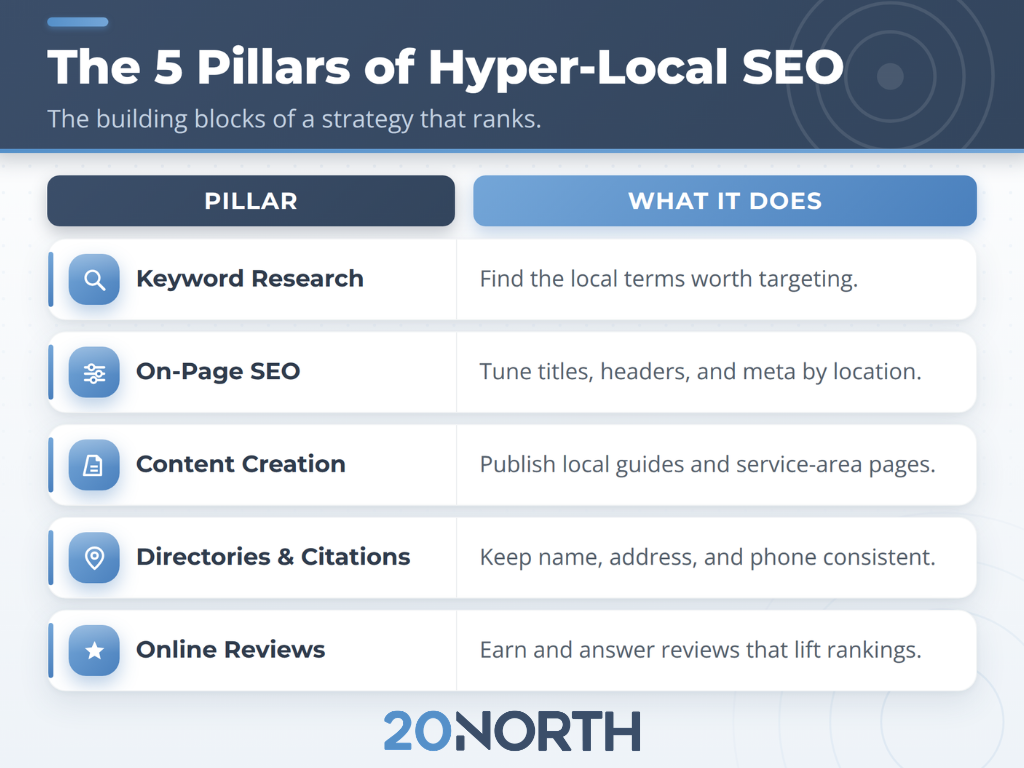
A strong hyper-local SEO strategy is built on a handful of pillars that work together. Skip one and the rest lose momentum.
Keyword Research and Competitive Analysis
Before making any changes, understand what your target market is typing into a search engine and what your competition already ranks for. Keyword research surfaces the local search terms with the highest opportunity, and competitive analysis shows which keywords are worth fighting for and which are locked up. This foundation shapes every other decision.
On-Page Optimization
Existing pages are usually the fastest win. On-page optimization means updating titles, headers, meta descriptions, image alt text, and body content so each page targets a specific location and search intent. Location pages should reference local landmarks, service areas, and nearby customers to signal relevance to Google and to the reader.
Content Creation
New content expands your footprint. A blog post about local events, a guide to a specific neighborhood, or a landing page for a service area gives Google more opportunities to rank you for related queries. Local content also builds trust with local customers who see your business engaging with their community.
Local Directories and Citations
Consistent listings across local directories, including Google Business Profile, Yelp, and industry-specific sites, reinforce your business information. When your name, address, and phone number match everywhere, Google trusts the data and rewards it with better local rankings.
Online Reviews
Positive reviews are one of the strongest local ranking signals and one of the most influential trust factors for buyers. Actively requesting reviews from happy customers, responding to every review, and addressing negative feedback publicly all shape your online reputation and your visibility in local search results.
Hyper-Local SEO vs Paid Advertising
Many local business owners weigh SEO against paid advertising. Google Ads puts your business in front of people searching specific keywords right now, in exchange for a per-click cost. SEO earns that visibility organically over time. Both can drive local traffic, and the two tend to reinforce each other, since a site that ranks well organically also runs paid campaigns more efficiently.
For a business with the budget for both, combining hyper-local SEO with paid ads produces the widest reach and the strongest brand presence in local search results. For a business that has to pick one, the answer comes down to timeline. Paid ads deliver leads quickly but stop the moment the budget stops. SEO takes longer to build but produces compounding, long-term value at a lower cost per lead. Most growing local businesses eventually invest in both.
Start Your Hyper-Local Strategy with 20North!
Building a hyper-local SEO strategy that improves your local rankings takes ongoing keyword research, content creation, on-page work, review management, and reporting. 20North is a full-service digital marketing agency that helps growing businesses across the country compete in their local markets. Our team combines SEO, paid media, web development, AEO, and email marketing into one strategy so every channel supports the same growth goals. Contact our team for a free audit and a plan built around your specific location, service area, and marketing goals.
.png)
.png)
.png)