
.png)
Yes, You Need a Long-Term Content Strategy
The Short Answer: A successful SEO content strategy gives your business a repeatable path to stronger organic search visibility, higher-quality traffic, and more qualified leads. A content strategy is more than publishing a blog post every few weeks. It is a long-term content plan that helps your brand show up with relevant information when your target audience searches for answers, services, products, and solutions.
What Is an SEO Content Strategy?
An SEO content strategy is a plan for creating, improving, organizing, and promoting content that can earn visibility in search results. It guides the topics you cover, the keywords you target, the format of each piece, and the internal links that turn your website into a useful resource for visitors and search engines.
The goal is to create high-quality content that answers questions, supports your sales team, and builds organic growth over time. Google’s guidance emphasizes helpful, reliable, people-first content that serves a clear audience and provides a satisfying experience.
Your SEO strategy should connect every stage of the content creation process:
- Understand your target audience and their needs
- Perform keyword research to find relevant opportunities
- Match each topic to search intent
- Create a content brief for every priority page
- Publish high-quality content consistently
- Add internal linking between related pages
- Review existing content and update what underperforms
- Track organic traffic, rankings, leads, and conversions
A strong content marketing program helps businesses build brand awareness before a prospect is ready to contact sales. It also creates more entry points for people to discover your company through organic search.
Why Consistent New Content Wins
Content marketing strategies are a lot like New Year’s resolutions. Many businesses start with good intentions, publish a few pieces, and then lose momentum. The brands that keep going, measure results, and improve their approach are the ones that build lasting search rankings. Search engine optimization takes time. Google needs to crawl, index, and evaluate new pages before they can compete in search results. A single long-form article may create traction, but a connected library of useful content gives Google and your audience more reasons to view your brand as a trusted source.
Long-term consistency also makes internal linking more valuable. Every new blog post can support service pages, pillar pages, and other marketing content across your website. This creates clearer paths for readers while helping search engines understand the relationship between your pages.
Start With Clear Content Goals
Before choosing content ideas, define what success means for your business. Your content plan should support measurable goals, not just fill a content calendar.
Common goals include:
- Increase organic traffic from Google search
- Improve search rankings for target keywords
- Generate leads for your sales team
- Build brand awareness in a competitive market
- Support service pages with educational SEO content
- Create content that strengthens paid media and email marketing campaigns
- Improve the user experience for visitors researching a purchase
Your goal affects the angle, format, and call to action of each blog post. A broad informational topic may be useful for brand awareness, while a service-focused page can support leads from people closer to making a decision.
For example, a business offering web development services could create a long-form article around website performance, then use internal links to direct readers to its web development and conversion rate optimization services.
Find Topics Through Keyword Research
Keyword research turns customer questions into a practical content strategy. Start with the services you provide, problems you solve, and questions your customers ask before they buy. Then, after thorough analysis and in-depth research, identify the keywords people use to search for those topics. Google Keyword Planner can help businesses discover new keyword ideas and view estimates for search demand. Pair that information with Google Search Console, sales conversations, customer reviews, competitor gap analysis, and your own website analytics.
Focus on a mix of target keywords:
- Primary keywords that align with priority services
- Long-tail keywords that reveal specific questions or needs
- Local keywords for service-area visibility
- Comparison and consideration keywords for mid-funnel visitors
- Transactional keywords for people ready to contact your business
- Informational keywords that support evergreen content
Long-tail keywords are often a strong opportunity because they tend to reflect a clearer search intent. Instead of targeting a broad term like “digital marketing,” a growing business may target “SEO content strategy for small business growth” or “how to create a content calendar for SEO.” The goal of keyword researchl is not ranking for every keyword. It is attracting the right audience with content that aligns with their needs and your business model.
Match Content to Search Intent
Keyword volume alone does not make a topic worth pursuing. You also need to understand what people expect to find after typing that phrase into Google.
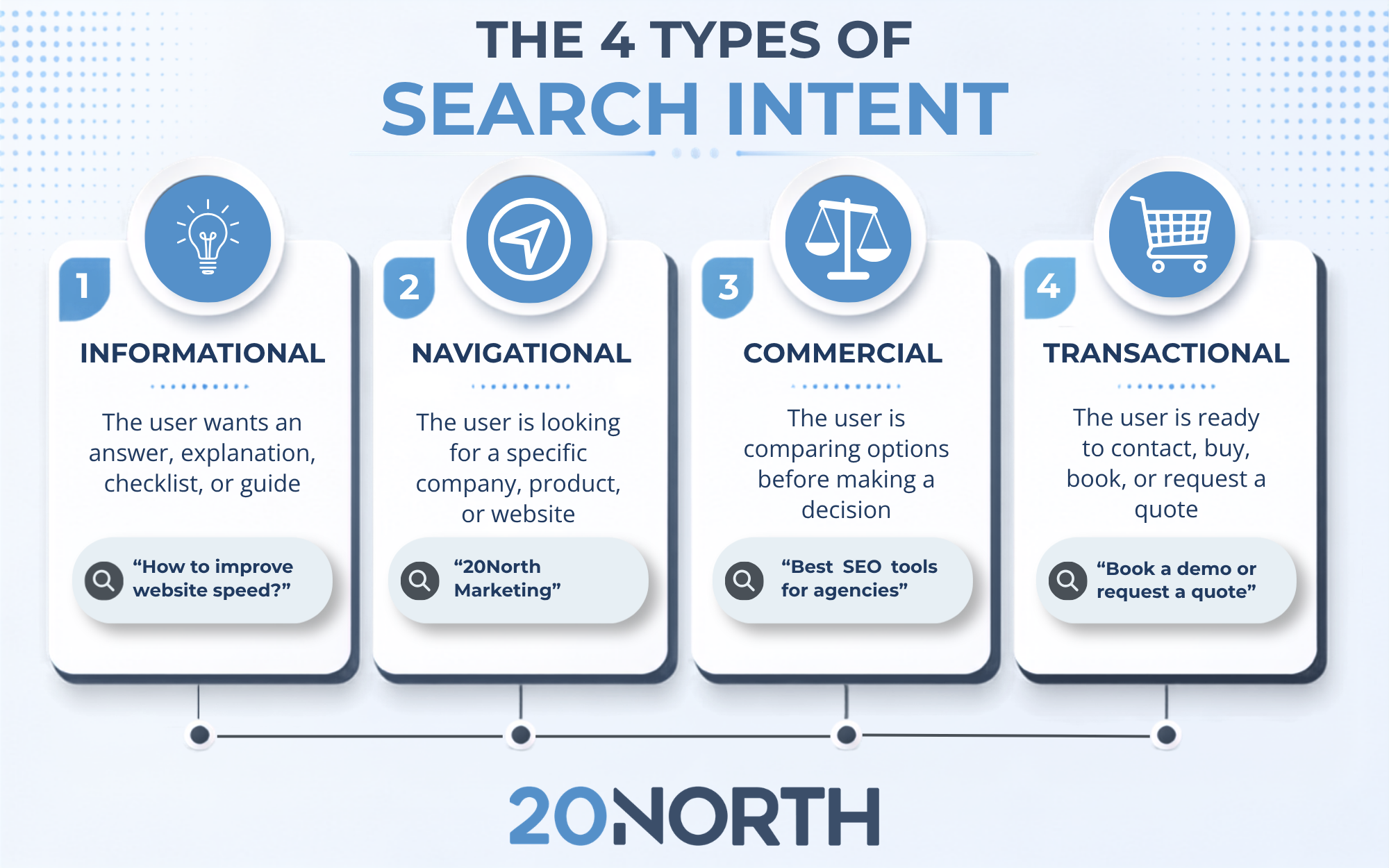
Review the current search results before assigning a topic. If Google shows guides, videos, and list-style content, a sales page may not be the best fit. If the search results feature service providers and location pages, the topic may need a stronger conversion focus.
This research informs your content brief. Each brief should document the target keywords, intended audience, search intent, content angle, internal links, external sources, call to action, and title tags before writing begins.
Build a Content System That Lasts
A reliable content system makes consistent content creation easier. Rather than choosing topics at random, create a content calendar that organizes your work by priority, keyword theme, format, publish date, and business objective.
Your content calendar can include:
- Blog posts that answer high-value audience questions
- Service pages that explain your offerings
- Evergreen content that remains useful throughout the year
- Seasonal marketing content tied to promotions or events
- Case studies that show real outcomes
- Email marketing content that brings readers back to new resources
- Content refreshes for pages that already earn impressions
Your content creation process should also include a regular content audit. Review existing content to find pages with outdated information, declining rankings, weak internal links, thin content, or strong impressions but low click-through rates. Updating a page that already has a foundation can be more efficient than starting over.
Create Content People Want to Read
High-quality content needs to be useful, accurate, organized, and easy to consume. Write for real people first. Use headings that make scanning easier, short paragraphs, clear examples, relevant images, and visual assets that help readers understand the topic. A large wall of text can weaken the user experience, even when the information is valuable.
For each piece of SEO content, focus on:
- A clear answer to the reader’s main question
- Relevant information supported by credible sources
- Natural use of keywords, without repetitive phrasing
- Original examples and insight from your team’s experience
- Title tags and headings that accurately describe the page
- Internal links to related services and resources
- A direct call to action for readers who need help
AI overview results have made clarity and content quality even more important. Google’s search guidance still centers on useful, people-first pages rather than special markup created only for AI-driven results. Publish content that fully addresses the topic, demonstrates real expertise, and is easy for readers to navigate.
Use Internal Linking Strategically
Internal linking is one of the most practical ways to strengthen an effective SEO content strategy. It helps search engines discover pages, establishes topical connections, and moves visitors toward the next useful resource.
Every blog post should link naturally to relevant service pages, supporting articles, and contact opportunities. For 20North, a blog about SEO content strategy can support the following pages:
- Search Engine Optimization
- Paid Media Services
- Email Marketing Services
- Web Development Services
- Conversion Rate Optimization
- Contact 20North
Use descriptive anchor text so readers know what they will find after clicking. Link to the most relevant page, not simply the homepage.
Track, Learn, and Improve
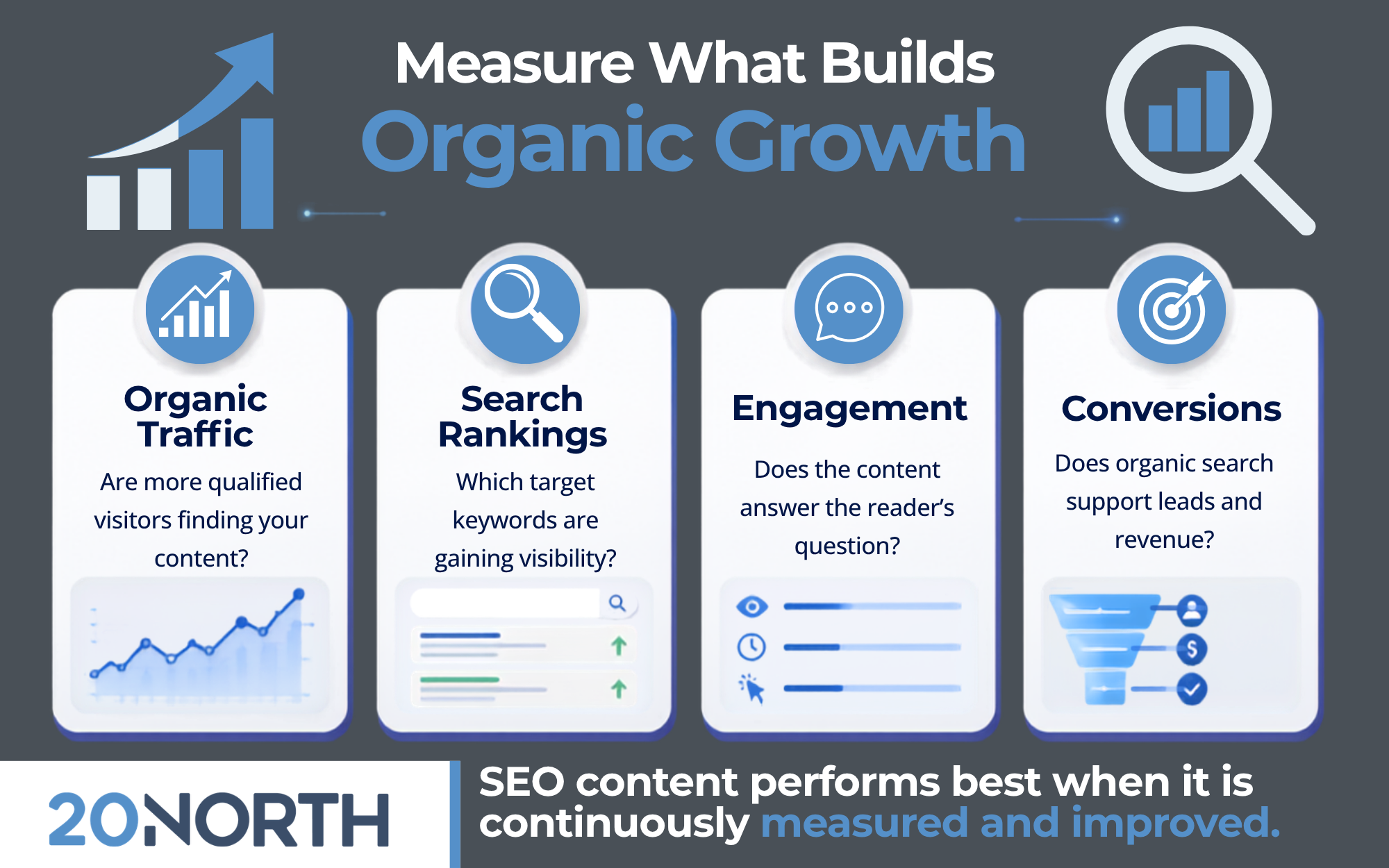
A content strategy should evolve as your data changes. Review performance on a monthly basis and look beyond pageviews. Organic traffic matters, but traffic without qualified engagement or conversions may not support business growth.
Monitor metrics such as:
- Organic search impressions and clicks
- Search rankings for target keywords
- Organic traffic by landing page
- Engagement time and scroll depth
- Form submissions, calls, and other conversions
- Assisted conversions from blog content
- Internal link clicks
- Pages that earn impressions but need stronger title tags or content updates
Use those findings to guide your next content plan. A page that ranks on the second page of Google may need better search intent alignment, additional relevant information, new internal links, or a clearer title tag. A blog that earns qualified traffic may deserve related cluster content that expands the topic.
Partner With 20North for SEO Content
A lasting SEO content strategy requires planning, research, writing, optimization, and ongoing improvement. 20North helps growing businesses develop content marketing programs that attract qualified visitors, strengthen search visibility, and support measurable revenue goals.
Our team of experts specializes in SEO, paid advertising, email marketing, and web development to help your business create a connected digital marketing strategy. Talk with our team to improve your content strategy today!
.png)
.png)
.png)