
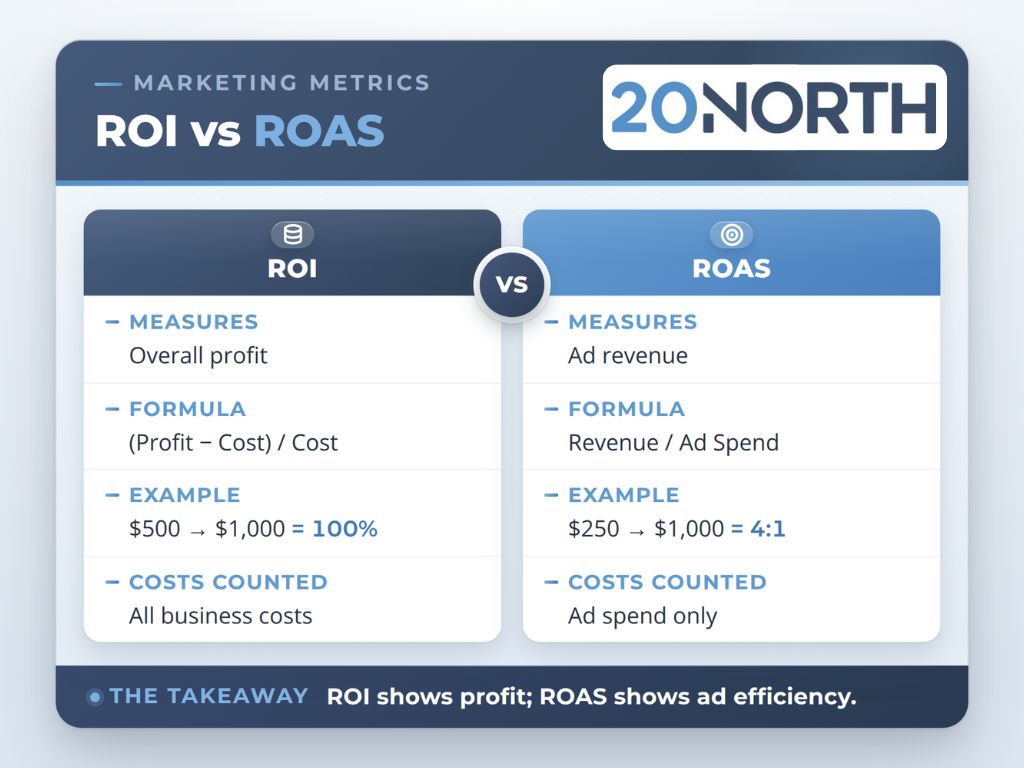
The Short Answer: ROI, or return on investment, measures the overall profit a business earns against its total cost. ROAS, or return on ad spend, measures the revenue a specific ad campaign earns for every advertising dollar spent. ROI tells you if the business is profitable while ROAS tells you if a campaign is efficient. Most growing businesses track both.
Global digital advertising spending is forecast to top $950 billion in 2026, so knowing what you get back for every advertising dollar matters more than ever. ROI and ROAS are two metrics that answer that question, and they can be easy to mix up. This guide breaks down the ROI vs ROAS comparison: what each metric measures, the formulas, and when to use each one to grow your profit from paid advertising.
What Is ROI?
Return on investment (ROI) is a financial metric that measures the overall profitability of an investment. It compares the net profit an activity generates against its total cost, which makes it useful for judging the success of a whole business, a business unit, or a mature marketing strategy that spans several channels. Because ROI accounts for the total investment and not just ad spend, it reflects the real profit left after marketing costs, operational costs, and other additional costs are subtracted. That gives you a picture of overall profitability rather than the performance of any single campaign.
What Is ROAS?
Return on ad spend (ROAS) is a marketing metric that measures how much revenue an advertising campaign earns for every dollar of ad spend. It is narrower than ROI and focuses on the campaign performance of a single ad platform, such as Google Ads or Meta Ads. ROAS uses top-line revenue rather than net profit, so it shows how efficiently a campaign turns ad spend into sales revenue. It does not tell you if the business is profitable once every other cost is counted.
ROI vs ROAS: The Key Differences
The main difference is scope. ROI looks at overall profitability across the whole business while ROAS looks at campaign performance for one advertising channel. The other key differences stem from that:
- What it measures: ROI measures net profit against total cost. ROAS measures gross revenue against ad spend.
- Scope: ROI covers the entire marketing effort and business. ROAS covers a single ad campaign or channel.
- Costs included: ROI includes all costs. ROAS includes only advertising costs.
- Best used for: ROI shows long-term profitability. ROAS shows real-time campaign efficiency.
The Formulas: How to Calculate ROI and ROAS
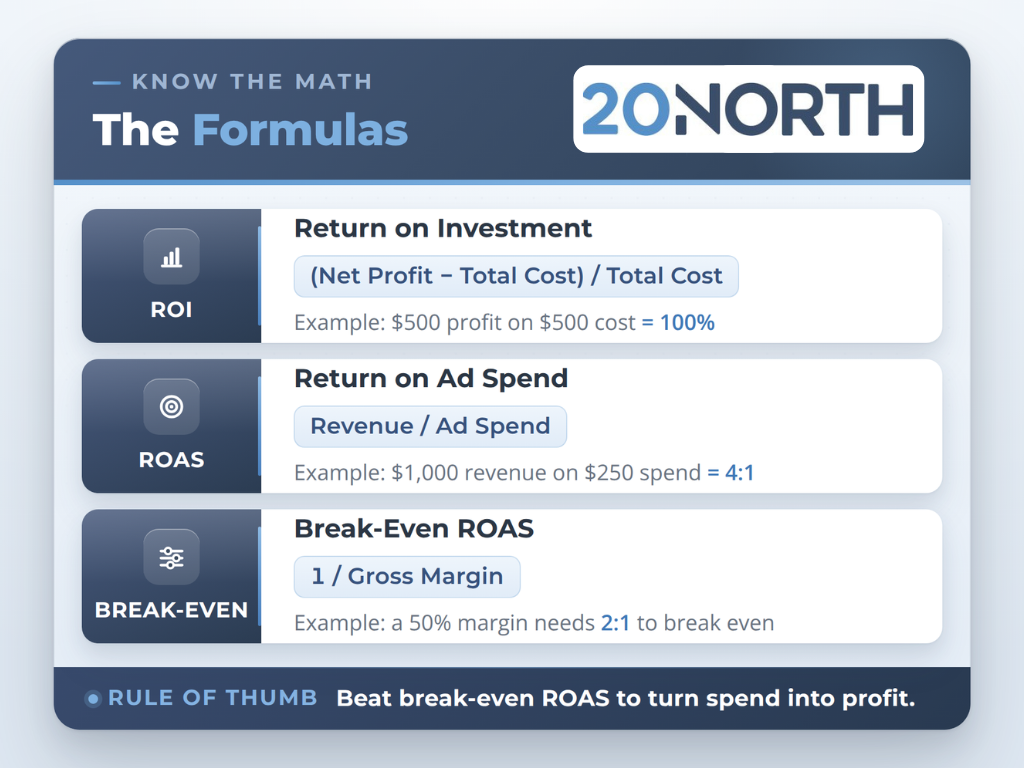
Both metrics come down to a short formula, and the real difference lives in what you feed into each one. ROI weighs profit against every cost, while ROAS weighs revenue against ad spend alone. That is why the same campaign can post a strong ROAS and a weak ROI at the same time.
How to Calculate ROI (ROI Formula)
The ROI formula is: (Net Profit − Total Cost) / Total Cost, expressed as a percentage.
For example, a business spends $500 on a marketing campaign and earns $1,000 back. Net profit is $500.
($1,000 − $500) / $500 = 1.0, or 100% ROI.
A positive percentage means the investment made a profit; a negative one means a loss. Because the ROI formula counts every cost, it is the truest read on if an advertising campaign actually grew the bottom line.
How to Calculate ROAS (ROAS Formula)
The ROAS formula is: Revenue / Advertising Costs, usually written as a ratio.
For example, a business earns $1,000 in revenue from $250 in ad spend.
$1,000 / $250 = 4, or a 4:1 ROAS.
That means every advertising dollar returned four dollars in gross revenue. The ROAS calculation is fast and available inside every major ad platform, which is why it is the go-to performance metric for day-to-day campaign management.
What Is a Good ROAS? Understanding Break-Even ROAS
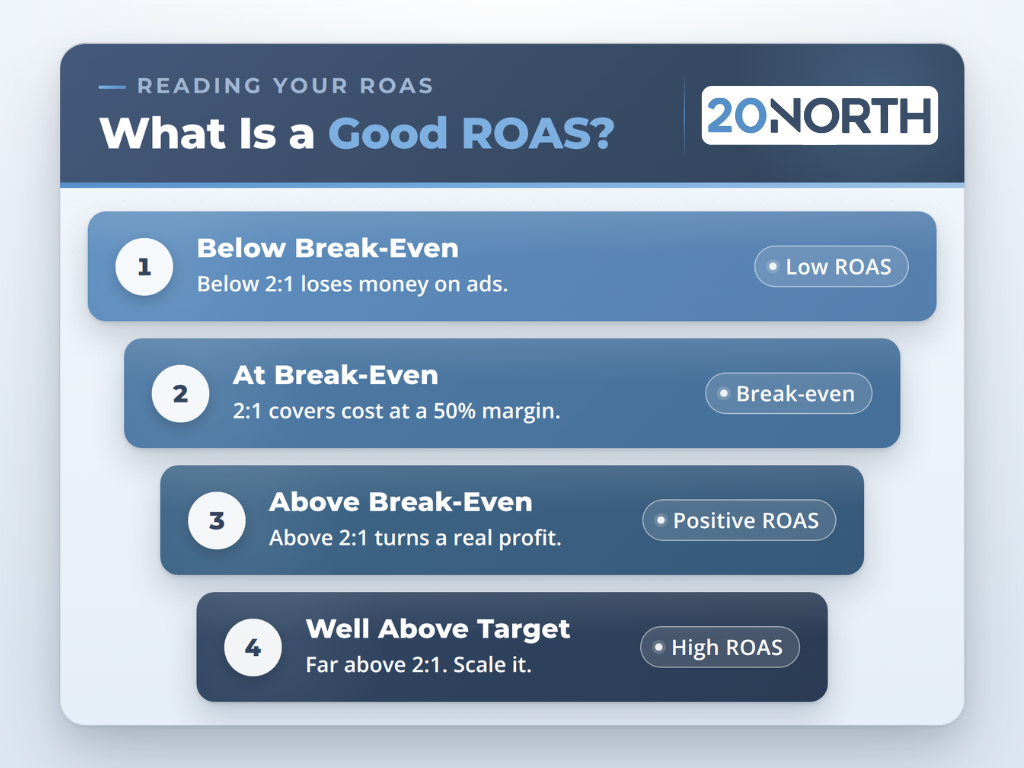
A "good" ROAS depends on your profit margin. It is not a universal number. The break-even ROAS is the point where revenue covers your costs, and you find it with a simple ROAS calculation: 1 / gross margin. A business with a 50% gross margin has a break-even ROAS of 2:1. Anything above that is a positive ROAS that earns a profit, and anything below is a low ROAS that loses money.
Businesses with razor-thin margins need a higher ROAS to stay profitable, while high-margin businesses can grow on a lower ROAS. A high ROAS on one channel does not always mean strong overall profitability, which is exactly why ROAS works best alongside ROI.
When to Use ROI
ROI is the better metric when you want to understand overall profitability. Use it for:
- Mature marketing campaigns that use several advertising channels
- The performance of a sales team or a business unit
- The success of the business over a set period
Because it captures the full picture, ROI also reflects value that a single campaign metric can miss, like brand awareness and repeat purchases that build long-term profitability over time.
When to Use ROAS
ROAS is the better metric when you want to judge a specific advertising campaign. Use it for:
- Google advertising campaigns
- Meta (Facebook and Instagram) advertising campaigns
- TikTok, Amazon, Reddit, and other ad platform campaigns
Because ad platforms report ROAS in real time, it is ideal for managing an active marketing budget and shifting spend toward the campaigns and target audience segments that perform best. If you are weighing where to put that budget, our guide to choosing digital advertising platforms can help.
Why Track Both ROI and ROAS
ROI and ROAS answer different questions, and using them together gives a complete view of campaign performance. ROAS shows which campaigns are efficient right now, and ROI confirms that the marketing budget is producing real profit after every cost. Watching only ROAS can hide a problem: a campaign with a high ROAS can still lose money once operational expenses and additional costs are counted. Watching only ROI can hide which channel is driving the result.
Together, the two metrics support data-driven decisions about where to invest the next advertising dollar. External factors like pricing changes, seasonality, and returns also move ROI, so pairing it with real-time ROAS helps you separate campaign performance from forces outside the ad account. For a wider look at the numbers worth reporting, see our post on the KPIs that matter.
Grow Your Profit With 20North
Understanding ROI vs ROAS is the starting point. Turning those metrics into consistent profit takes ongoing testing, reporting, and optimization. At 20North, our paid advertising team builds every ad campaign around clear targets for both ROI and ROAS, then reports the results so you can see how each advertising dollar performs.
We manage Google Ads, Meta Ads, and other channels, then pair them with conversion rate optimization to lift revenue. If you want the campaign-level playbook, read how to run a successful Google Ads campaign, then see the double-digit ROAS results in our case studies.
20North is a full-service digital marketing agency in Atlanta that helps growing businesses turn ad spend into measurable revenue. Our team manages paid advertising, SEO, AEO, email marketing, and web development under one strategy, so every channel supports the same goals.
Contact our team for a free PPC audit and a plan built around your goals.
.png)
.png)
.png)