
.png)
The Short Answer: Technical SEO vs. content SEO is not an either-or decision. Technical SEO helps search engines crawl, index, and understand your website’s infrastructure, while content SEO helps your pages match search intent and provide useful answers. Strong organic traffic requires both.
Search engine optimization helps businesses appear where potential customers are already looking: Google Search and other search engine results. The work can lead to higher search rankings, more website traffic, and more qualified leads, but only when your website can be found, understood, and trusted by users.
Technical SEO focuses on the technical elements behind the scenes, while content SEO focuses on the website content people read and search engines evaluate. Together, they create a better user experience and give important pages a stronger opportunity to appear in organic search.
What Is Technical SEO?
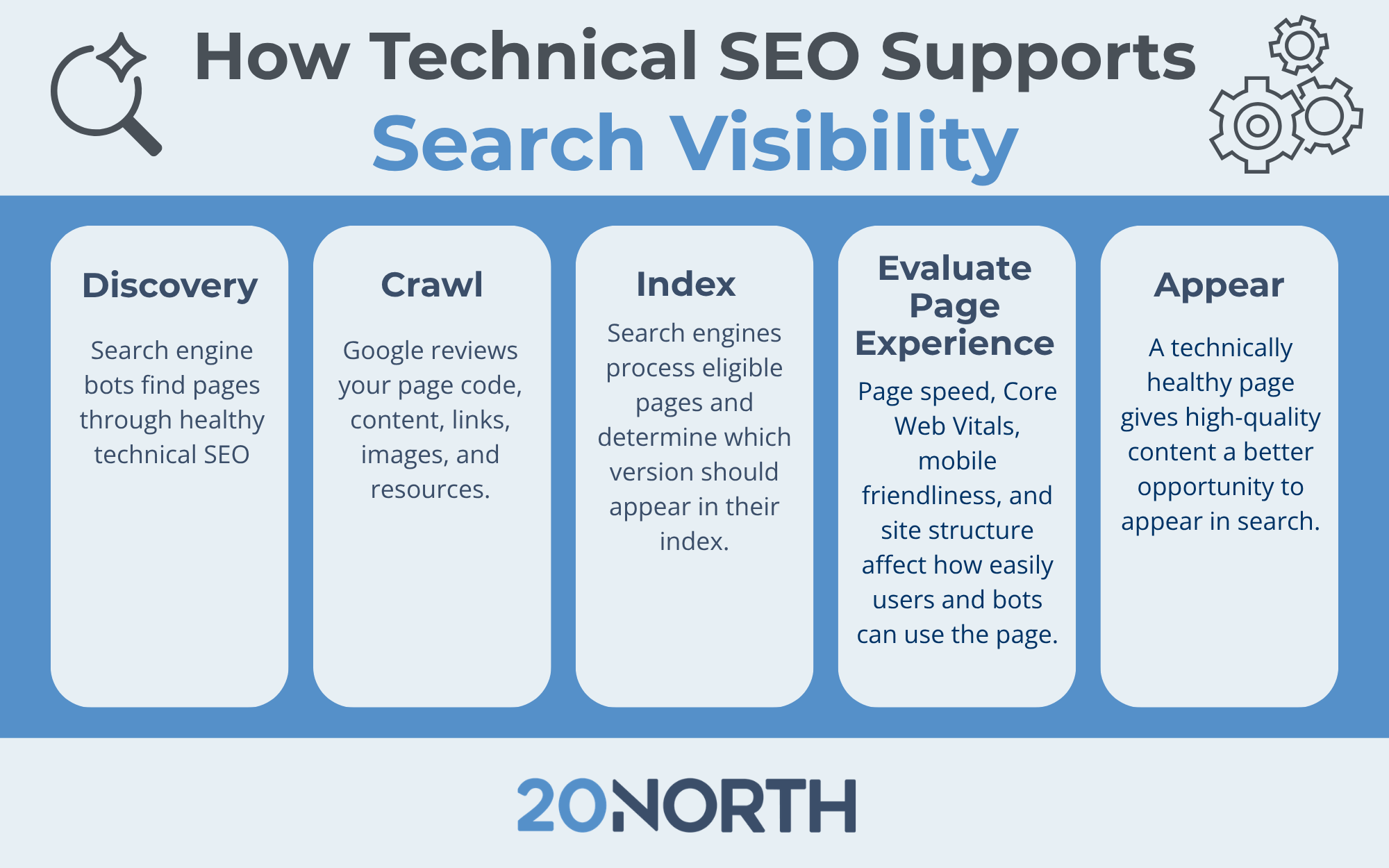
Technical SEO is the process of improving the website’s infrastructure so search engine bots can crawl, render, index, and understand each web page. It covers the behind-the-scenes technical issues that may prevent high-quality content from appearing in search results.
Google explains that its crawlers discover and process web pages automatically, but a site still needs accessible resources, logical organization, and clear signals to help search engines understand its content. Google’s SEO Starter Guide outlines these fundamentals, including crawlability, site organization, helpful content, internal links, and canonicalization.
Site visibility and crawlability
If Google cannot access a page, it cannot include that page in Google search results. A free technical SEO audit from 20North reviews crawl errors, XML sitemaps, robots.txt directives, redirects, broken links, and indexation status to identify barriers that limit organic traffic.
Google Search Console is one of the best tools for reviewing index coverage, URL inspection data, crawl statistics, and technical issues that Google has identified.
Site speed and core web vitals
Page speed affects how quickly people can use your site. Slow pages create friction, especially on mobile devices, and can reduce the value of your SEO efforts when visitors leave before they can engage with your content.
Technical SEO work can include image optimization, script cleanup, caching, code improvements, and hosting recommendations that support faster load times. Reviewing Core Web Vitals and page speed also gives businesses a clearer picture of how real users experience the site.
Mobile friendliness and mobile optimization
Mobile friendliness matters because people use smartphones to research services, compare products, and contact businesses. A mobile-friendly website should load quickly, display content clearly, use readable text, and make navigation simple on smaller screens.
Mobile optimization is also a search engine optimization best practice. If a mobile user cannot easily read your content, tap a button, or move between relevant pages, the user experience suffers, which means conversions suffer.
Site structure and internal linking
A logical site structure helps users find the information they need and helps search engines understand which pages matter most. Clear navigation, descriptive URLs, helpful breadcrumbs, and internal links create connections between service pages, blog posts, category pages, and other important pages.
An intentional internal linking strategy can guide visitors toward related content while helping search engines discover pages and understand topical relationships across the site.
Duplicate content, canonical URLs, and schema markup
Technical SEO also addresses duplicate content, canonical URL signals, structured data, and other technical elements. Duplicate content can appear when similar or identical website content is available at multiple URLs, which may divide crawl attention and make it harder for search engines to determine the preferred version.
A canonical URL tells search engines which version of a page should represent the primary page. Schema markup provides additional context about a page, such as its article type, organization, service, product, or location. Google notes that valid structured data can make pages eligible for certain enhanced search appearances.
What Is Content SEO?
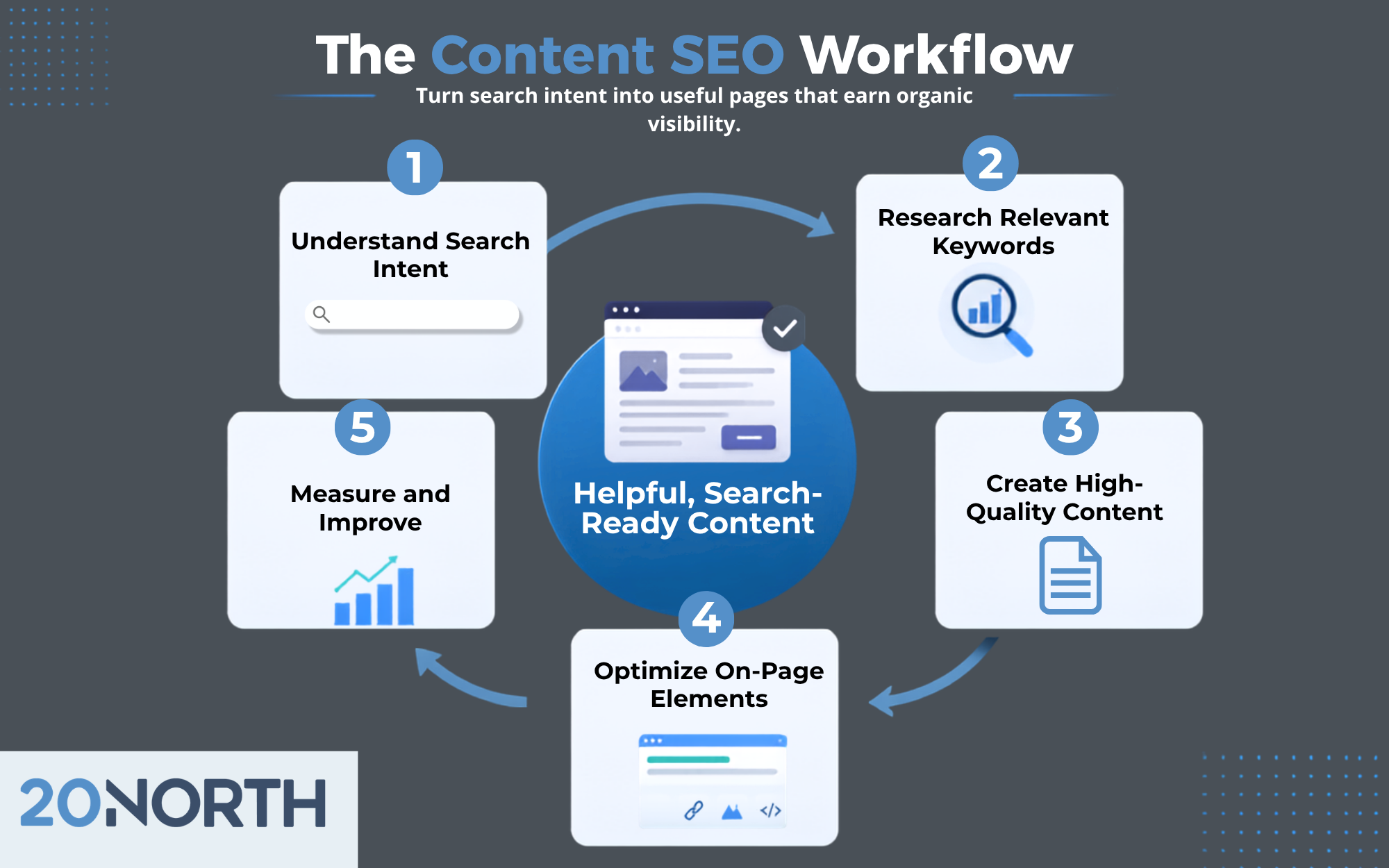
Content SEO is the process of planning, creating, optimizing, and improving website content so it meets search intent and provides a useful answer for the audience. It includes keyword research, content strategy, content creation, on-page optimization, internal linking, and link building.
Content SEO is not about keyword stuffing or repeating relevant keywords as often as possible. Google actually advises against keyword stuffing and emphasizes people-first, unique, useful, well-organized content.
Keyword research and search intent
Keyword research identifies the terms your target audience uses in search engines. Content strategy turns those findings into a practical plan by assigning relevant keywords and search intent to the right blog posts, landing pages, service pages, and product pages.
A search for “technical SEO audit” signals a user looking for a diagnostic service or process. A search for “technical SEO vs content SEO” signals an informational need. Those users need different content, calls to action, and content structure.
20North’s keyword research and SEO services help businesses uncover the search queries that can bring qualified visitors to their site.
High-quality content creation
High-quality content answers the question behind the search query. It should be clear, accurate, easy to scan, and organized with meaningful headings that help users find the information they need.
A strong content strategy may include blog posts that build topical authority, service pages that explain offerings, industry pages that address specific audiences, and conversion-focused landing pages. Every web page should have a clear purpose instead of competing with another page for the same search results.
On-page optimization
On-page optimization improves the elements users and search engines see on the page. This includes title tags, headers, image alt text, URLs, meta descriptions, internal links, external links, and page copy.
A well-written meta description can help communicate the page’s value in the search engine results page. Clear page titles and relevant content also make it easier for Google to understand how a page relates to a user’s search.
Link building and external links
Link building earns links from other trusted websites to build authority and broaden reach. Internal linking helps distribute authority throughout your own site. External links can add context and point readers to useful, trustworthy resources.
The quality of the links matter more than volume. A useful external link should support the topic, help the reader, and lead to a credible source.
Technical SEO vs. Content SEO
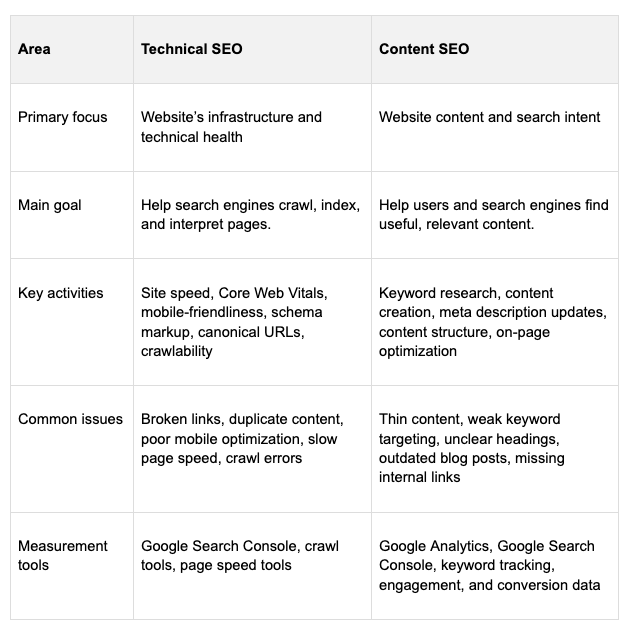
Technical SEO and content SEO have different jobs. A content page cannot perform at its full potential if search engine bots cannot access or index it. In the same way, a technically healthy site cannot attract the right audience without relevant content that answers real questions. Both contribute to stronger search engine rankings and a better user experience in different ways:
How They Work Together
Think of technical SEO as the foundation of a building and content SEO as what makes the building useful to the people inside. One supports access, stability, speed, and navigation. The other gives visitors a reason to arrive, stay, learn, and convert.
For a blog post targeting “technical SEO vs content SEO,” technical work may include fast loading, mobile optimization, schema markup, a canonical URL, and strong internal linking. Content work includes researching the target keyword, answering the comparison clearly, writing useful sections, adding descriptive visual assets, and linking readers to related SEO services.
This approach supports more than rankings. It improves the full path by making the page easier to find, easier to understand, and easier to use.
Build a Stronger SEO Strategy with 20North
Technical SEO and content SEO should work as part of one ongoing SEO strategy. Start with a technical SEO audit to uncover crawlability, site speed, mobile friendliness, duplicate content, and site structure issues. Then, use keyword research and content analysis to identify content gaps, improve existing pages, and create high-quality content around relevant search intent.
At 20North, our SEO team combines technical SEO, on-page optimization, SEO audit services, AI SEO, and web development to help growing businesses improve organic search visibility, user experience, and qualified website traffic.
Ready to strengthen your SEO strategy? Reach out today to improve your business’s SEO and get a free audit.
.png)
.png)
.png)