
.png)
The Short Answer: The future of e-commerce belongs to brands that can sell wherever a customer shows up and adapt faster than their competition. Artificial intelligence is rewriting product discovery, social platforms have turned into storefronts, and agentic commerce is putting software in the buyer's seat.
The Driving Force
The e-commerce landscape is dynamic, always shifting. We see the velocity of those shifts increasing over the next few years, making agility and adaptation a necessary competitive advantage. The brands taking market share are rarely the ones with the biggest budgets. They are the ones that spotted a shift early.
Where the E-Commerce Market Stands Today
In the first quarter of 2026, U.S. retail e-commerce sales reached $326.7 billion, or 16.9% of all retail sales, according to the U.S. Census Bureau. E-commerce grew 9.8% year over year against 3.9% for total retail, so online sales are expanding roughly two and a half times faster than retail overall. The other 83% still happens offline, and buy-online-pickup-in-store, same-day delivery, and connected inventory management keep pulling brick-and-mortar stores into the digital customer journey. E-commerce growth looks less like a replacement of retail than a merger of the two. That changes what an e-commerce business has to be good at.
Theme 1: More Touchpoints and Less Friction
We believe there will be more opportunities to get in front of consumers in more places, and anywhere you can reach a consumer, you should be able to convert in that moment.
More platforms keep appearing, more smart devices come online every year, and more influencers and affiliate marketers are building audiences that behave like media companies. The strongest brands work through all of it to find which channels actually drive revenue, a tradeoff we cover in digital marketing versus affiliate marketing.
Amazon normalized and set a standard for convenience with short shipping windows and one-click checkout. Consumers now do not want to enter shipping and credit card information. They want an online purchase to be incredibly easy because they have been trained to expect that. Marketing products in as many low-friction settings as possible protects conversion rate and brand perception, which is why conversion rate optimization is now a standing workstream for most stores.
Social commerce took this further by turning social media into the place where the whole purchase happens. Product discovery, reviews, checkout, and reorder all live inside one app, so merchandising and customer service have to work natively on social media platforms. User-generated content carries the weight there, and paid amplification decides who sees it. Paid media and social advertising do that work. Virtual reality and augmented try-on are removing the last hesitation before checkout in categories like fashion and apparel, where mobile commerce already set the expectation of speed.
Theme 2: Artificial Intelligence and Agentic Commerce
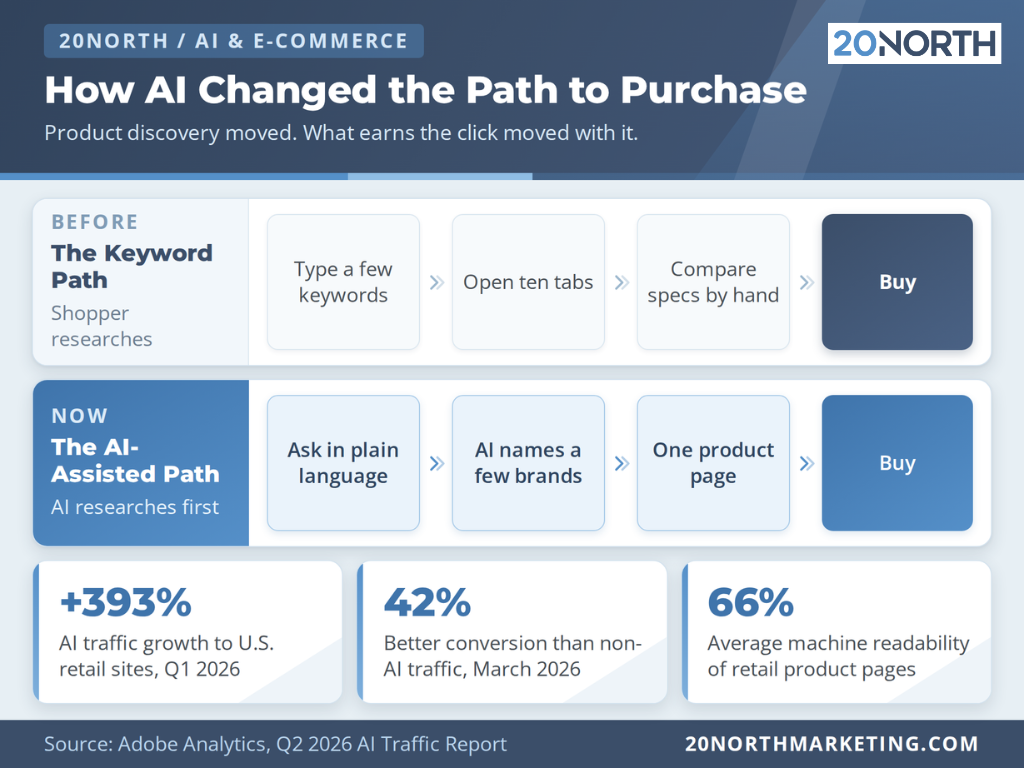
Generative AI changed where product research starts. Instead of typing three words into a search box and opening eight tabs, shoppers describe what they need in natural language and get one answer with a handful of brands named in it.
Traffic from AI sources to U.S. retail sites grew 393% year over year in the first quarter of 2026, according to Adobe Analytics, and in March 2026 it converted 42% better than non-AI traffic. A year earlier it converted 38% worse. Shoppers arriving from an AI assistant have already done their research, so they land ready to buy. The catch in the same data is that product pages scored an average of 66% on machine readability, so a third of a typical page cannot be parsed by the systems deciding which brands to recommend.
AI Overviews and Product Discovery
AI Overviews answer shopping questions at the top of Google before anyone clicks, and the brands cited are the ones publishing clear, structured, consistent information, while vague marketing copy gets skipped. We break the mechanics down in our guide to optimizing product pages for AI Overviews, and schema markup is the piece most stores are missing. None of this replaces traditional search work, a point we cover in our look at AI and the future of SEO. The internal linking and content quality that earn rankings also earn citations, which is the thinking behind our AI SEO services.
Agentic Commerce
Agentic commerce is the step past AI-assisted research. Here the software acts instead of just recommending. A shopping agent compares options against stated customer needs, checks stock and price in real time, and completes the transaction for the buyer.
Your product page now has two audiences, a person and a machine reading for that person, and the machine cares about accurate, current data more than persuasive copy. Feed accuracy, live inventory status, and consistent pricing become ranking factors for a purchase you never see happen. That is a business model question, because it decides how much of the customer relationship you still own.
AI also reshaped what happens after the click. Recommendation engines adjust in real time to customer behavior instead of a segment someone defined last quarter, and AI-driven send times have made email marketing, SMS, and Klaviyo flows far more responsive to the individual.
Pro Tip: Before investing in AI personalization, run a Klaviyo audit on what you have. Most brands have flows sitting half-configured, and fixing those returns more than any new tool.
Theme 3: Data Science Versus Privacy
Attribution and mapping the end-to-end customer journey is still topical among marketers who use many channels. Tech-forward companies push the envelope by feeding every datapoint into a warehouse, cleansing it, and drawing conclusions. In our opinion, no one has fully solved this, though someone eventually will.
Working against that goal is a macro trend that is not going away: data privacy. Privacy-focused search engines, browsers, and device manufacturers keep gaining ground, and privacy legislation continues to advance. Third-party signal loss made the old attribution playbook less reliable every year.
Regardless of the forces at play, there will always be ways to make data-driven marketing decisions. It just takes more creativity and agility as challenges and opportunities present themselves. Most brands land on first-party data, which is why owned channels and a well-designed email customer journey keep gaining budget. We cover what to measure in the SEO KPIs worth tracking.
Theme 4: Headless Commerce and the Supply Chain
Headless commerce has grown into a larger theme. It involves decoupling your store's front and back end architecture, delivering information to the front end through an API, then moving off the big e-commerce platforms so you can build a user experience native to each channel.
Headless companies can deliver content, products, and payment gateways to any device. Hardware manufacturers keep making connected devices out of nearly everything, so headless means deploying content and checkout to any platform that exists now or will exist later. Agentic commerce will demand exactly that flexibility.
The tradeoff is complexity, and plenty of brands are better served by a well-optimized platform build. We looked at that decision in our review of Shopify as an e-commerce SEO platform, and our web development and Shopify Plus B2B teams work both sides of it.
Operational efficiency is the other half of this. Consumer demand arrives in sharper, less predictable bursts now because one creator video can move more units in a day than a quarter of paid search. Predictive inventory management and supply chain visibility let a brand say yes to that moment instead of posting a sold-out page. For many operators, being ready when demand arrives is harder than generating it.
Best Practices to Prepare Your E-Commerce Business
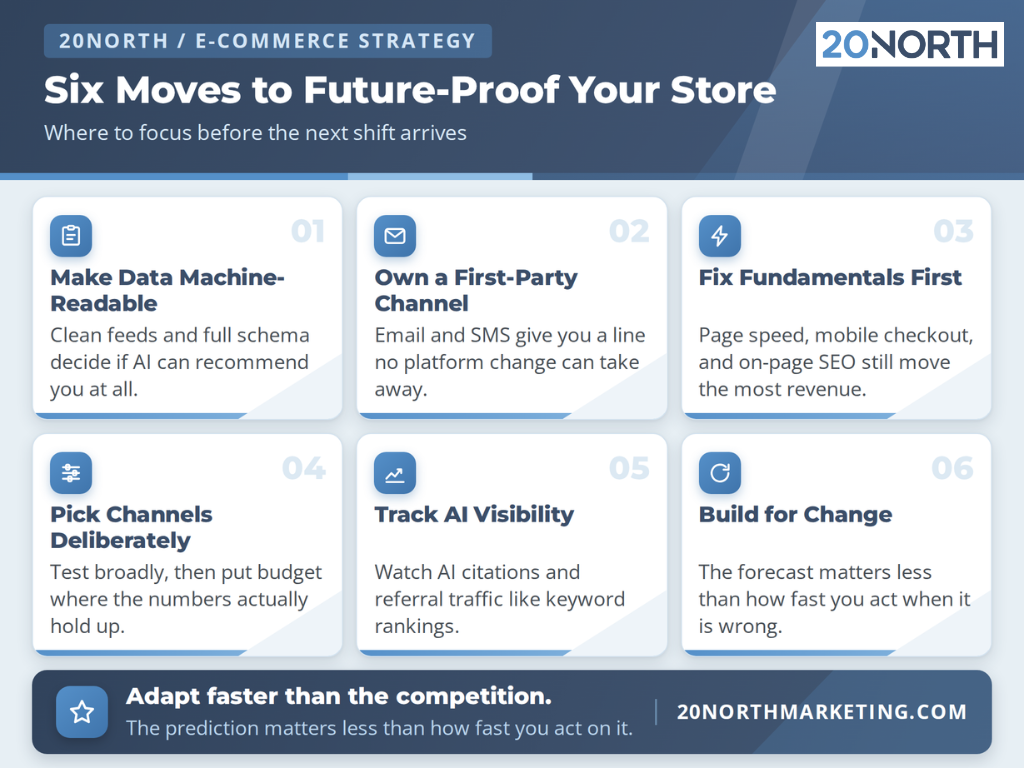
This is what we would prioritize to carry your store forward:
- Make your data machine-readable. Structured product data, clean feeds, and full schema decide if AI can recommend you at all.
- Own a first-party channel. Klaviyo email campaigns and SMS give you a line no platform policy change can take away.
- Fix the fundamentals first. Page speed, mobile checkout, and on-page SEO still move the most revenue, and site usability decides what happens after the click.
- Pick channels deliberately. Test broadly, then concentrate your marketing efforts where the numbers hold up.
- Track AI visibility like a rankings report. We cover the tools in the best AI SEO tools and how to track brand visibility in AI search.
- Build for change, not for a forecast. The prediction matters less than how fast you act when it turns out to be wrong.
Building for the Future of E-Commerce with 20North
We picked these themes because they look most relevant to us, but there are many factors at play. The only thing we know for sure is that the landscape changes quickly. Winners and losers get sorted by their ability to adapt, and adapting faster than the competition remains the single largest success factor in the rapidly shifting ecosystem that is e-commerce.
That is the work 20North does every day. Our team pairs e-commerce SEO, search engine optimization, paid advertising, email marketing, and web development so your brand shows up in search results, AI answers, and social feeds. See it in our case studies, including how Blessed Performance grew organic traffic and revenue. Start with a free AI SEO audit, browse our digital marketing services, or get in touch.
.png)
.png)
.png)