
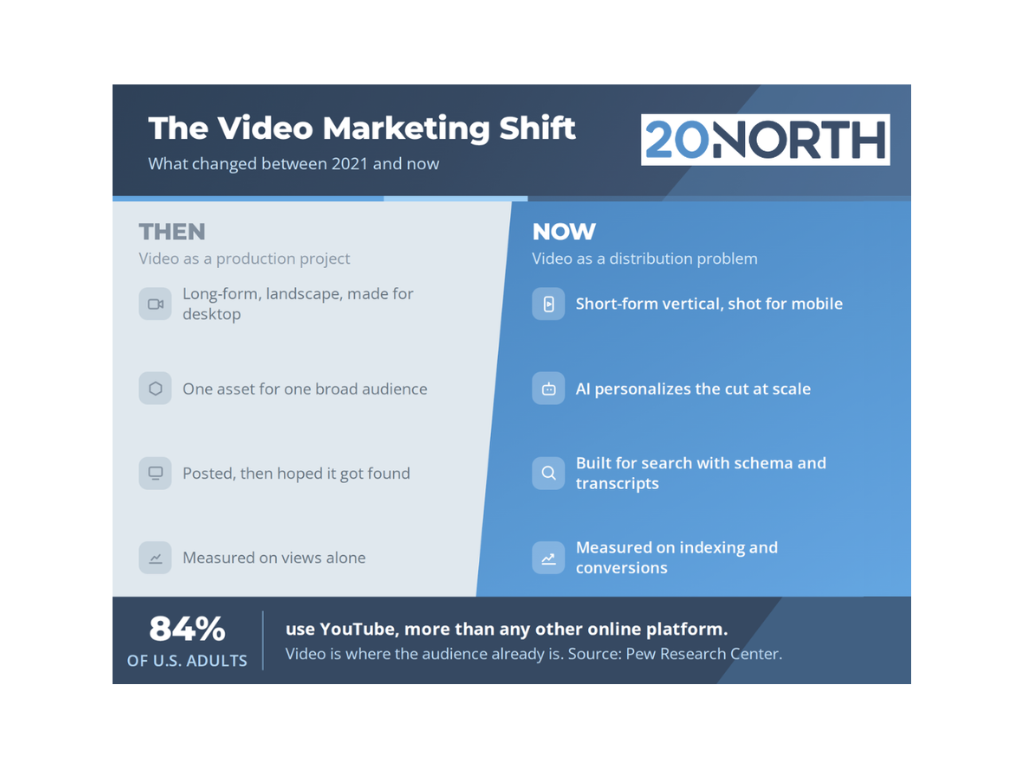
The Short Answer: The future of video marketing looks less like better cameras and more like better distribution. Short-form video dominates attention, AI handles personalization at scale, live and interactive formats keep growing, and none of it matters if nobody finds the video. Discovery is the constraint, and SEO video marketing is how you solve it.
If a picture is worth a thousand words, what is a video worth?
That was the question we opened with when we first published this piece, and the honest answer is that the number matters less than the reach. YouTube is now used by 84% of U.S. adults, more than any other online platform, according to Pew Research Center. Video is where the audience already is.
That is the state of video today. If you are wondering about the future, here are the things we see on the horizon.
Discovery Is Still the Hardest Part
Discovery continues to be the biggest concern for marketers, and it has only gotten harder.
Enormous volumes of online video get uploaded every minute of every day. If you did nothing but watch, you could not keep up with a single day of it. Is it any wonder much of what gets produced never gets seen by more than a handful of people?
Video marketing strategy has to be heavily focused on SEO best practices to aid discovery. It does not matter how good your video is if your target audience cannot find it.
What Google Needs to Rank Your Video
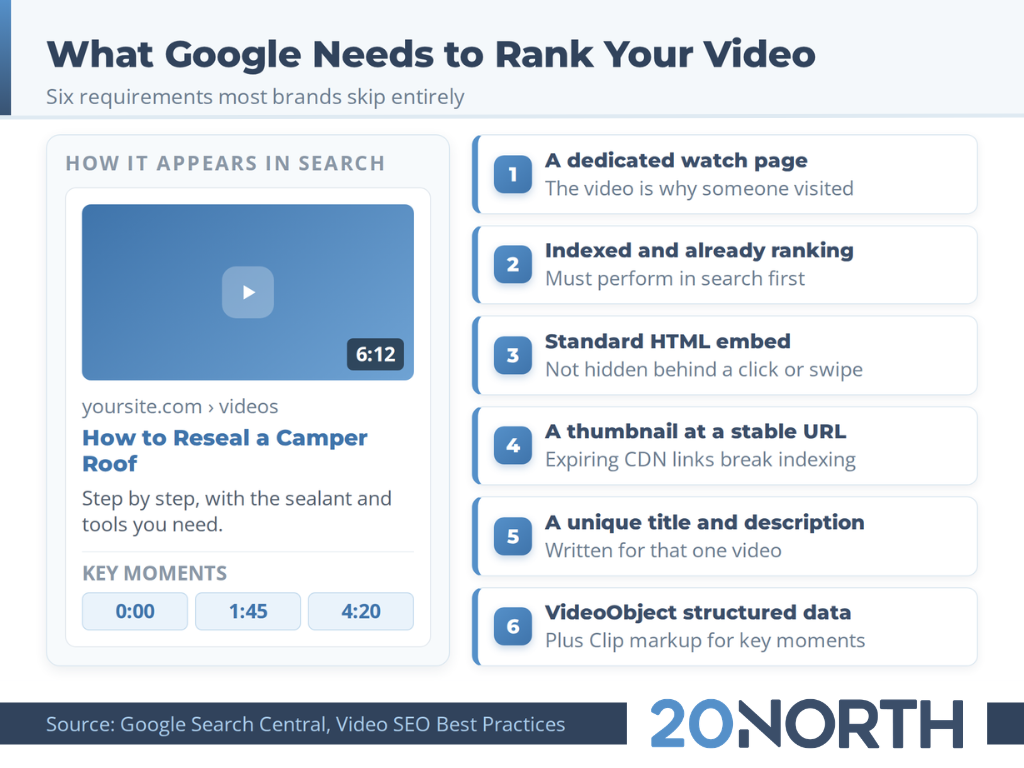
This is where most video marketing efforts leak. Google publishes exactly what it needs, and most brands skip it.
Videos can appear on the main search results page, in Video mode, in Google Images, and in Discover. To be eligible, Google requires a few specific things:
- The video must sit on a watch page that is indexed and already performing in search.
- The video must be embedded in a standard HTML element and not hidden behind a click or swipe.
- The video needs a valid thumbnail at a stable URL that does not expire.
- Each watch page needs a video title and description unique to that video.
Google draws a clear line here. A dedicated watch page is one where the video is the reason someone visited: a video landing page, a product demo page, or an events clip. A blog post that happens to embed a video is not a watch page, and Google says so directly. Both can rank, but only the watch page is eligible for the richer video features.
Structured data is the other piece. VideoObject markup and a video sitemap tell Google what your video is about, and Clip or SeekToAction markup enables key moments, which lets viewers jump to the part they want straight from the search result. Schema markup is the step most sites skip in video content marketing.
Write the Video Title Like a Web Page Title
A video title is a page title, and the same rules apply. Front-load the specific term someone would actually search, keep it readable, and make it unique to that video. Long-tail keywords work harder here than broad ones, because a search for how to reseal a camper roof has clear intent and far less competition than camper maintenance. Our keyword research team builds video titles the same way we build on-page titles.
Video transcripts are the other free win. A transcript on the page gives search engines text to crawl on a page that would otherwise be a thumbnail and a play button, and it makes the visual content usable for people who watch without sound or use a screen reader. Captions and a full transcript take minutes with current marketing tools and improve both accessibility and organic search.
Then measure it. Search Console has a video indexing report showing how many of your watch pages contain an indexed video and why the others failed. Pair it with the performance report filtered to videos, which we cover alongside other numbers worth watching in the SEO KPIs that matter.
Short-Form Video Took Over
The format shift nobody fully predicted in 2021 is now the default. Short-form video runs on every social platform, and the economics changed with it. A phone, decent light, and a clear first three seconds beat a produced spot most of the time.
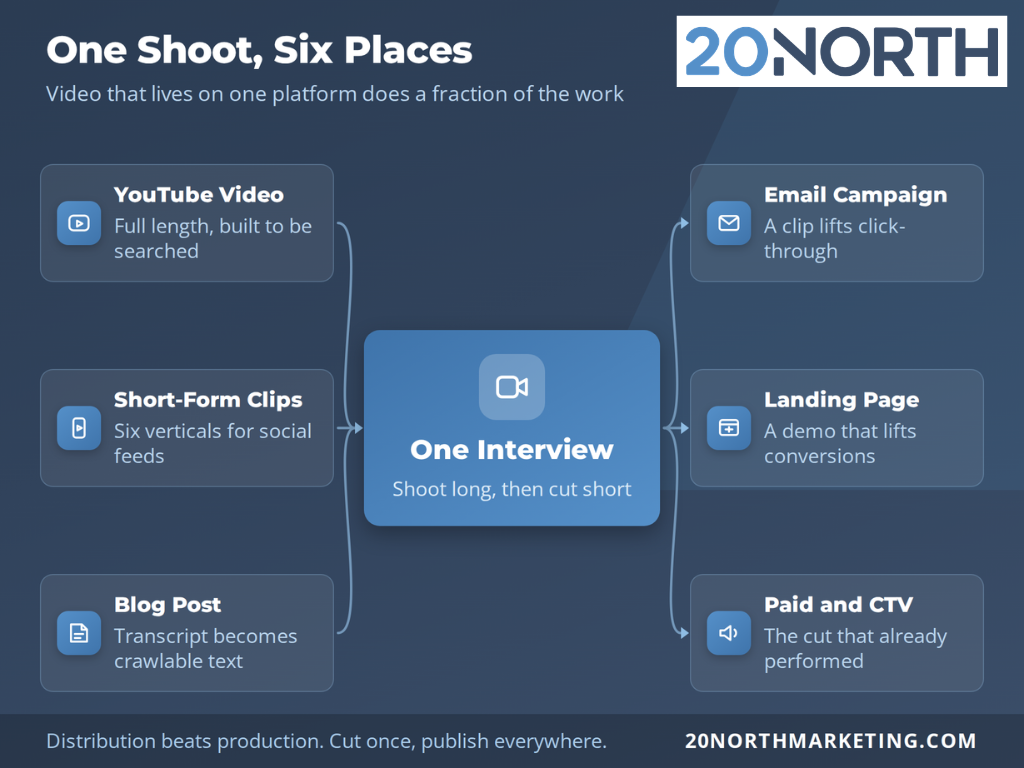
That does not retire long-form. An explainer video still does work a fifteen-second clip cannot, and YouTube remains the place people go to learn something properly. The practical approach is to shoot long, then cut short. One good interview becomes a YouTube video, six vertical clips, an email, and a blog post.
Match the format to the job. Short-form builds brand awareness with people who have never heard of you, since social platforms will show it to strangers. Long-form converts people already considering you, because someone twelve minutes into a product demo is not browsing. Running only one format means you are either invisible or unpersuasive.
One Message, Every Screen
The future of video marketing is about delivering messages across different screens without friction. A consumer might watch on a smartphone, a laptop, a TV, or a streaming service, and the video needs to be attuned to that choice.
Mobile devices carry most of it now, which changes production decisions rather than just playback. Shoot for vertical, caption everything because most people watch without sound, and put the point in the first few seconds. User experience on the page matters too, since a video that delays your load time hurts the web page it sits on.
Hyper-Targeted Personalization
Marketers have targeted niche audiences with video for years. The next phase is hyper-targeting based on personalization.
AI-driven algorithms now serve the most relevant videos to audiences and personalize at scale. Rather than producing one generic video for a broad audience, marketers can create videos that allow automated personalization on the fly. We have already seen algorithms use first-party data to deliver videos that reference viewers by name.
The same shift is reshaping search itself, which we cover in will AI replace SEO.
Continued Experimentation
As platforms evolve, so will video production. Marketers will keep experimenting with different forms, formats, and platforms. Filters, overlays, and production tools keep getting simpler to use.
Augmented reality and virtual reality have moved from novelty toward practical use in categories where seeing the product in your space decides the sale. Furniture, eyewear, and fashion and apparel brands use it to cut returns as much as to win attention.
User-generated content belongs in the same conversation. Customer videos and unboxings carry more weight with buyers than anything a brand produces about itself, and they cost you a request rather than a production budget.
Interactive Experiences
Interactive video keeps growing. Rather than a passive viewing experience, users can interact with video content directly. Clicking, touching, or swiping can reveal product information, buy now options, or related content.
When playing a video, users may branch into multiple paths to make the experience more relevant to their interests. Shoppable video is the version of this with the clearest conversion rate impact, since it removes the step between wanting something and buying it. E-commerce brands are furthest along here.
Live Video
Live webinars, Q&A sessions, and live demos provide an experience on-demand video cannot deliver. A live video can go in different directions based on viewer questions.
Giving people a look behind the curtain in a live format creates spontaneous moments that would otherwise not happen. The interactions feel more authentic, which is a large part of why live formats hold attention.
Google supports this in search too. BroadcastEvent structured data enables a red LIVE badge on your result while you are streaming.
Programmatic Buying
Streaming adoption and connected TVs continue to push more programmatic buying and placement of video. Connected TV inventory now sits alongside Meta Ads and Google Ads in most media plans rather than being treated as an experiment, which changes how paid media budgets get built.
What Is Not Changing
The future of video keeps evolving, but some things hold. Serving relevant content to interested consumers at the right place and time is how you optimize its impact.
Video still needs to feed your other channels. In a crowded digital landscape, a video that lives on one platform is doing a fraction of the work it could. A YouTube video becomes a blog post that earns organic search traffic. A clip becomes an email. A demo becomes a landing page asset that lifts conversion rate.
Build Your Video Marketing Strategy With 20North
Video production is the visible part of video marketing. Distribution, search engine optimization, and measurement are where campaigns are won or lost.
20North is a full-service digital marketing agency in Atlanta. Our team pairs search engine optimization with paid media, email marketing, and web development so your video content earns visibility in search results, social media feeds, and AI answers at the same time. See it in our case studies, including how Spartan Camera doubled ad spend and drove more than a million dollars in Meta-attributed sales.
Get in touch with 20North today and let us show you how we can help grow your business through video marketing content.
.png)
.png)
.png)