
.png)
The Short Answer: When developing a search-optimized website, avoid common issues like poor site structure, low-quality content, keyword stuffing, duplicate pages, slow performance, and missing technical SEO elements. Building SEO into the development process from the beginning helps search engines understand your website, improves user experience, and creates a stronger foundation for long-term organic visibility.
Search engines are the starting point for most people looking for a product or service. If your business does not show up in the search results, you are handing that customer to a competitor who does.
So how does a page earn one of those top spots? Google's algorithm reviews a website's content, structure, and overall user experience to decide which pages deserve to rank for a given query. Search-optimized website development is the process of building and writing a site that meets those standards from day one, rather than trying to fix problems after launch. That means user-friendly design, keyword phrases used naturally, and a healthy website backend. The algorithm has gotten better at rewarding sites that do this well. Below are the mistakes we see most often in SEO web development.
Common Mistakes in SEO Web Development
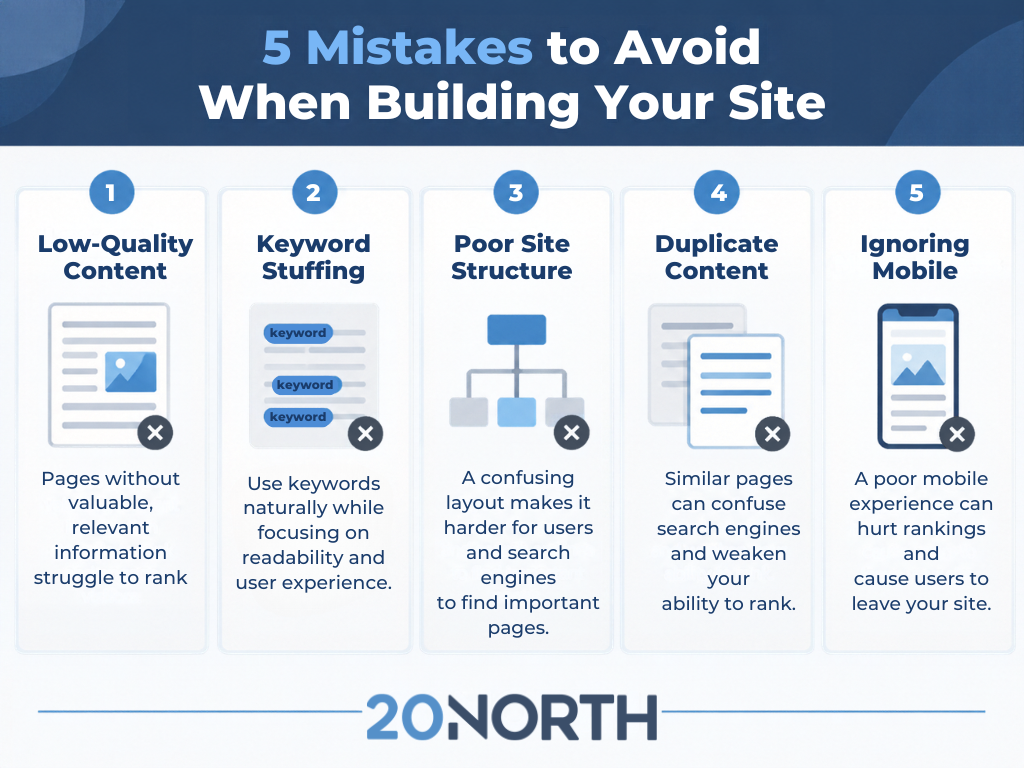
Most business owners have heard the standard SEO tips. It’s important to understand what to avoid as well. A technical or content mistake can undo months of otherwise solid marketing strategies. These are the habits that hold a new website back the most.
Publishing Low-Quality Content
Content that is thin, poorly written, or unrelated to what the user actually searched for gets treated as untrustworthy by Google. Search engines are built to serve the most useful answer to a query, so content that doesn't deliver value gets pushed down the search engine results page regardless of how many blog posts you publish. Every page on your site, including product pages and blog content, should answer a question your target audience is asking.
Keyword Stuffing
Cramming a page full of the same keyword phrases used to be a shortcut to higher rankings, but not anymore. Search engines flag this as a black hat SEO tactic, and it usually produces copy that reads unnaturally. The better approach is choosing one target keyword per page, then supporting it with related terms and synonyms the way a person would actually write or speak. Google rewards content that reads well and ranks well as a result.
Ignoring Site Structure
Site structure is how your pages, categories, and internal links connect to one another. A disorganized structure makes it harder for users and search engine crawlers to find what they need, which drags down rankings and increases bounce rates. A logical hierarchy, with clear categories and consistent internal linking between related pages, gives search engines a map of what your site covers and how each page relates to the rest.
Duplicate Content
Publishing the same or nearly identical content across multiple URLs confuses search engines about which page to rank and can dilute the authority of both. This sometimes happens by accident, through product variants or printer-friendly page versions, but the fix looks similar either way. se canonical tags, consolidated pages, or rewritten copy to give each URL its own purpose.
Overlooking Mobile Devices and User Experience
Over 60% of searches happen on a mobile device. Google evaluates the mobile version of your site first when deciding how to rank it. A page that loads slowly, has text too small to read, or requires pinching and zooming will lose visitors before they see what you offer. Website design that prioritizes clean navigation, fast load times, and responsive design across every screen size directly supports both search engine ranking and conversion rate.
SEO Best Practices That Get Overlooked
Content and user experience get most of the attention in SEO conversations, but there are technical pieces of SEO web development that are just as important and easier to miss.
Meta Tags and Descriptions
Meta tags, including the page title and meta description, are the snippets of code that tell search engines and searchers what a page is about before they click. They don't appear on the page itself, but they show up directly in the search results and heavily influence if someone clicks your link over a competitor's. Every new page or blog post should have a unique, keyword-aware title tag and description written to appeal to a real reader deciding if they want to click.
Tracking Performance With the Right Tools
You cannot improve what you don't measure. Google Analytics and Google Search Console show which pages are driving organic traffic, how users move through your site, and which queries are already bringing people to your domain. Pairing that data with a tool like Semrush helps an SEO team spot the latest trends, monitor keyword phrases, and catch drops in visibility before they become a bigger problem. Our team at 20North walks through how to read these reports in more detail in our guide to e-commerce analytics tools.
HTTP Status Errors
A high number of 404 errors or broken redirects tells search engines your site isn't well maintained, and it will also frustrate site visitors. Every URL that changes or gets removed should be redirected properly, and pages that are intentionally taken down should be no-indexed rather than left to return an error. Cleaning these up regularly is one of the simplest ways to protect the search engine ranking you've already earned.
Internal and External Linking Strategies
Links remain one of the clearest signals search engines use to understand authority and relevance. Internal links connect your own pages together and help distribute ranking power across your site, while backlinks from other reputable domains signal that outside sources trust your content. External links to credible, non-competing sources show search engines that your content is well researched and part of a larger, trustworthy conversation.
Site Maps and Indexability
A sitemap lists every page on your website and gives search engines a road map for crawling it. Submitting an updated sitemap to Google Search Console whenever you publish a new website section or make major structural changes helps your pages get indexed faster. Sites without a current sitemap often see new content take far longer to show up in search results, if it shows up at all.
Core Web Vitals and Site Speed
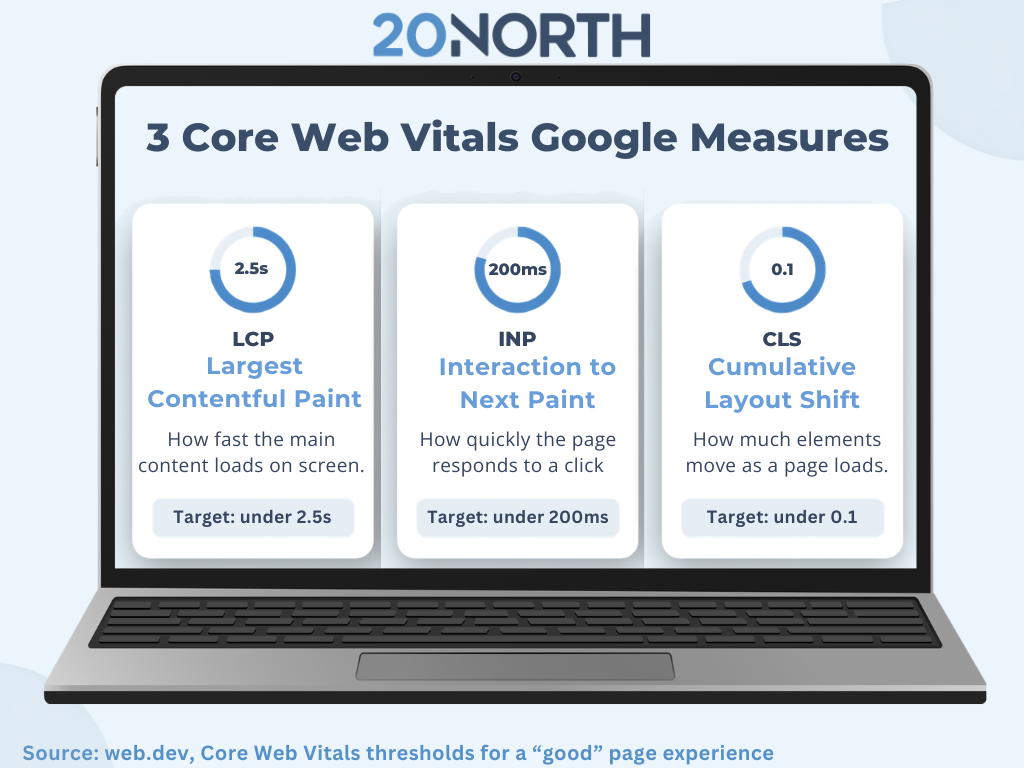
Beyond content and links, Google measures the technical performance of your site directly through Core Web Vitals, a set of metrics covering loading speed, interactivity, and visual stability. A slow, unstable page can undercut an otherwise well-optimized website, which is why site speed deserves attention alongside content and keywords. This is where a back-end developer and a web developer focused on front-end performance need to work from the same playbook. Compressed images, clean code, and a reliable hosting environment all feed into these scores, and a development agency that treats performance as part of the design process from the start will save you from a costly rebuild later.
Develop a Search-Optimized Website With 20North
Search engine optimization touches nearly every part of a website, including the words on every web page and the code running behind it. Avoiding these common mistakes and paying attention to the best practices gives your site a real shot at ranking well and staying there. A search-optimized website is not created through one single tactic. It requires a combination of quality content, technical performance, clear site structure, and a user experience that helps both visitors and search engines understand your business.
20North builds websites and content strategies together instead of treating them as separate projects. Our team supports businesses with ongoing SEO services, paid media campaigns, email marketing, and conversion rate optimization strategies that help drive qualified traffic and turn website visitors into customers. By combining these services under one strategy, businesses can create a digital presence that continues to improve after launch.
Contact 20North today and get a free audit. Let’s talk about what a search-optimized website could do for your business!
.png)
.png)
.png)