
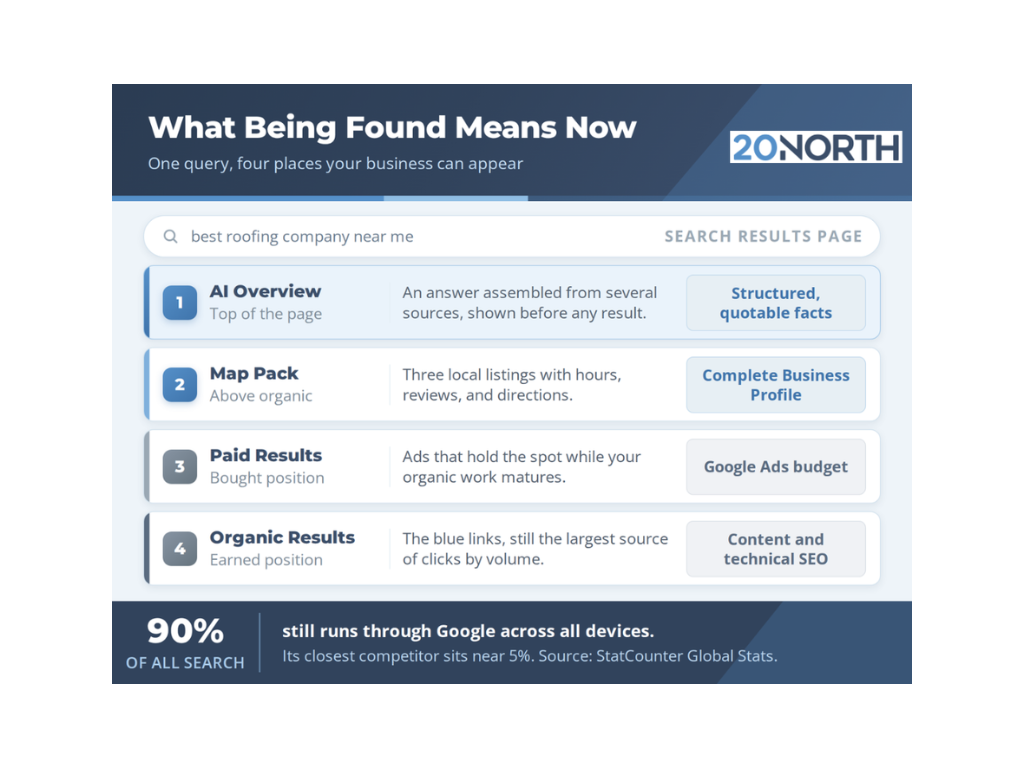
The Short Answer: Google still handles roughly nine in ten searches worldwide, so it remains the largest single source of demand most businesses can reach. What changed is the page itself. Being found now means showing up in AI Overviews and AI Mode as well as the blue links, and the brands doing both are pulling away from the ones still optimizing for 2021.
Google Search is where the demand is. It holds about 90% of worldwide search across all devices, according to StatCounter. Its closest competitor sits around 5%, and on mobile, the gap is wider still.
No other channel puts your business in front of that much active intent. Search intent is also the useful kind, because someone typing a query is already looking for what you sell rather than being interrupted by an ad while doing something else. That is the whole argument for search, and it has not weakened.
What has changed is how crowded the search engine results pages have become and how much of it a competitor can occupy before a user ever reaches your listing. If you are not doing everything possible to get your SEO in order and take advantage of that, you are missing out. The companies that have dialed it in are pulling ahead.
What Changed on the Search Results Page
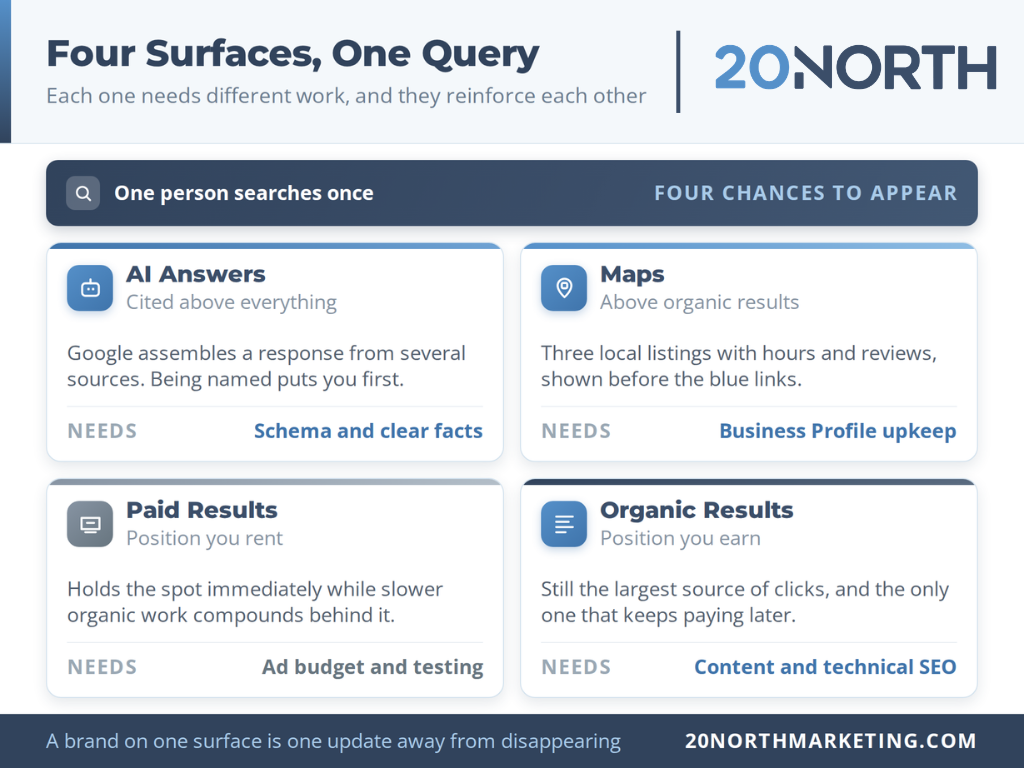
Being found used to mean ranking in the ten blue links. Now a search engine results page can open with an AI Overview, and Google has added AI Mode as a separate conversational surface. Your page can rank well and still lose the click if the answer appears above it and satisfies the user.
That cuts both ways. Getting cited inside an AI answer puts your brand at the very top of the page, above every organic result. Losing that citation to a competitor costs you the visit even when your ranking has not moved.
Google published official guidance in 2026 on optimizing for generative AI features, and its position is that the underlying work has not changed. Clear content, sound technical setup, and unique information are what get pages surfaced. There is no separate playbook, which is good news for anyone who has already invested in doing this properly. We unpack the distinction further in AEO vs SEO and will AI replace SEO.
Search visibility now has two halves. Traditional rankings still drive most of the traffic. AI visibility decides how often your brand gets named when someone asks a question instead of typing keywords.
SEO and Paid Search
SEO is a long game, but you need to play. Companies that invest in SEO best practices to rank high in organic search can count on a regular stream of visitors and conversions. Those that excel propel their brand and reap the benefits for years.
That compounding is the part people underestimate. A page that ranks keeps earning without further spend, and the authority it builds makes the next page easier to rank. Ad spend stops working the day you stop paying. We go deeper on this in what is compound SEO.
Paid search does something different. It buys position immediately while your organic work compounds, and it lets you test which messages and keywords convert before you commit content to them.
The testing value alone justifies it for most brands. A month of ad data tells you which terms produce customers rather than visitors, and you can point your content budget at those terms instead of guessing.
We suggest you do both. Organic gives you durability and margin, while paid gives you speed and control. Running only one means either waiting a year for results or renting your position forever. Our post on balancing an SEO strategy covers how to split the effort.
How Businesses Actually Get Found Now
Being found is not one task. It is four, and most businesses are only doing one or two of them.
- Show up in organic results. That means content that answers real search engine queries, clean technical setup so Google can crawl and index your pages, and enough authority that Google trusts you on the topic. A page Google has crawled but not indexed earns nothing, which is a more common problem than most site owners realize.
- Show up in AI answers. The same content quality work applies, plus structured data and clear, quotable facts that an AI can lift and attribute. We break down how to optimize content for AI Overviews separately.
- Show up in Maps. For any local business, the map pack sits above the organic results. A complete Google Business Profile is the cheapest visibility available, and local search rewards accurate hours, real photos, and steady reviews more than clever copy.
- Show up in paid placements. Google Ads covers the terms where organic will take too long, and it holds position while the rest of the work matures.
Those four surfaces do not compete for the same budget so much as reinforce each other. A brand that ranks organically, gets cited in AI answers, and holds the map pack takes up most of the visible page. A brand present on one surface is one algorithm update away from disappearing.
Start With What People Are Actually Searching
Google Trends shows you which queries are rising and falling and how demand shifts by season and region. It is free, and it will save you from building content around a topic that peaked three years ago. Pair it with proper keyword research to find the terms that carry both volume and intent.
Pay attention to how queries are getting longer. People who used to type two words now ask full questions, partly because AI surfaces reward it. That favors specific pages that answer one question well over broad pages that gesture at a category.
Then check Search Console. It shows the queries you already appear for, which pages earn impressions, and where you rank on page two and could reasonably reach page one. Most sites have a dozen of those sitting unnoticed, and moving them is faster than starting from nothing.
Search Console also now reports impressions from generative AI surfaces, so you can see where your pages appear inside AI answers rather than guessing at it.
Measuring What Worked
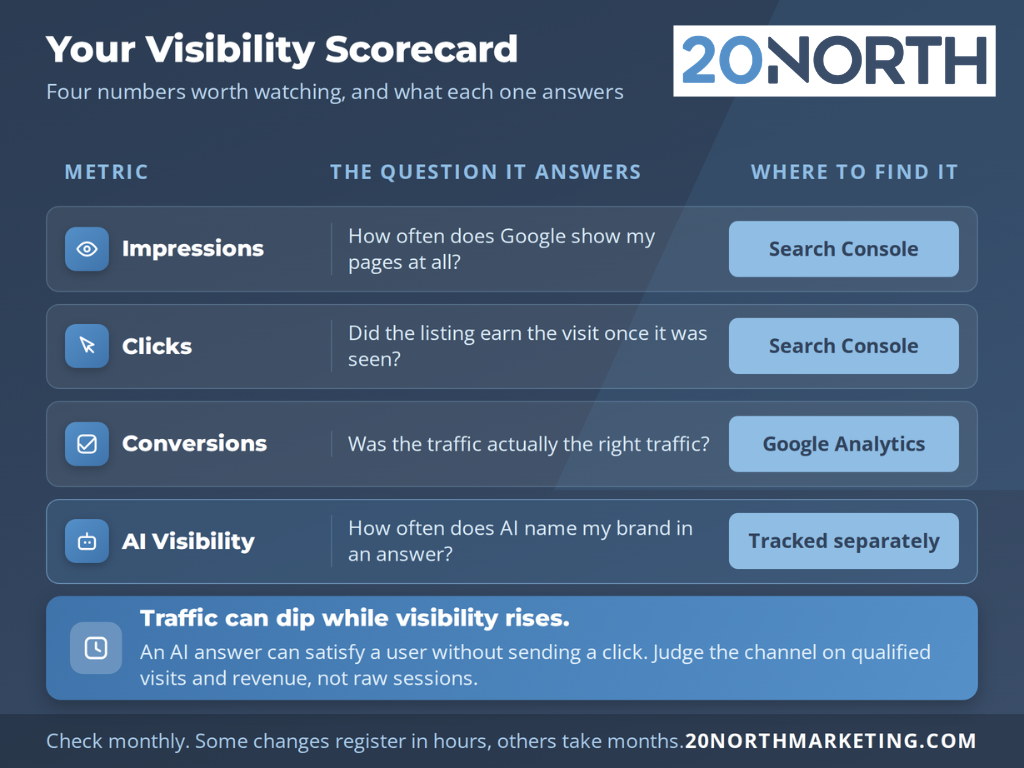
Impressions tell you how often Google shows your pages at all. Clicks tell you how often the listing earned the visit. Conversions tell you how much of that traffic was worth having.
Watch all three, and watch them monthly rather than daily. Google says some changes register within hours and others take months, so a flat week means nothing. Set a target for each metric before you start, because three numbers with no goal attached turns reporting into a habit rather than a decision tool. Our guide to the SEO KPIs that matter covers the full set.
Track AI visibility separately. A brand mention inside an AI answer will not appear in your click data the way a blue link does, so it needs its own measurement. We cover the tooling in our guide to tracking brand visibility in AI search.
One caution on reporting. Traffic can dip while visibility rises, because an AI answer can satisfy a user without sending a click. Judge the channel on qualified visits and revenue rather than raw sessions, or you will cut budget on a channel that is working.
Serious About Winning on Google?
Being found on Google is more competitive than it was in 2021 and more valuable, because the same page now decides both who clicks and which brands AI systems cite.
The businesses winning right now are not doing anything exotic. They publish content that answers real questions, keep their technical house in order, claim every surface Google offers, and measure the result. The advantage comes from doing all of it consistently while competitors do parts of it occasionally.
20North is a full-service digital marketing agency in Atlanta. Our team pairs search engine optimization with AI SEO, paid media, and web development, so your business earns visibility across organic results, AI answers, and Maps at the same time.
Ask the team at Roam. Through a blend of SEO and paid search, they saw an 82% increase in Google impressions, a 202% surge in organic revenue, and 130% growth in keywords ranking on Google's first page. Roam now holds the number one AI visibility position in its category. See more in our case studies.
Contact the search experts at 20North today and let us put together a plan to grow your business. You cannot afford to wait any longer.
.png)
.png)
.png)