
.png)
The Short Answer: Backlinks are links from one website to another, and search engines treat them as votes of confidence. The more high-quality, relevant backlinks point to your site, the more authority you build, which lifts your search rankings and brings in organic traffic. Quality beats quantity every time.
Backlinks are one of the building blocks of search engine optimization, and earning good ones is one of the steadiest ways to grow your website traffic. This guide covers what backlinks are, why they matter, what separates a quality backlink from a spammy one, and how to build more of them.
What Are Backlinks?
Backlinks, also known as inbound links or incoming links, are a link from one website to another. When you link to another website, they have a backlink from you, and when another website links to you, you have a backlink from them. Most backlinks carry anchor text, the clickable words that describe where the link points, and they pass along authority that SEOs often call link juice. If you are working to optimize your website's SEO, backlinks matter because search engines like Google use them as a ranking signal.
Not every link is the same. A do-follow link passes authority to the page it points to, while a no-follow link tells search engines not to pass that authority. External links from other websites to yours are the ones that build your reputation, and the mix of them makes up your backlink profile.
Why Are Backlinks Important?
Backlinks refer users to other sites, which signals to Google that your content is trustworthy. Consider them votes of confidence: the more quality votes you have, the more trustworthy your content looks. Google and other search engines use the quantity, quality, and relevance of backlinks to judge how important your site is. The data backs this up. Backlinko found that the number one result in Google has an average of 3.8 times more backlinks than the pages in positions two through ten.
Backlinks do more than please a search engine. They build your brand. When another website links to yours, that site's readers can click through and discover you, which sends referral traffic your way. High-quality and relevant backlinks help raise your position in organic search and support your wider marketing strategy. Quality matters more than quantity, so it is worth confirming that your backlinks come from websites that are trustworthy, well-known, or authoritative. Links from low-authority or spammy sites do the opposite. Domain authority, also called site authority, is a metric that estimates how "rankable" a site is, so a backlink from a site with high domain authority carries real weight.
What Makes a High-Quality Backlink?
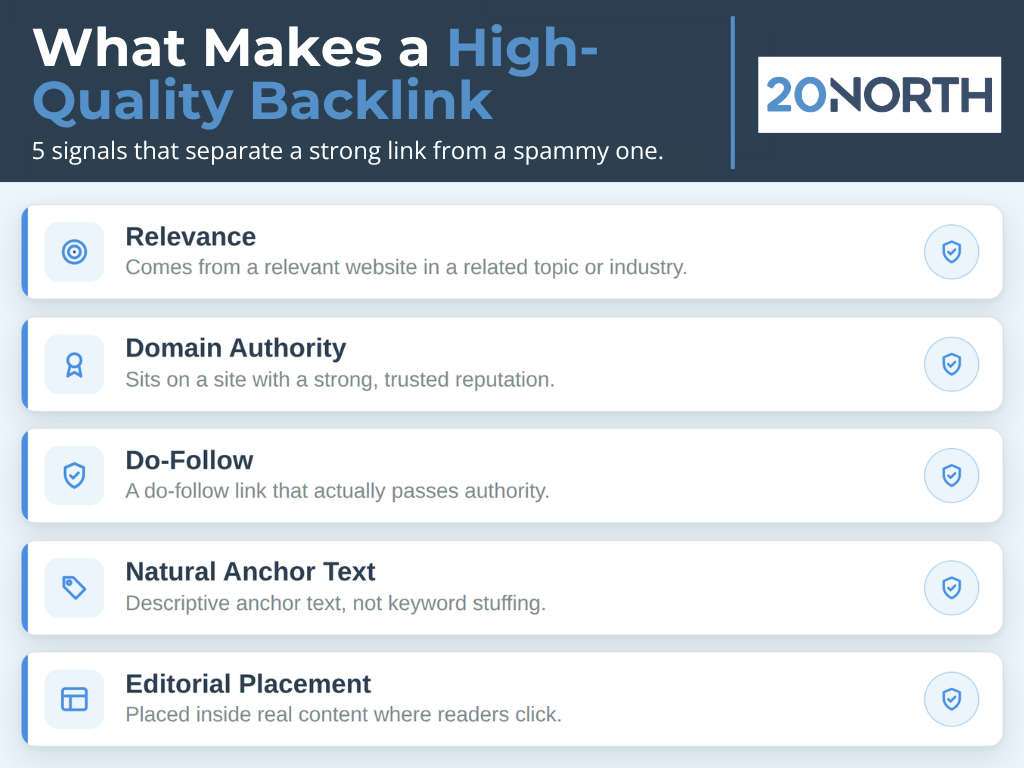
Not all backlinks help. A quality backlink usually shares a few traits:
- Relevance: it comes from a relevant website in a related topic or industry, not a random source.
- Domain authority: it comes from a site with a strong reputation, so it passes more value.
- Do-follow: it is a do-follow link that actually passes authority.
- Anchor text: the anchor text is natural and descriptive rather than stuffed with keywords.
- Link placement: the link sits inside real editorial content, where readers actually click, not buried in a footer.
On the other side, low-quality backlinks from spammy sites, link farms, or paid schemes can hold you back. A handful of relevant, high-quality backlinks will always outperform a pile of low-quality links.
How Do You Build Backlinks?
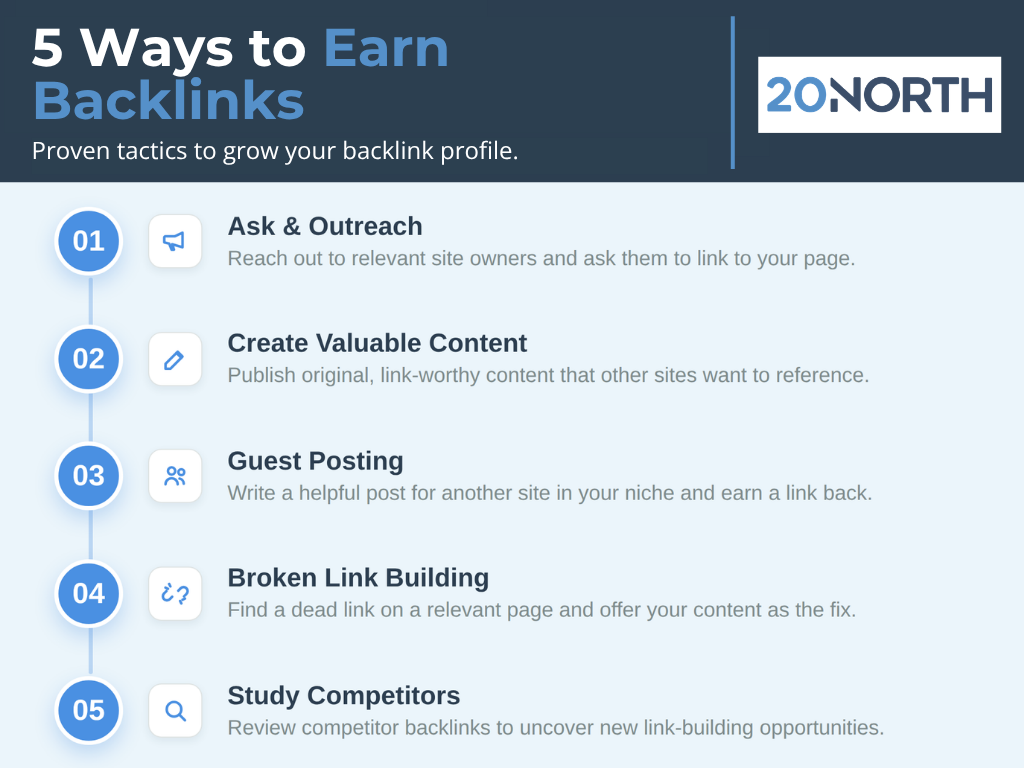
The most direct method is to ask. Reach out to other site owners, bloggers, or editors and ask them to link to your site. The hard part is getting responses and finding people willing to link to you. Building backlinks takes time and effort, but it pays off for your site and your business. A few approaches work well:
- Ask with a clear value proposition. Tell the other site exactly why linking to your page helps their readers.
- Create valuable content. Produce relevant, link-worthy content, like an in-depth ultimate guide, original research, or shareable content that other sites want to reference. Strong content creation is the foundation of every link-building program.
- Guest posting. With guest posting, or guest blogging, you write a blog post for another site in your niche and earn a link back.
- Broken link building. Find a broken link on a relevant site, then suggest your page as the replacement.
- Study competitor backlinks. Review the backlinks your competitors have earned to uncover link-building opportunities you can pursue too.
- Promote on social media. Sharing your content on social media puts it in front of people who may link to it.
Show legitimacy through well-produced, well-written content, and the outreach gets easier every time.
Analyze Your Backlink Profile
Before and during any campaign, run a backlink analysis so you know where you stand. A backlink checker or SEO tool shows which sites link to you, the anchor text they use, and the authority they carry. Many offer a free tool or free backlink report to start, and most let you export the data to a CSV file for review. Use one to audit your own backlink profile, study competitor backlinks, find fresh link-building opportunities, and flag any low-quality or spammy links pointing at your site. Our roundup of the best AI SEO tools is a good place to start, and our AI SEO services put those tools to work for you.
How to Measure Backlink Results
Building links is only half the job. You also need to watch what they do for your site. Track your referral traffic to see how many visitors each linking site actually sends, and watch your organic traffic and search rankings for the pages you are building links to. A steady climb in incoming links from relevant websites usually shows up as better positions in organic search and more website traffic over the following weeks. Compare your backlink profile against competitor backlinks every quarter so you can spot new link-building opportunities and confirm your links are helping, not sitting on low-quality or spammy sites.
A Few Things to Remember
Backlinks matter for ranking well in search engines and for your website's overall growth, but it is not about how many you have, it is about how much they are worth. Quality trumps quantity, and building quality backlinks takes time and effort. Track your progress with the SEO KPIs that matter so you can see how new links move your search rankings and traffic.
Work With 20North
20North is a full-service digital marketing agency in Atlanta, and link building is one piece of how our SEO team grows your organic traffic. We pair it with paid advertising, email marketing, and web development so your whole marketing strategy works together. See our case studies, client reviews, and contact 20North today. Let's talk!
.png)
.png)
.png)