

The Short Answer: Klaviyo is the stronger email marketing platform for e-commerce businesses that need advanced automation and deep customer data, while Mailchimp is a better fit for small businesses looking for an affordable, general-purpose marketing tool. Your choice depends on your business model, budget, and how much you plan to lean on email as a revenue driver.
Choosing the right email marketing platform can shape the success of your entire marketing strategy. Both Klaviyo and Mailchimp have earned strong reputations, but they serve different audiences and solve different problems. This guide breaks down everything you need to know about both platforms, from pricing plans and automation capabilities to segmentation, integrations, and reporting, so you can make an informed decision for your specific needs.
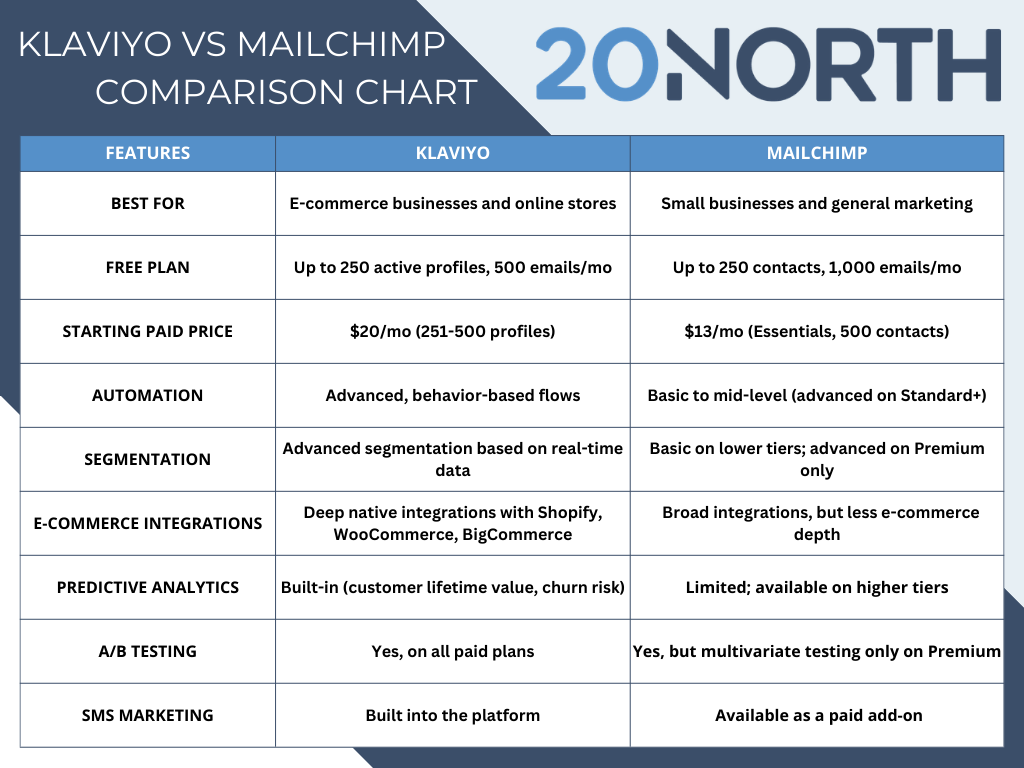
At a Glance: Klaviyo vs Mailchimp
Who Is Each Platform Built For?
Klaviyo: Built for E-Commerce
Klaviyo was designed from the ground up as an email platform for e-commerce businesses. If you run a Shopify store, WooCommerce shop, or BigCommerce site, Klaviyo connects directly to your e-commerce platform to pull in real-time customer data, including browsing behavior, purchase history, and cart activity.
This makes it a powerful tool for any e-commerce brand that wants to send highly targeted messages. A Shopify merchant, for example, can set up an abandoned cart email flow, a welcome series for new subscribers, or a post-purchase sequence without needing to manually manage customer data.
Mailchimp: Built for Broad Marketing
Mailchimp started as a straightforward email campaign tool and has grown into a general-purpose marketing tool that offers landing pages, social posting, basic CRM features, and a website builder. It works well for small businesses, freelancers, nonprofits, and service-based companies that need a single platform to manage multiple marketing channels without a steep learning curve.
Automation Capabilities
Automation is one of the biggest areas where these two marketing platforms differ.
Klaviyo's Automation
Klaviyo offers advanced automation through what it calls "flows." These are behavioral email sequences that trigger based on customer actions. Common flows include:
- Welcome series for new email list subscribers
- Abandoned cart recovery emails
- Post-purchase follow-ups and review requests
- Browse abandonment messages
- Win-back flows for lapsed customers
Each flow supports conditional splits, time delays, and dynamic content, which means the emails adjust based on each customer's behavior. For example, a welcome email for someone who signed up through a product page can look different from one triggered by a homepage pop-up.
Mailchimp's Automation
Mailchimp offers automation through its Marketing Automation Flows (formerly called Customer Journey Builder). On the Essentials plan, you are limited to basic, single-step automations. Multi-step workflows and pre-built automation templates are available starting on the Standard plan ($20/mo for 500 contacts).
If you only need a simple welcome email or a basic abandoned cart reminder, Mailchimp can get the job done. On the other hand, if you are looking to build out complex, behavior-driven flows that adjust in real time, Klaviyo has a clear advantage.

Segmentation and Personalization
Klaviyo's Advanced Segmentation
Klaviyo's advanced segmentation features are one of its standout advantages. The platform lets you build segments using real-time data from your e-commerce store, including purchase frequency, average order value, product categories browsed, email engagement, and more. This advanced segmentation functionality updates automatically, so your segments are always current.
You can also use Klaviyo's predictive analytics to segment by customer lifetime value, predicted next order date, and churn risk. This level of detail allows you to send the right message to the right person at the right time without manual list management.
Mailchimp's Segmentation
Mailchimp provides basic segmentation on its lower-tier plans using tags, groups, and simple filters. Advanced segmentation based on user behavior, purchase history, and engagement patterns is only available on the Premium plan, which starts at $350/mo for 10,000 contacts. For many small businesses, this pricing puts Mailchimp's most capable segmentation tools out of reach.
Pricing Comparison
Pricing is a major factor for most businesses, so here is a side-by-side look at what each platform charges.
Klaviyo's Pricing
Klaviyo's pricing is based on the number of active profiles in your account. As of 2025, Klaviyo updated its billing model so that you pay based on your total active profile count, not just the contacts you email.
- Free plan: Up to 250 active profiles, 500 email sends/mo, 150 SMS credits/mo
- Email plan: Starts at $20/mo for 251-500 profiles
- Email + SMS plan: Starts at $35/mo for 251-500 profiles with 1,250 SMS credits
All paid plans include every feature, from advanced segmentation to predictive analytics and A/B testing. There are no feature gates between tiers, so your access to the platform's tools stays the same as your list grows. Mailchimp charges more for advanced features on higher tiers, while Klaviyo gives you everything upfront.
Mailchimp Pricing
Mailchimp pricing follows a tiered structure where the plan you choose determines which features you can access:
- Free: Up to 250 contacts, 1,000 emails/mo, basic templates, single-step automation
- Essentials: Starts at $13/mo for 500 contacts (basic A/B testing, 24/7 email and chat support, 3 audiences)
- Standard: Starts at $20/mo for 500 contacts (multi-step automation, dynamic content, send-time optimization)
- Premium: Starts at $350/mo for 10,000 contacts (advanced segmentation, multivariate testing, phone support)
One thing to watch out for: Mailchimp charges for unsubscribed contacts that are still in your account. Archived, cleaned, and deleted contacts do not count, but if you forget to clean your list, your bill can creep up.
Pricing at Scale
.png)
At smaller list sizes, the two platforms are priced similarly. As your email list grows, Klaviyo's pricing becomes noticeably higher. However, many e-commerce brands find that the added revenue from Klaviyo's advanced features, detailed reporting, and deeper automation offsets the extra cost.

Integrations
Klaviyo
Klaviyo's integration with e-commerce platforms is where it really shines. The platform connects natively with Shopify, WooCommerce, BigCommerce, Magento, and more, pulling in real-time customer and order data automatically. It also integrates with review platforms, loyalty programs, subscription tools, and customer service software.
For any e-commerce store that runs on Shopify, the Klaviyo integration is particularly strong. Data syncs in real time, so flows and segments always use the most current information.
Mailchimp
Mailchimp integration options are broad, with hundreds of third-party connections available. It connects with tools like WordPress, Squarespace, Canva, and various CRM platforms. However, Mailchimp's e-commerce integrations do not provide the same depth of behavioral data that Klaviyo pulls in. If your online store relies heavily on customer behavior tracking for email personalization, Mailchimp may fall short.
Reporting and Analytics
Klaviyo provides detailed reporting that ties email performance directly to revenue. You can see total revenue generated by each email campaign, each automation flow, and even each individual email. The platform also offers predictive analytics tools that estimate customer lifetime value and expected purchase dates.
Mailchimp offers solid reporting on open rates, click-through rates, and basic revenue tracking. Comparative reports and more advanced analytics are available on the Premium plan. For most small businesses, Mailchimp's reporting will cover the basics. For e-commerce brands that need to connect email performance to dollars, Klaviyo provides a clearer picture.
Email Design and Templates
Both platforms include a drag-and-drop editor for building emails without coding knowledge.
Klaviyo's drag and drop editor supports dynamic content blocks that change based on subscriber data. You can show different product recommendations, images, or copy depending on who is receiving the email. This is particularly useful for e-commerce brands that want to personalize every email campaign.
Mailchimp's editor is intuitive and easy to use, with a library of pre-built templates. Dynamic content is available on the Standard and Premium plans. For straightforward email campaigns that do not require heavy personalization, Mailchimp's design tools are more than capable.
Customer Support
Klaviyo provides email support on all plans and adds chat support on paid plans. The platform also offers a resource library, Klaviyo Academy with free certification courses, and a community forum.
Mailchimp's customer service varies by plan. The free plan includes email support for the first 30 days only. The Essentials plan adds 24/7 email and chat. Phone support is reserved for the Premium plan. If quick access to a support team matters to your business, factor this into your decision.
Which Platform Should You Choose?
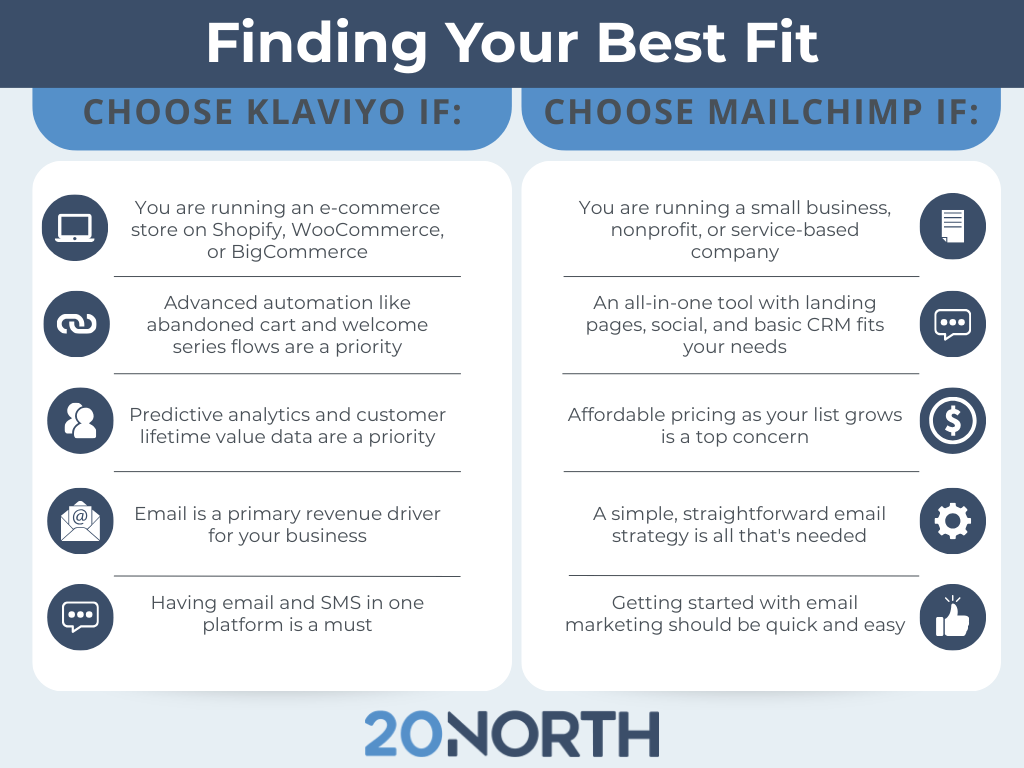
Choose Klaviyo If:
- You run an e-commerce business or e-commerce store on Shopify, WooCommerce, or BigCommerce
- You need advanced automation flows like abandoned cart, welcome series, and browse abandonment
- You want predictive analytics, customer lifetime value data, and advanced segmentation
- Email is a primary revenue channel for your business
- You plan to combine email and SMS marketing in one platform
Choose Mailchimp If:
- You run a small business, blog, nonprofit, or service-based company
- You need a general-purpose marketing tool with landing pages, social posting, and basic CRM
- Your budget is tight and you need affordable pricing plans at scale
- Your email strategy is straightforward and does not require behavior-based automation
- You are new to email marketing and want an easy-to-use email platform
The Bottom Line
Both Klaviyo and Mailchimp are solid email marketing platforms, but they are built for different types of businesses. Klaviyo is the preferred choice for e-commerce brands that want to turn email into a revenue-driving channel through advanced automation, deep segmentation, and predictive analytics. Mailchimp works well for small businesses that need a budget-friendly, all-in-one marketing tool with a low barrier to entry.
If you are an e-commerce brand looking for help choosing, setting up, or managing your email marketing platform, 20North can help. As a Klaviyo Silver Master Partner, our team builds custom email strategies, implements high-converting automation flows, and continuously optimizes campaigns to drive measurable results. Get in touch to learn how we can help grow your email marketing revenue.
.png)
.png)
.png)