

The Short Answer: To optimize content for AI Overviews, structure your pages with clear headings, lead with direct answers, and target question-based long-tail keywords that match user intent. Google's AI pulls from well-structured content on pages that already rank well and demonstrate real expertise.
Google's AI Overviews have changed the search landscape. Instead of just scanning a list of blue links, users now see an AI-generated summary at the top of their Google search results for many queries. For content creators, digital marketers, and business owners, this shift creates a new question: how do you get your content cited in those AI summaries? This guide walks through what AI Overviews actually are, how Google selects content for them, and the specific content creation and optimization steps you can take for better visibility in this new layer of search.
What Are Google's AI Overviews?
Google's AI Overviews are AI-generated responses that appear at the top of Google search results for certain queries. They were introduced in May 2024 and now reach over 1.5 billion users monthly across 200+ countries. Unlike traditional featured snippets that pull from a single page, AI Overviews use generative AI (Google's Gemini model) to pull information from multiple sources and combine it into one summary.
What Triggers an AI Overview?
Not every Google search shows an AI Overview. They appear most often for:
- Informational queries like "how does solar energy work" or "what is schema markup"
- Question-based searches that start with how, what, why, or which
- Long-tail keywords with four or more words
- Multi-step queries like "how to start a small business in Georgia"
A Semrush study of over 10 million keywords found that AI Overview visibility peaked at nearly 25% of queries in mid-2025 before settling around 15-16% by November 2025. The feature appears most frequently in science, technology, and informational search categories.
AI Overviews vs. AI Mode
It is worth knowing the difference between AI Overviews and AI Mode, since both affect how your content shows up in Google search.

Both pull from web content, so optimizing for AI Overviews also helps your content show up in AI Mode and other AI-driven search experiences.
How Google Selects Content for AI Overviews
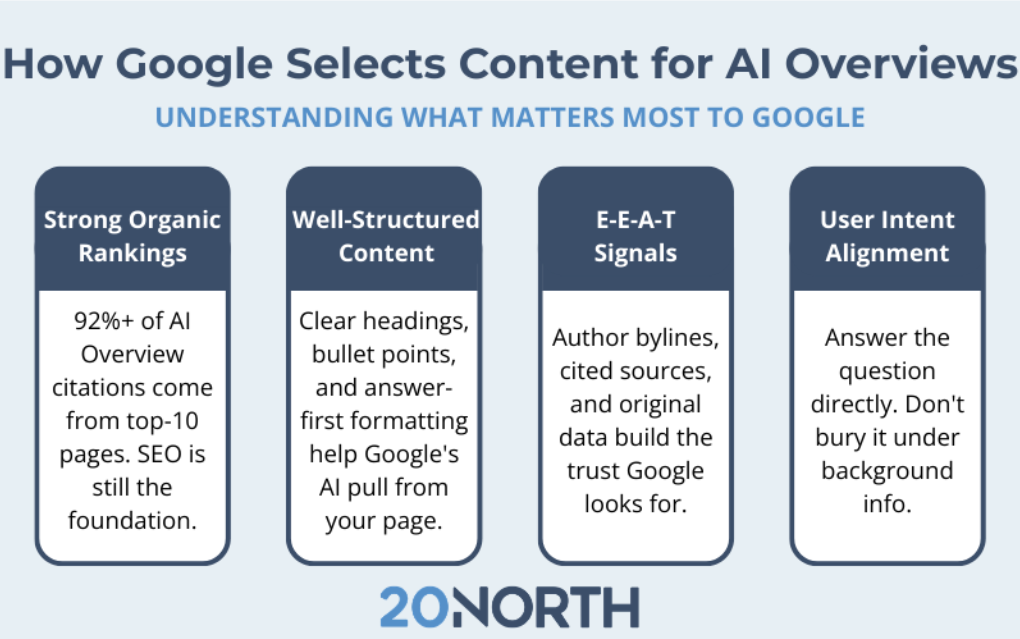
Understanding what Google looks for can help you tailor your content optimization approach. Based on available data and Google's own guidance, here is what matters most:
Strong Organic Rankings
Over 92% of AI Overview citations come from pages that already rank in the top 10 organic search results. This means traditional search engine optimization is still the foundation. If your page is not ranking well in organic results, it is unlikely to be cited in an AI Overview.
Well-Structured Content
Google's AI favors content that is easy to parse. That means clear heading hierarchy (H2s and H3s), bullet points, numbered lists, short paragraphs, and an answer-first approach where the direct answer comes before the supporting details.
E-E-A-T Signals
Experience, Expertise, Authoritativeness, and Trustworthiness (E-E-A-T) still matter. Pages with real author bylines, cited sources, original data, and demonstrated expertise are more likely to be selected for AI-generated responses.
User Intent Alignment
Your content needs to match the user intent behind the query. If someone searches "best way to improve click-through rates," your content should answer that specific user query directly, not bury the answer under paragraphs of background information.
How to Optimize Content for AI Overviews
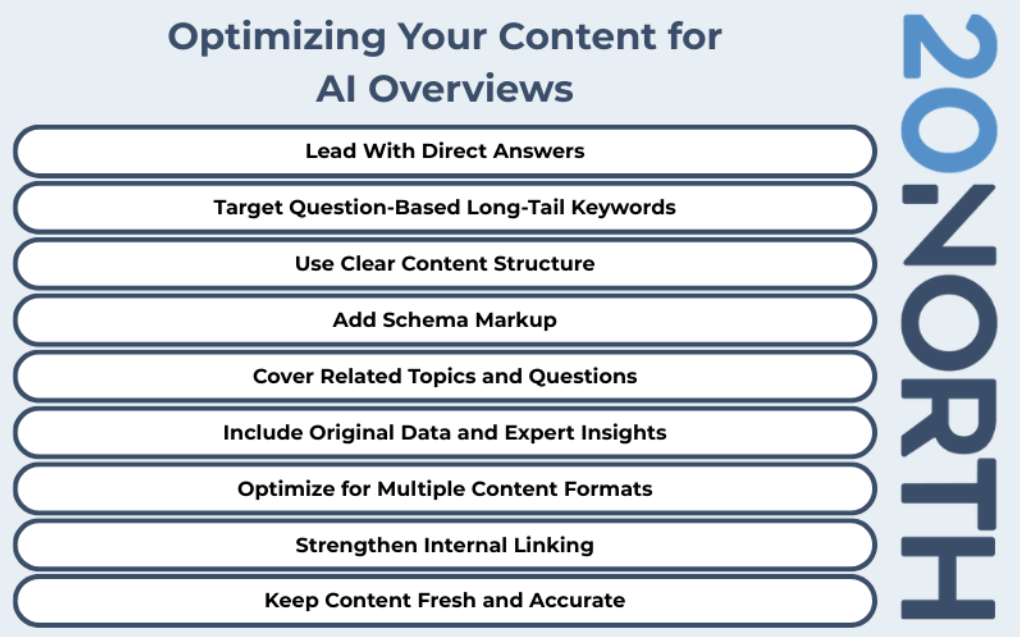
Here are the specific steps you can take to improve your chances of being cited in Google's AI Overviews.
1. Lead With Direct Answers
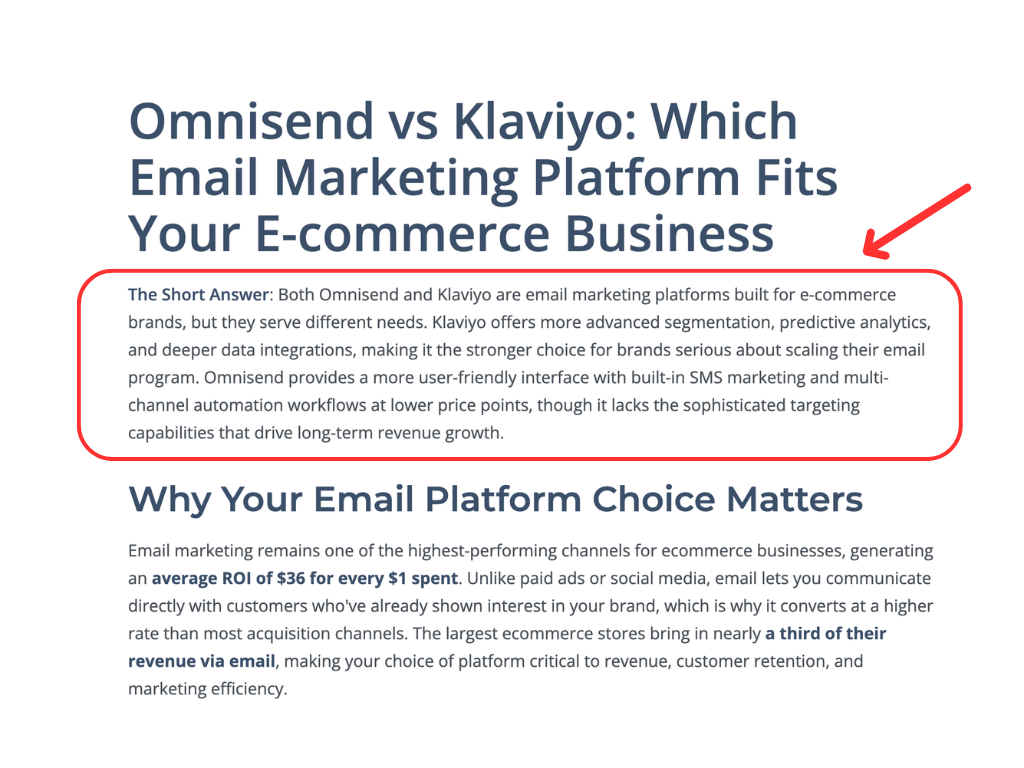
Start each section with a clear, concise answer to the question it addresses. AI systems look for content that directly resolves the user query without requiring heavy interpretation. Aim for a 50-70 word summary at the top of each section that a generative AI model could pull directly into an AI summary.
2. Target Question-Based Long-Tail Keywords
Informational queries and question-based searches trigger AI Overviews at the highest rate. Focus your keyword research on conversational phrases that match how people actually search. Instead of targeting a broad term like "content marketing," go after specific phrases like "how to create a content marketing strategy for ecommerce."
3. Use Clear Content Structure
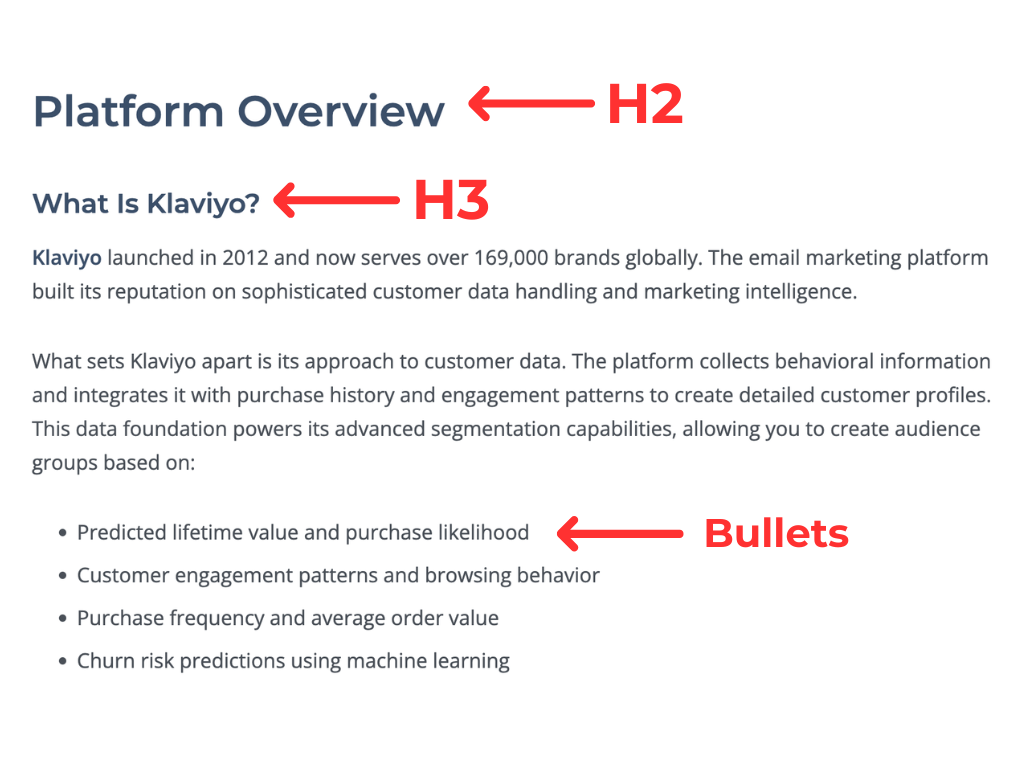
Break your content into scannable sections with descriptive headings. Use bullet points, tables, and numbered lists to organize information. This formatting makes it easier for Google's AI to identify and extract relevant content from your page. Think of it as making your blog post easy for both users and search engines to read.
4. Add Schema Markup
Schema markup helps search engines understand your content better. Pages with FAQ schema are significantly more likely to be featured in AI-generated search results. If your page answers common related questions, add FAQ or HowTo structured data so Google can identify those answers more easily.
5. Cover Related Topics and Questions
AI Overviews often pull from pages that cover a topic thoroughly. Look at the "People Also Ask" section and related questions in Google search results for your target keyword. Then address those follow-up questions within your content. This kind of topic clustering signals to Google that your page is a relevant content source on the subject.
6. Include Original Data and Expert Insights
Content that includes original statistics, proprietary research, or direct expert quotes is more likely to be cited. AI models prefer pulling from sources that offer information not widely available elsewhere. If you have performance data, survey results, or unique industry insights, include them.
7. Optimize for Multiple Content Formats
AI Overviews increasingly pull from different content types. Make sure you are optimizing across formats:
- Blog posts and articles with structured headings and direct answers
- Video content and YouTube videos with descriptive titles and transcripts
- Images with descriptive alt text and relevant file names
8. Strengthen Internal Linking
A strong internal linking structure helps Google understand the relationship between your pages and builds topical authority across your site. Link related blog posts, service pages, and resource pages together so search engines can see the full breadth of your expertise on a topic.
9. Keep Content Fresh and Accurate
Google's AI systems favor up-to-date content. Review your existing pages regularly and update statistics, dates, and recommendations. A blog post from two years ago with outdated information is less likely to be cited than a recently updated piece covering the same topic with current data.

What About Zero-Click Searches?
One of the biggest concerns with AI Overviews is the rise of zero-click searches, where users get the answer they need directly from the AI-generated summary without clicking through to any website. This is a valid concern, and it does affect organic traffic patterns for some informational queries.
While AI Overviews may not be primary traffic drivers on their own, they serve as a strong authority signal. Appearing in an AI Overview tells Google, and users, that your content is trustworthy enough to cite, and that kind of authority can lift your rankings across queries that do drive traffic and conversions.
Google has also stated that clicks from search results pages featuring AI Overviews tend to be higher quality. Users who click through are more likely to spend time on the site and engage more deeply with the content. The goal is not to fight AI Overviews but to position your content as the source they reference. Even when an AI Overview does not generate a direct click, being cited builds brand awareness and reinforces your site's authority in your space.
Tracking Your AI Overview Performance
Google Search Console started including AI Overview data in its Performance report as of June 2025. However, it does not separate AI Overview impressions and clicks from traditional organic results. To get a clearer picture, combine your Search Console data with manual sampling. Search your target keywords regularly and note whether your pages are being cited. Third-party tools from platforms like Semrush also offer AI visibility tracking that can help you monitor which of your pages are showing up in AI-generated search results.
Start Optimizing for the Future of Search with 20North
AI Overviews are not going away. Google continues to expand these features, and with AI Mode rolling out broadly, the search landscape will keep shifting toward AI-driven search. The good news is that the fundamentals of good content optimization still apply. Write well-structured content that directly answers what people are searching for, build real authority in your space, and keep your technical SEO strong.
If you want help making sure your content is optimized for both traditional search engine rankings and AI-generated results, 20North's SEO team can help. We build data-driven SEO strategies that focus on organic growth, content optimization, and staying ahead of how Google search is changing.
Reach out to talk about how your content can work harder in the age of generative search.
.png)
.png)
.png)