
What is Schema Markup in Layman's Terms? A Beginner's Guide for Business Owners

At a Glance: Schema markup is code added to your website that helps search engines understand your content and display it more prominently in search engine results pages (SERPs). It powers star ratings, FAQ answers, prices, and business details that appear directly inside Google search results. Rotten Tomatoes measured a 25% higher CTR on pages with structured data, and Nestlé saw an 82% higher CTR on rich result pages, according to Google's own case studies — and pages with schema markup are significantly more likely to be cited by AI tools like Google AI Overviews and ChatGPT. You don't need to understand the code to benefit from it; just ensure it is implemented correctly.
If you've ever heard "schema markup" in a meeting and weren't sure what it meant, you're not alone. Many business owners leave it to their SEO agency without fully understanding its importance.
That’s a mistake. Schema markup affects how your business appears in search engine results pages and whether AI platforms cite your content. It’s a clear signal to Google, but many businesses skip schema markup implementation, implement it incorrectly, or forget about it after setup. This guide explains schema markup and how to use it effectively for your website.
What Is Schema Markup?
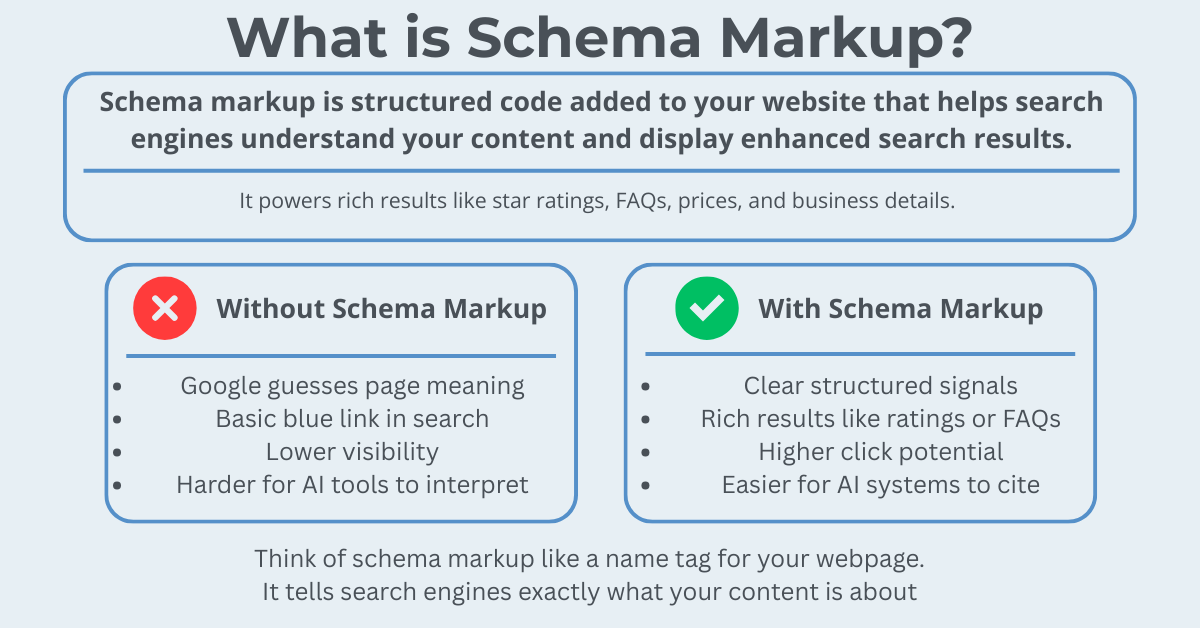
Think of schema markup as a name tag for your web page. Without it, Google guesses what your page contains. With it, you provide a structured label that tells Google exactly what your business is, where it’s located, what it sells, and what customers think. Schema markup can describe almost any entity on your site: products, services, events, articles, and more.
Developed through Schema.org, a project backed by Google, Bing, Yahoo, and Yandex, schema markup provides a standardized vocabulary so search engines recognize and understand content consistently. There are many schema types for different content, like articles, products, FAQs, and events. Choosing the appropriate schema type is key because it impacts how search engines interpret and display your content.
Schema markup is invisible to visitors and isn’t a direct ranking factor. It won’t push a weak page to the top alone. Instead, it helps search engines and AI systems understand your content better, enabling them to display it prominently and cite it confidently.
Why Is Schema Markup Important?
Adding schema markup enables rich results (or rich snippets) in search listings, which go beyond a plain blue link. These include:
- Star ratings and review counts
- Product prices and availability
- FAQ answers expandable in the listing
- Event details like dates and locations
- Business hours and contact info

Rich search results provide structured info that helps search engines understand your content deeply, improving page performance. Pages with schema markup consistently get higher click-through rates (CTRs) and longer visitor dwell times, as shown in Google case studies.
Schema markup is also crucial for AI search tools like Google AI Overviews and ChatGPT, which now answer queries directly instead of just listing links. Schema markup helps these systems interpret your content accurately, making your pages more reliable sources. Without it, AI often chooses competitor pages that are easier to understand.

If you want to know how your pages are currently performing without schema, 20North's SEO team can pull that picture together quickly.
Key Types of Schema Markup for Businesses
There are hundreds of schema markup types in Schema.org, but most businesses only need a few relevant ones. Using the right schema markup types per page is essential for effective schema markup implementation. Here are the main ones:
Organization Schema
Identifies your company: name, logo, website, and social profiles. Every business website should have this. It helps AI systems build an accurate understanding of your brand for AI-generated answers.
Local Business Schema
Provides details about a physical business: address, phone, hours. This local business markup feeds into local search engine results pages and Google Maps. It is vital for voice search queries.
Service Schema
Defines the services your business offers, including descriptions, service areas, and availability. Service schema helps search engines understand what solutions you provide and improves visibility for transactional and location-based queries.
Offer Catalog Schema
Organizes multiple products or services into a structured catalog format. Offer catalog schema is useful for businesses with complex service menus or ecommerce collections, helping search engines and AI tools interpret pricing, packages, and options more clearly.
Product Schema
For ecommerce, product schema adds price, availability, and star ratings to listings. It also supports Google Shopping and AI shopping queries.
Article Schema
Describes content pieces, including author and publication date. It helps content marketing efforts by improving AI visibility.
FAQ Page Schema
Shows questions and answers as expandable dropdowns in search listings, taking up more space and attracting attention.
Review Schema Markup
Displays aggregate star ratings under your listing. For businesses relying on social proof, star ratings in search results influence user decisions before clicking.
What Does Schema Markup Code Look Like?
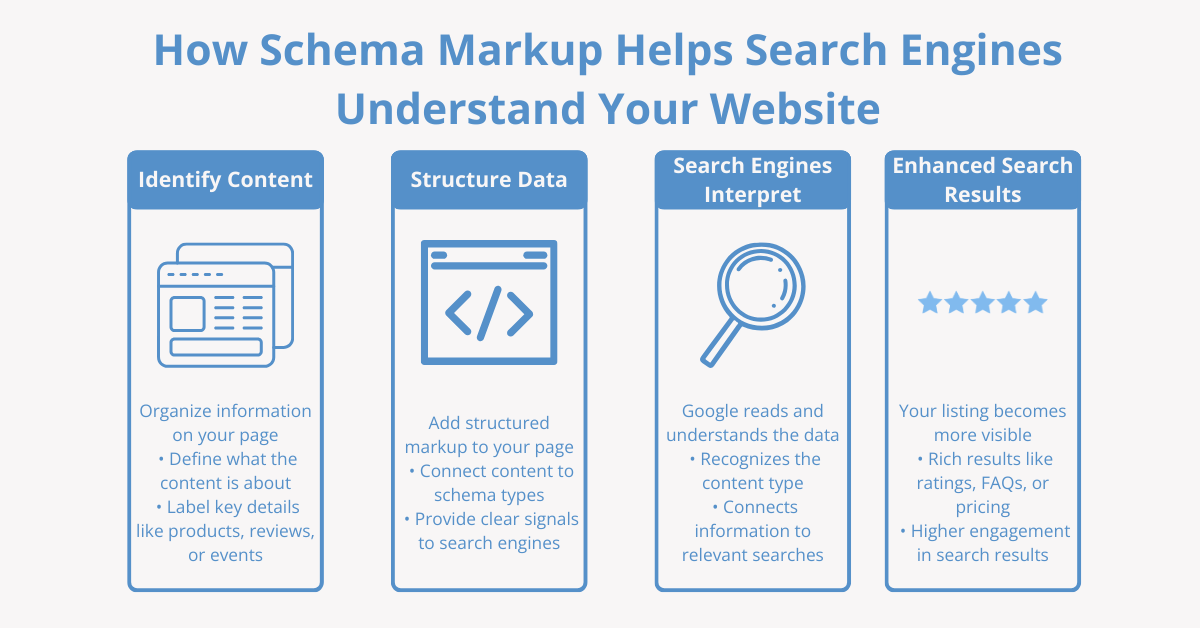
Schema markup is written in a standardized format called JSON-LD (JavaScript Object Notation for Linked Data), which Google recommends because it is easy to implement and maintain.
At its core, schema markup is structured code that highlights the most important information about a page. Instead of search engines guessing what your content means, the markup clearly labels key details like the page type, business name, price, reviews, or event date.
Here is a simplified example of what schema markup code can look like on a product page:
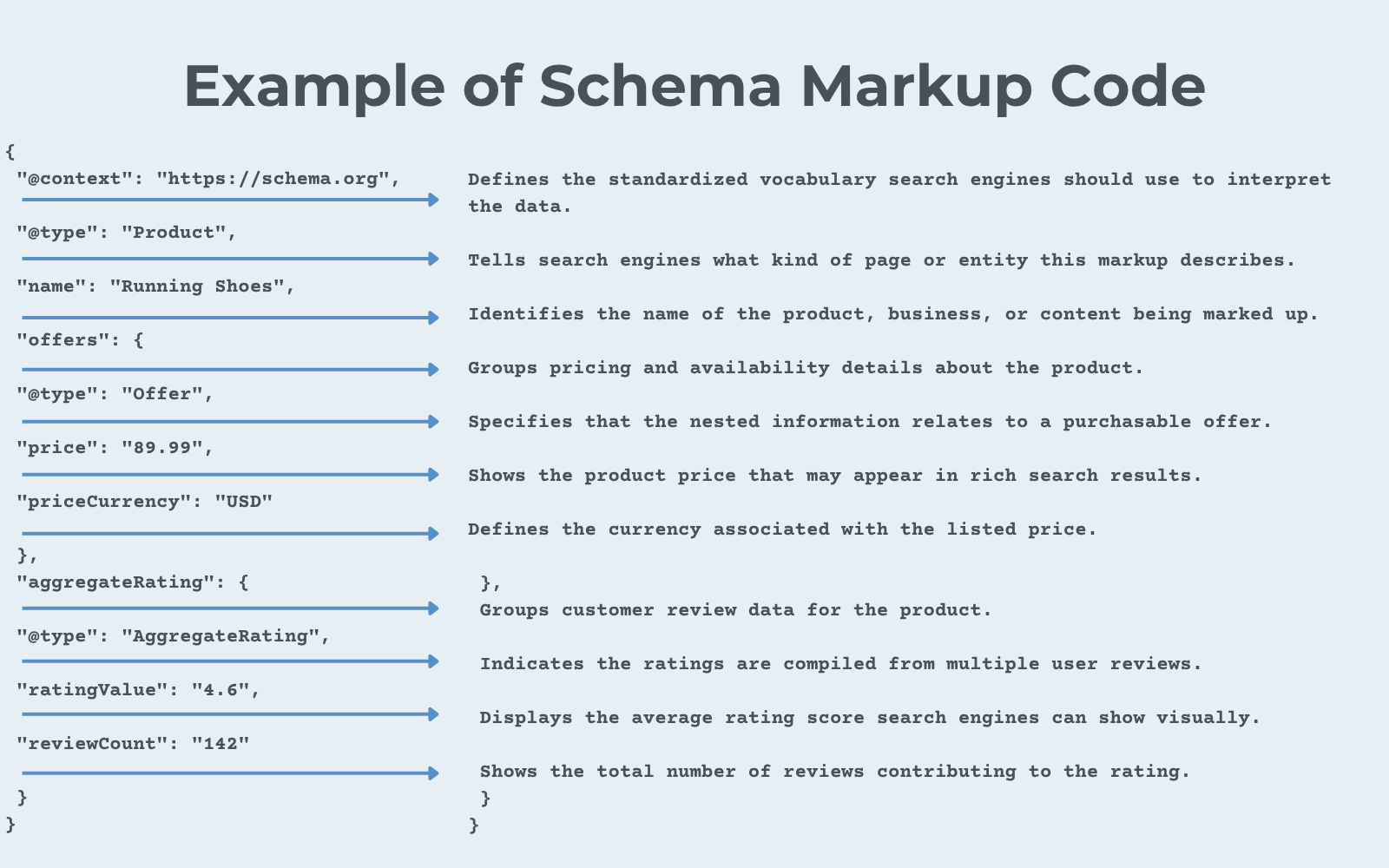
Think of schema markup as a structured summary of your page that only search engines and AI systems read. Visitors see your content normally, but search platforms use this code to confidently display enhanced search results like star ratings, FAQs, pricing, or event details.
Because the format is standardized through Schema.org, search engines can interpret structured data consistently across millions of websites. This consistency is what enables rich search results and improves how AI systems extract reliable answers.
How to Know If Your Site Has Schema Markup
You can quickly check whether your website uses schema markup with a few free tools with no technical background required.
- Google's Rich Results Test: Paste your page URL and Google will show whether structured data is detected and if the page qualifies for rich results.
- Google Search Console: Under Enhancements, view reports for each schema type detected across your site, including errors, warnings, and valid implementations. Valid means your schema is eligible to appear in rich results.
- Schema Markup Validator: Test any page or code snippet against the Schema.org vocabulary. This tool catches structural issues that the Rich Results Test may miss.
Common Schema Markup Mistakes
- Skipping schema markup entirely: Many sites have none, missing out on rich results.
- Using the wrong schema type: Mismatched schema sends conflicting signals.
- Marking up invisible content: Google penalizes markup that describes content not visible on the page.
- Setting and forgetting: Schema markup requires ongoing maintenance and updates as site content changes.
- Adding excessive schema markup: Marking up irrelevant elements, duplicating schema types, or applying structured data too broadly can confuse search engines and trigger spam policy violations.
Best Practices for Schema Markup
To get the full SEO and AI visibility benefits of schema markup, businesses should follow a few core implementation best practices:
- Choose the right schema type per page: Match schema to page content for accurate rich result display in search engine results pages.
- Mark up only visible content: Structured data must reflect what users see.
- Keep schema markup updated: Update markup as business details or content change.
- Validate regularly: Use Google’s Rich Results Test or schema markup validator before and after implementation.
- Use JSON-LD format: It’s easier to manage and recommended by Google.
- Leverage schema markup generators and plugins: Tools simplify markup creation and reduce errors.
- Monitor performance: Track visibility, click-through rates, and rich result appearances via Google Search Console and Google Analytics.
Following these ensures your schema markup work is implemented correctly, helps search engines understand your site, and boosts your chances of standing out in Google search results and other major search engines.
How to Know If It’s Working
Look for these signs:
- Increased impressions in Google Search Console’s Rich Results reports.
- Your content appears in featured snippets or AI-generated answers.
- Improved click-through rates tracked in Google Search Console and Google Analytics.
If the schema markup work is done correctly, many businesses begin seeing measurable visibility improvements within several weeks.
Schema Markup Is a Foundation, Not a Feature
Every business website should have schema markup in place. It’s essential infrastructure for search engine crawlers to interpret content and display rich results in search engine results pages. Businesses implementing schema markup as standard infrastructure show up with richer listings, earn more AI citations, and capture more real estate in SERPs over time.
If you are not sure whether your site has schema markup in place, or your current agency has not brought it up recently, that is worth a conversation. The 20North team audits schema as part of every SEO engagement and can tell you exactly where you stand and what needs to be fixed. Get in touch with our team for a free SEO Audit including a schema review here.
.png)
.png)
.png)