

The Short Answer: As SEO experts, Shopify is our #1 recommendation for e-commerce clients. Built-in features like editable meta tags, automatic sitemaps, structured data for rich snippets, and a user-friendly interface let store owners manage SEO without touching the source code. Combined with Shopify's lead in AI search and integrations across your full marketing stack, the platform sets brands up for long-term growth in a way most competitors cannot match.
Shopify's Built-In SEO Features
One of Shopify's biggest advantages is that core SEO functionality is baked into the platform for free on every plan. On most other e-commerce platforms, you pay for a third-party SEO plugin to unlock these features or simply do not have access to them. The tools are there, but turning them into real search engine performance still takes the technical work and content strategy of a dedicated developer and SEO partner.
Here is what Shopify includes:
Editable title tags, meta descriptions, and URL handles on every page.
These are what show up in Google search results and what tell search engines what each page is about. Customizing them is one of the most important on-page SEO levers for any Shopify store.
Automatic XML sitemap generation.
A sitemap is a roadmap that tells Google which pages exist on your site so they all get crawled and indexed. Shopify generates and updates this automatically as you add products, collections, and blog posts.
Automatic robots.txt file with sensible defaults.
Robots.txt tells search engines which parts of your site they should and should not crawl. Shopify ships with a clean default that protects sensitive pages like checkout while opening up the parts you want indexed.
Canonical tags on product, collection, and blog pages.
Canonical tags solve duplicate content issues that can hurt your search engine rankings. Shopify applies them automatically across product, collection, and blog pages, which is something WordPress and other open-source platforms typically require a plugin to handle.
Structured data for rich snippets and rich results.
Shopify product pages come with structured data that powers rich snippets and rich results in Google search, like the star ratings, prices, and product details that show up in listings. These visual upgrades meaningfully lift click-through rates.
Fast page speed on managed infrastructure.
Shopify hosts every store on its own infrastructure, which means page speed is generally faster than self-hosted e-commerce platforms like WooCommerce or Magento. Faster page speed helps both user experience and Google rankings, since speed is a confirmed ranking factor.
Mobile-responsive themes by default.
Mobile responsiveness is a direct ranking factor in Google's algorithm, and every Shopify theme is built with mobile-first design out of the box, while many other platforms require additional development work to hit the same standards.
Easy image optimization.
Shopify automatically serves images in modern formats and lazy-loads them, which handles a big chunk of image optimization without any extra work. You still need to add alt text manually for accessibility and SEO, but the technical side of image optimization is built in.
Built-in blog for content marketing and long-tail keyword targeting.
The blog is where you target the long-tail keywords that drive consistent organic traffic over time. Having a blog built directly into your store keeps content and product pages on the same domain, which strengthens overall search engine authority.
Automatic 301 redirects when URLs change.
When you change a product URL or remove an old page, 301 redirects send visitors and search engines to the new location without losing the SEO value of the original page. Shopify handles this automatically, while other platforms often require manual setup or a paid plugin.
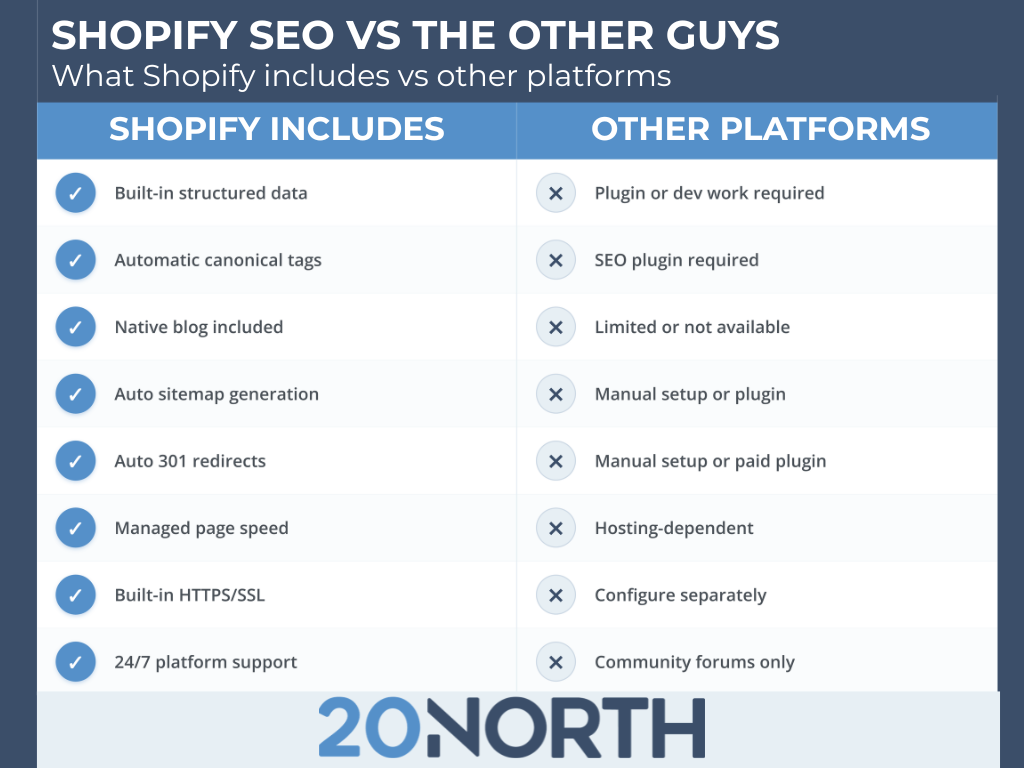
Shopify SEO vs The Other Guys
Here is how Shopify stacks up on SEO against the most common alternatives. BigCommerce, Adobe Commerce, Squarespace, and Wix round out the field alongside WooCommerce.
How Shopify Leads on AI Search and Answer Engine Optimization
AI-driven search experiences like Google AI Overviews, ChatGPT, and Perplexity are reshaping how shoppers discover products. Shopify is one of the few e-commerce platforms that has actively invested in keeping merchants visible across these new search formats, which is a differentiator over WooCommerce, Squarespace, Wix, and other alternatives.
Built-In Structured Data That AI Search Engines Read
Shopify ships with the structured data that AI search engines and answer engines use to understand and surface product information. Product schema, review schema, pricing, and availability data are all generated automatically on Shopify product pages, giving your store a stronger chance of being cited in AI-generated answers and AI Overviews. On most other platforms, this work falls to your developer or a paid plugin, and inconsistent implementation often causes AI engines to skip your products entirely.
Shopify Knowledge Base for AI Visibility
Shopify recently launched Shopify Knowledge Base, a feature designed specifically to help AI search engines understand and represent your brand accurately. Knowledge Base lets you provide structured information about your business, products, policies, and brand voice so AI assistants like ChatGPT and Perplexity have clean, accurate data to draw from. This is a significant edge over competing platforms, where merchants have no native way to communicate brand context to AI search.
A Platform That Adapts as Search Evolves
Shopify's release cadence keeps merchants in front of search trends rather than chasing them. As AI Overviews, conversational searches, and answer engines continue to grow, Shopify ships platform updates that protect merchant visibility, while open-source platforms wait on the community to catch up. For brands serious about staying visible in AI-driven search, Shopify is the platform built for what comes next.
For a deeper look at how AI search is changing e-commerce, explore 20North's AI SEO services.
Common SEO Issues to Watch For

Every e-commerce store runs into SEO issues over time. The difference between a site that ranks and one that does not usually comes down to whether someone is actively monitoring and fixing these issues. Here are the most common issues we see during Shopify SEO audits and migration audits, and exactly the kind of work 20North's Shopify SEO team handles for clients every day.
Missing or Generic Meta Descriptions
Every product, collection, and blog post needs a unique meta description. The default behavior on most platforms is to leave them blank, which lets Google generate one automatically. Custom meta descriptions almost always perform better in search results, and writing them at scale is one of the first wins our team delivers in a new engagement.
Thin Collection Pages
Collection pages without intro copy or supporting content rarely rank. Adding 100 to 300 words of unique copy at the top or bottom of every important collection page is a high-impact fix that most internal teams do not have the bandwidth to handle alongside their day-to-day work.
Unoptimized Product Pages
Product pages need keyword-rich title tags, descriptive product copy, alt text on every image, and internal links from related collections and blog posts. Skipping any of these leaves search visibility on the table. Our team builds these optimizations into a repeatable workflow so every new product launches SEO-ready instead of getting flagged in an audit six months later.
Slow Page Speed From Apps
Shopify is fast by default, but every app you install can slow your store down. Running regular page speed audits and removing apps that are not pulling their weight keeps performance strong. For stores with deeper performance issues, a Shopify migration, replatform, or theme rebuild is sometimes the cleaner fix.
Broken Internal Links
When products are deleted or URLs change, broken internal links pile up over time. Tools like Google Search Console and SEO apps surface them, and our team builds redirect maps and internal link audits into our ongoing work so issues get caught before they impact rankings.
Missing Structured Data on Custom Pages
Shopify includes structured data on standard product and collection pages, but custom pages and blog posts often miss it. Adding structured data to every content type helps your pages earn rich results in Google search and increasingly powers visibility in AI-driven search experiences.
Quick Tips to Improve Your Shopify SEO Today

- Set up Google Search Console and Google Analytics. You cannot improve what you cannot measure.
- Do real keyword research before writing. Write product copy and blog posts around what people actually search for.
- Edit every meta tag. Title tag and meta description on every page. No exceptions.
- Build internal links from blog posts to product and collection pages. This passes authority where it matters.
- Encourage product reviews. They feed structured data, build trust with potential customers, and help with rich snippets in search results. Email marketing is one of the best channels for sending review requests after a purchase.
- Audit page speed quarterly. Apps and themes change. Speed drifts.
- Use AI tools carefully for content. AI is great for outlines and ideas but can produce thin, generic copy if you publish it raw.
Is Shopify the Best CMS for E-commerce SEO?
The answer is simply yes. Between built-in SEO, AI search readiness, fast performance, and a clean user experience, Shopify is the right balance of capability and ease of use for brands that want to focus on growth instead of infrastructure.
How Shopify Supports Your Entire Marketing Stack
The case for Shopify gets even stronger beyond SEO. Every piece of your marketing stack works together on Shopify instead of fighting each other, giving you the foundation for SEO, CRO, email, paid media, and operations in one place.
Conversion-Focused Themes Out of the Box
Shopify themes are designed around proven e-commerce conversion patterns, with clear product pages, fast checkout flows, and mobile-first layouts that convert well from day one. Once your traffic is dialed in, Shopify CRO turns those themes into structured A/B testing programs that lift conversion rate over time.
The Best Klaviyo Integration in the Industry
Klaviyo, the leading email marketing platform for e-commerce, was built around Shopify's data architecture. The native integration syncs customer data, purchase history, and cart activity in real time, powering automation and segmentation that competing platforms cannot match. Shopify brands running Klaviyo consistently see email become one of their top revenue channels.
Strong Performance for Paid Ads
Shopify's clean URL structure, fast page speed, and built-in conversion tracking make it one of the easiest platforms to run Google Ads and Meta Ads on. The result is better-performing campaigns and a higher return on every ad dollar.
Tight App Ecosystem for Everything Else
The Shopify App Store covers reviews, loyalty, subscriptions, shipping, and dozens of other categories with apps that plug cleanly into your store. The depth of the ecosystem is why brands stay on Shopify long-term: the platform grows with your business.
Get More Organic Traffic to Your Shopify Store with 20North!
Wherever you are in your Shopify journey, we'd love to help you take the next step.
If you're already on Shopify but not seeing the organic traffic and revenue you expected, we can run a free Shopify SEO audit with actionable recommendations you can act on right away.
For brands running on another platform and weighing a switch, our Shopify Plus development team handles migrations carefully, protecting your existing rankings rather than resetting them.
And if you're launching something new and need a development partner from day one, 20North can build the foundation that makes long-term Shopify SEO and e-commerce growth possible.
Get in touch to talk through where your store stands and where you are leaving money on the table.
.png)
.png)
.png)