
.png)
The Short Answer: To optimize product pages for AI Overviews, give AI systems clear, structured information they can pull, like specific product descriptions, Product schema markup, an FAQ, a comparison table, and real customer reviews. Pages that are easy for machines to read and trust are the ones AI Overviews cite and recommend.
Google AI Overviews now answer shopping questions at the top of search results, often before a shopper clicks anything. When someone asks for the best option in your category, Google pulls product details straight from pages it can read and trust. That makes product page SEO about more than search rankings.
Why Product Pages Matter for AI Overviews
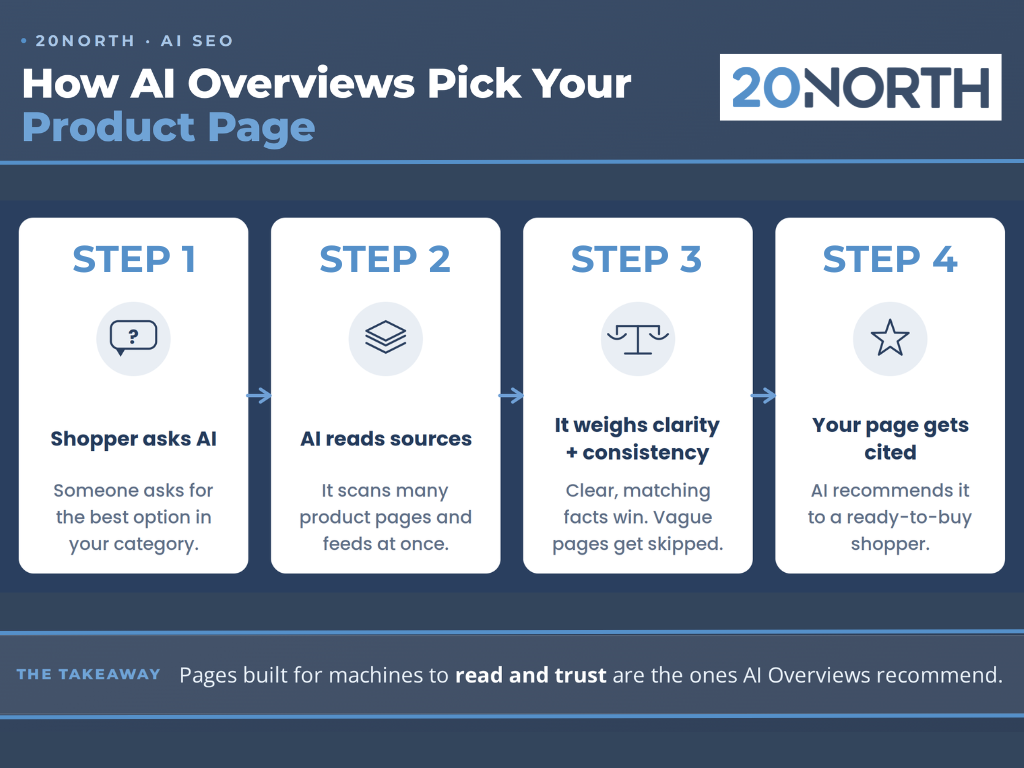
AI Overviews do not rank a single page the way a normal search result does. They read many sources, pull the clearest facts, and build one answer. Your product page needs to give those facts in a form AI can use or it will get skipped for a competitor.
Two things decide whether your page makes the cut:
- Clarity: Can a machine quickly tell what the product is, who it is for, and what makes it different?
- Consistency: Does the product name, price, and detail match across your e-commerce website, your product feed, and other sites?
If your product pages are both clear and consistent, they will become a source AI Overviews quote. That means more search visibility with potential customers who are ready to buy.
How to Optimize Product Pages for AI Overviews
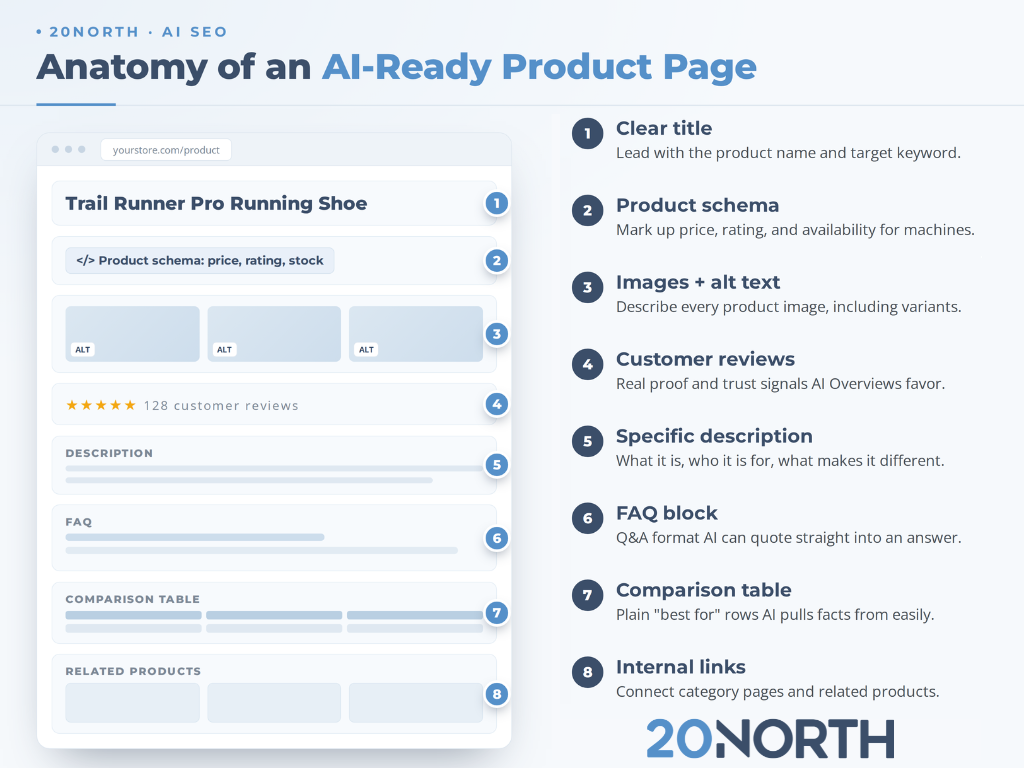
Optimizing product pages builds on normal search engine optimization. Each step makes your page easier for both shoppers and AI to read.
Write Clear, Specific Product Descriptions
Open every product description by answering four questions fast: what the product is, who it is for, what category it belongs to, and what makes it different. Use the product name and brand name naturally, work in your target keyword, and skip vague filler. AI systems reward pages that state facts plainly over pages that bury relevant information in marketing language.
Add Product Schema Markup
Schema markup is code that labels your page so machines understand it. Product schema spells out the product name, price, availability, and rating in a format AI and search engines parse with confidence. Also, add Review and FAQ schema for increased citing opportunity. Google's own product structured data guide shows the fields to include.
Answer Real Questions with an FAQ
An FAQ block is one of the highest-value spots for an AI Overview citation, because the question-and-answer format matches how people ask AI and how AI replies. Pull the questions customers actually ask from your site search, support tickets, and the "People also ask" box. Keep each answer to two or three sentences. Then mark the block up with FAQPage schema in JSON-LD, which labels each question and answer explicitly so the systems parsing your page do not have to infer the structure. That clarity is what AI systems look for when they decide what to extract and cite.
Use a Comparison Table
AI systems pull facts from tables more easily than from long paragraphs. A short comparison table helps your page get cited when shoppers compare options. Keep headers plain and specific:

"Best for" works better than clever labels because it matches the language shoppers and AI use.
Optimize Titles, Tags, and Images
Small on-page details still carry weight:
- Page title and title tag: Lead with the product name and primary keyword. Keep the meta title clear and front-loaded.
- Meta description: Write one or two plain sentences that include a long-tail keyword a shopper might search.
- Alt text: Describe each product image so AI and screen readers know what it shows.
- High-quality product images: Use clear photos for every angle and for product variants, since strong visuals support both AI shopping results and conversion rate.
Strengthen Internal Linking
Smart internal linking helps AI crawlers reach your best pages and understand how they connect. Link each product page to its category page, to related products, and to any similar product a shopper might also want. A clear internal link structure keeps priority pages from sitting buried deep in your e-commerce site, and it improves user experience at the same time.
Show Trust with Customer Reviews
AI Overviews favor pages backed by real proof. Customer reviews and other user-generated content add the trust signals AI looks for, and they often contain the natural language shoppers search with. Display reviews on the page itself so both Google and AI can read them.
Fix the Technical Basics
None of the above helps if AI cannot load your page. Watch your page speed, keep the layout clean on mobile, and make sure search engines can crawl every product page. These are standard best practice items, but they determine if your work gets seen.
Pro Tip: Start small. Begin with your top 10 revenue-driving product pages. Add schema, an FAQ, and a comparison table to those first instead of trying to fix the whole catalog at once.
How to Track Product Page Performance in AI Search
You can’t improve what you don’t measure. Use these free tools to watch your progress:
- Google Search Console: Its generative AI performance reports show how often your pages appear inside AI Overviews and AI Mode. Watch impressions on your product and category pages over time.
- Google Analytics: Check referral traffic from AI platforms next to your organic traffic to see which pages bring visitors from AI search.
Turning Product Pages Into AI-Ready Pages with 20North
Optimizing product pages for AI Overviews comes down to giving AI clear, consistent facts it can trust. Write specific product descriptions, add Product schema and an FAQ, include a comparison table, show customer reviews, and tie everything together with strong internal linking. Then track impressions in Google Search Console and referral traffic in Google Analytics to see what is working. These changes help both shoppers and AI, so they lift your search engine ranking and your AI visibility at the same time.
If that feels like a lot to manage, 20North can help. Our team handles this work every day through our AI SEO services and Shopify SEO services, optimizing product pages, schema, and internal linking so your store gets found in AI search. Start with a free AI SEO audit or get in touch to see where your product pages stand.
Frequently Asked Questions
Do AI Overviews replace normal product page SEO?
No. They build on it. The same clear content, schema markup, and internal linking that help your Google search results also help AI Overviews cite your pages.
What is the single most important change to make first?
Add Product schema markup and a short FAQ to your top product pages. Together, they give AI clean, structured facts and a question-and-answer format it can quote directly.
How long until I see results in AI search?
It varies. Technical fixes can show up in Google Search Console within weeks, while trust signals like customer reviews build over months.
Does this work for any e-commerce platform?
Yes. The same ideas apply to any online store. Shopify, WooCommerce, and other platforms each handle setup differently, but the goals are the same.
Do I need to optimize every product page?
No. Start with your best sellers and highest-margin products. Those pages get the most searches and gain the most from a citation, so they earn the work first. Roll out to the rest of your catalog over time.
.png)
.png)
.png)