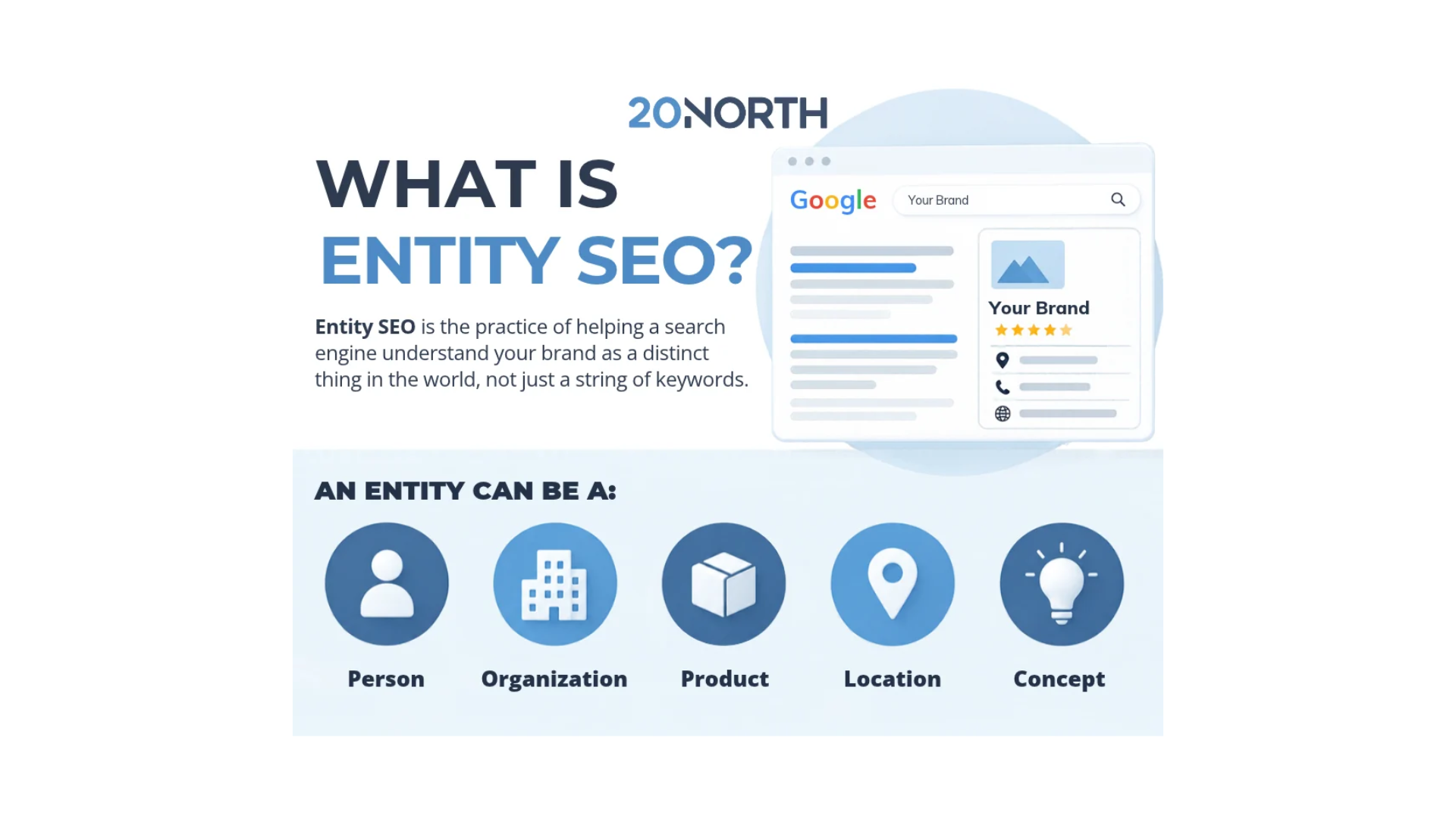
The Short Answer: Entity SEO is the practice of helping a search engine understand your brand as a distinct thing in the world, not just a string of keywords on a page. When Google recognizes your business as an entity with clear attributes and relationships, it can surface you in a knowledge panel, cite you in AI answers, and match you to the right search query with more confidence.
Search used to reward the page that repeated a phrase most convincingly. That era is fading. Google now reads the web as a network of people, places, organizations, and concepts, and it maps how those things connect. For a business, this means your visibility depends on how clearly a search engine can identify who you are, what you do, and how you relate to the topics your customers care about. Below, we break down what entities are, how Google’s Knowledge Graph works, and the steps you can take to strengthen your own entity clarity.
What Is an Entity in SEO?
An entity is a thing a search engine knows about and can tell apart from everything else. A person, a company, a product, a location, even an abstract concept can each be a separate entity. The Eiffel Tower is an entity. Your business is an entity. The service you sell is a related entity. What makes an SEO entity useful is that Google assigns it a unique identifier and connects it to other relevant entities, so the search engine understands meaning rather than matching letters.
This is the shift Google described as “things, not strings.” Two people can type the same search query and mean different things, and entity recognition is how Google tells those different entities apart. When someone searches your brand name, Google needs to know whether you are the organization they want or a similarly named one three states away. Strong entity clarity removes that doubt.
How Google’s Knowledge Graph Works
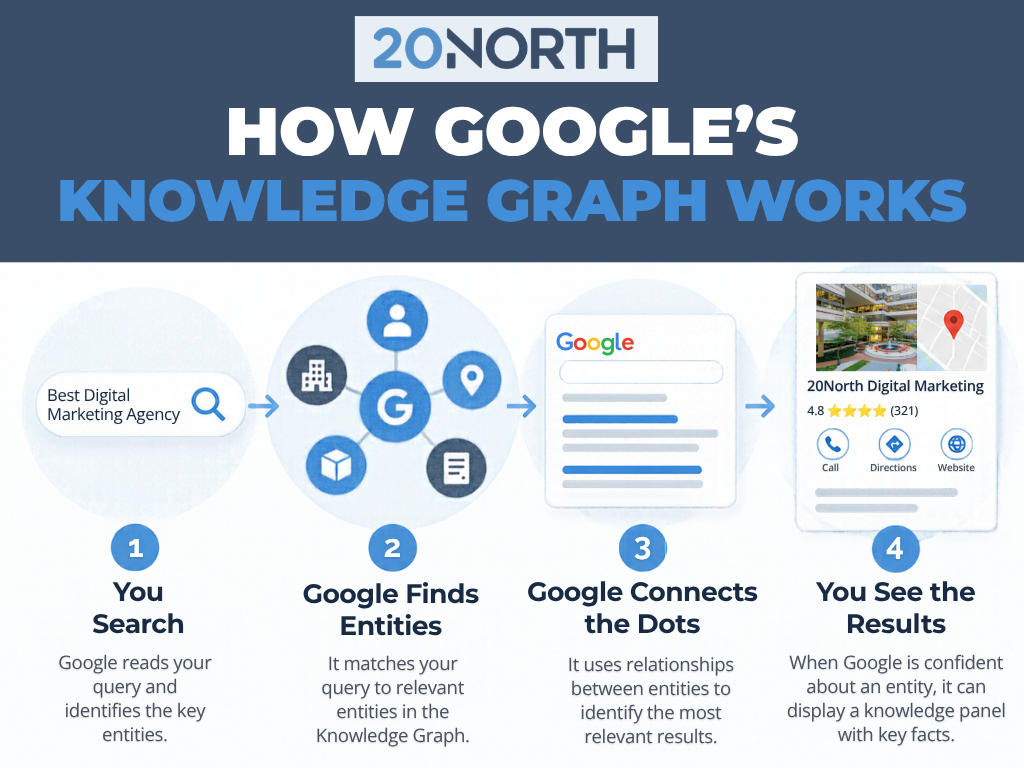
The knowledge graph is the database behind much of what you see in a search result. Google built it to store entities and the relationships that link them, then draw on that structure to answer questions. Google has said its knowledge graph holds more than 500 billion facts about 5 billion entities, a scale that lets semantic search move past single keywords and toward real understanding.
Entity Recognition and Natural Language
When you enter a search query, Google uses natural language processing to read it the way a person would. It identifies the entities in your words, works out the search intent behind them, and pulls relevant results built around meaning. This is why natural language queries now return such precise answers. The search engine is parsing concepts, not counting keyword matches.
Relationships Between Entities
A knowledge graph is valuable because of its connections. Google’s launch example linked Marie Curie to her Nobel Prizes, her husband, and her children, and each of those entities linked onward to facts of its own. Entity relationships give Google context, so it can group related topics, suggest related entities, and surface a brand in the situations where it fits.
The Knowledge Panel
When Google is confident about an entity, it can display a knowledge panel, the summary box that appears beside or above the organic search results. A knowledge panel pulls structured facts straight from the knowledge graph and signals that Google treats your brand as an established entity worth highlighting.
Pro Tip: Search your own brand name and see whether a knowledge panel appears. If one does, confirm that every fact is accurate. If none appears, that gap is a clear starting point for your entity optimization work.
Why Entity SEO Matters for Your Website
Keyword research still has its place, but it no longer carries the full weight of search engine optimization on its own. As AI answers and richer search features take over more of the results page, the brands that win are the ones a search engine can identify and trust as a separate entity. Our SEO team treats entity clarity as part of the same foundation that supports strong rankings.
Entity optimization also feeds directly into AI visibility. When answer engines build a response, they lean on well-defined entities and the relationships between them. A brand with strong entity salience and clear structured data is far easier for an AI system to cite, which is the core of generative engine optimization. Clear entities are a competitive advantage across organic search and AI search alike.
How to Optimize for Entity SEO
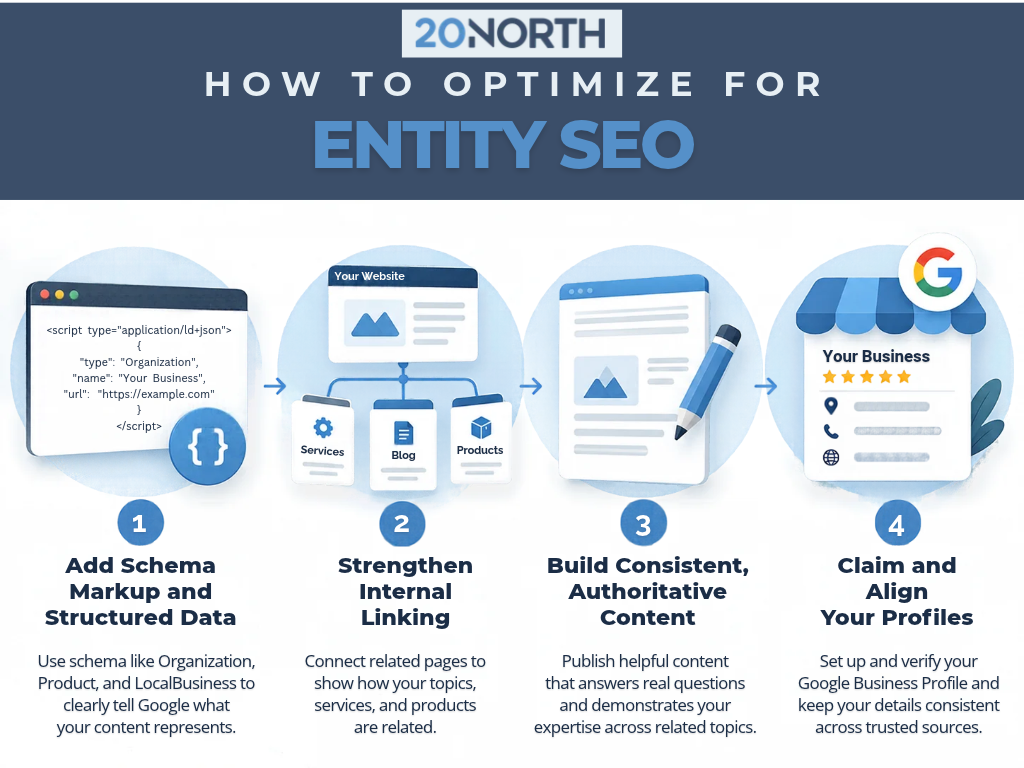
You cannot add your brand to the knowledge graph directly, but you can give Google the signals it needs to recognize you, understand you, and connect you to the right relevant topics. These steps build entity clarity across your site.
Add Schema Markup and Structured Data
Schema markup tells a search engine exactly what each piece of content represents. Organization, Person, Product, and LocalBusiness schema all help Google match your pages to the correct entity. Structured data is the clearest way to state your brand’s attributes, so the search engine does not have to guess. Our web development team builds these signals into the site structure.
Strengthen Internal Linking
Internal linking shows Google how your own entities relate to one another. When you connect a service page to the relevant blog post, and that blog post to a related product, you are mapping relationships the same way the knowledge graph does. A clear internal link structure helps the search engine understand which topics you cover and how deeply, which supports both entity recognition and a smoother user experience.
Build Consistent, Authoritative Content
Entity salience grows when your content consistently covers a subject from multiple angles. Publish content that answers real questions, states facts plainly, and demonstrates genuine expertise. The more authoritative and consistent your information, the more confidence a search engine has in surfacing your brand for relevant search results.
Claim and Align Your Profiles
Set up and verify your Google Business Profile, then keep your name, details, and description consistent everywhere your brand appears online. Matching information across trusted sources reinforces that you are one clear entity, which strengthens entity clarity and improves your website’s visibility.
Making Your Brand Understandable to Search Engines
Entity SEO comes down to a single idea. The clearer you make your brand as a distinct thing with defined attributes and relationships, the more accurately a search engine can represent you. Schema markup, structured data, internal linking, and consistent content all point Google toward the same conclusion about who you are and what you do. That clarity earns knowledge panels, better placement in search features, and citations in AI-generated answers, and it strengthens traditional organic search at the same time.
At 20North, a full-service digital marketing agency in Atlanta, we build search strategies that make brands easy for both people and search engines to understand. Explore our SEO services or reach out to our team to get started.