
.png)
The Short Answer: Schema markup for AI optimization is the practice of using structured data, specifically JSON-LD format, to help AI search engines like ChatGPT, Google AI Overviews, and Perplexity understand, verify, and cite your content. Beyond standard rich results, schema is now a direct citation-extraction signal that influences whether your page shows up inside AI-generated answers.
If you already know what schema markup is, this guide takes you to the next level. AI search engines rely on structured data more heavily than traditional search ever did, and the schema types that drive AI citations are not always the same ones that drive traditional rich results. This guide breaks down which schema types matter most for AI optimization, how to use the JSON-LD format, and how to test your work.
Why Schema Matters More for AI Search
Traditional search engines use schema to display rich results in Google search, like star ratings, recipe cards, and FAQ dropdowns. That still matters, but AI engines use schema differently.
AI search engines treat structured data as machine-readable signals that explain what your content means, who wrote it, and how it relates to other entities. These signals feed entity recognition systems that build the knowledge graphs AI models pull from when generating AI-generated responses.
Pages with well-structured content and proper schema markup show up in AI-generated answers far more often than pages without it. Schema is no longer a nice-to-have for AI visibility, it is a direct citation-extraction signal that gives your brand a competitive advantage in AI-driven search.
The JSON-LD Format
There are three ways to write schema: Microdata, RDFa, and JSON-LD format. AI systems and traditional search engines prefer JSON-LD because it sits in a clean block at the top of your page, separate from your visible content, and is easy for machines to parse.
A simple JSON-LD block looks like this:
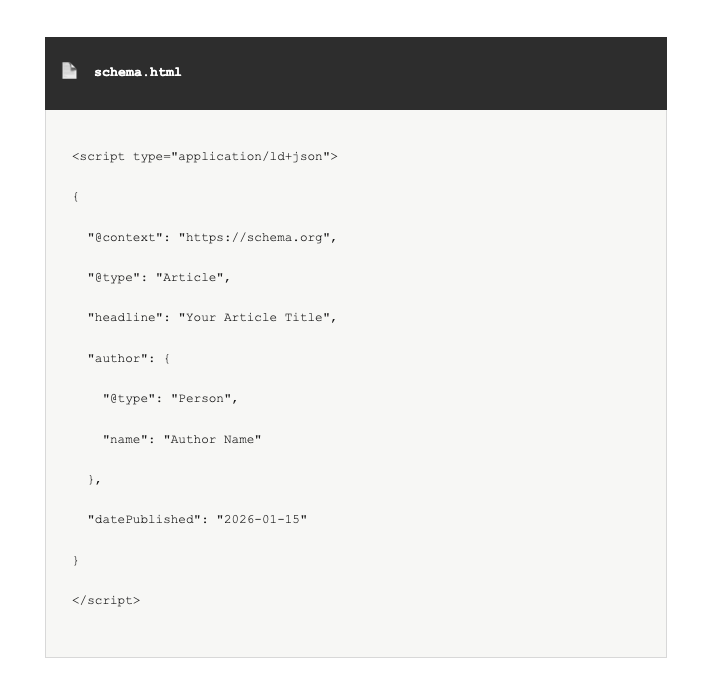
Use JSON-LD for all new structured data work. Microdata and RDFa still function, but they live inside your HTML, which makes them harder to maintain and harder for AI engines to extract cleanly.
Schema Types That Drive AI Citations
Article Schema
Article schema (and its variants like NewsArticle and BlogPosting) tells AI engines that your page is editorial content, who wrote it, when it was published, and what topic it covers. AI models cite content with article schema more often because they can verify the date, author, and subject without guessing.
Use article schema on every blog post and editorial page. Include fields for headline, author (linked to a Person schema), date published and date modified, publisher (linked to Organization schema), image, and description.
FAQPage Schema
FAQ schema (technically called FAQPage schema) marks up frequently asked questions and their answers. AI assistants love this format because it matches the question-and-answer structure they already generate. FAQPage schema has one of the highest ai citation rates of any schema type because every Q&A pair is already shaped like an AI-generated answer.
Use FAQPage schema on product pages, service pages, pillar content, and blog posts that include common questions. Only mark up real, visible Q&As, not hidden ones.
Organization Schema
Organization schema tells AI engines who you are as a brand. It feeds entity recognition and helps AI platforms connect your content to your business across the web. Add Organization schema to your homepage or About page and include legal name, logo, social profiles (using the sameAs property), contact info, and address.
Person Schema
Person schema marks up author profiles. AI engines use Person schema to verify who wrote a piece of content, which feeds E-E-A-T signals. Pair Person schema with article schema for the strongest results.
Product Schema
Product schema marks up items for sale, including price, availability, and reviews. For e-commerce brands, Product schema drives AI citations for shopping-related queries on ChatGPT, Google AI Mode, and Perplexity shopping features.
How AI Engines Use Schema
AI engines do not just read schema for rich results. They use it to:
- Confirm what your page content is about
- Verify who wrote it and when it was published
- Check if the content matches the markup
- Add your brand to their entity graph
- Decide whether to cite you in an AI Overview or other AI-generated response
Mismatched schema can hurt you. If your article schema says the publish date is 2026 but the page shows 2024, AI engines flag the inconsistency and may pull from a more trustworthy source instead.
Testing Your Schema
Before any schema goes live, test it. Two reliable tools:
- Google's Rich Results Test validates if Google can read your markup and shows what rich result types you qualify for in Google search.
- Schema.org Validator performs stricter type-checking against the full Schema.org vocabulary.
For AI specifically, also confirm that your schema is in the server-rendered HTML, not loaded by client-side JavaScript after the page loads. AI crawlers often cannot see JavaScript-rendered schema. If the markup isn’t in the source code, it doesn’t count.
Common Schema Mistakes That Hurt AI Citations
A few patterns hurt AI optimization efforts:
- Adding Product schema to blog posts. Use article schema for editorial content.
- Marking up content that does not exist on the page. AI engines treat this as a trust violation.
- Skipping author markup. Without Person schema, AI engines often cannot identify an author at all.
- Forgetting to update dateModified. Stale dates suggest stale content and lower citation rates.
- Stuffing irrelevant schema types onto pages. More is not better. Use only the schema types that match what is actually on the page.
A Quick Schema Checklist for AI Optimization
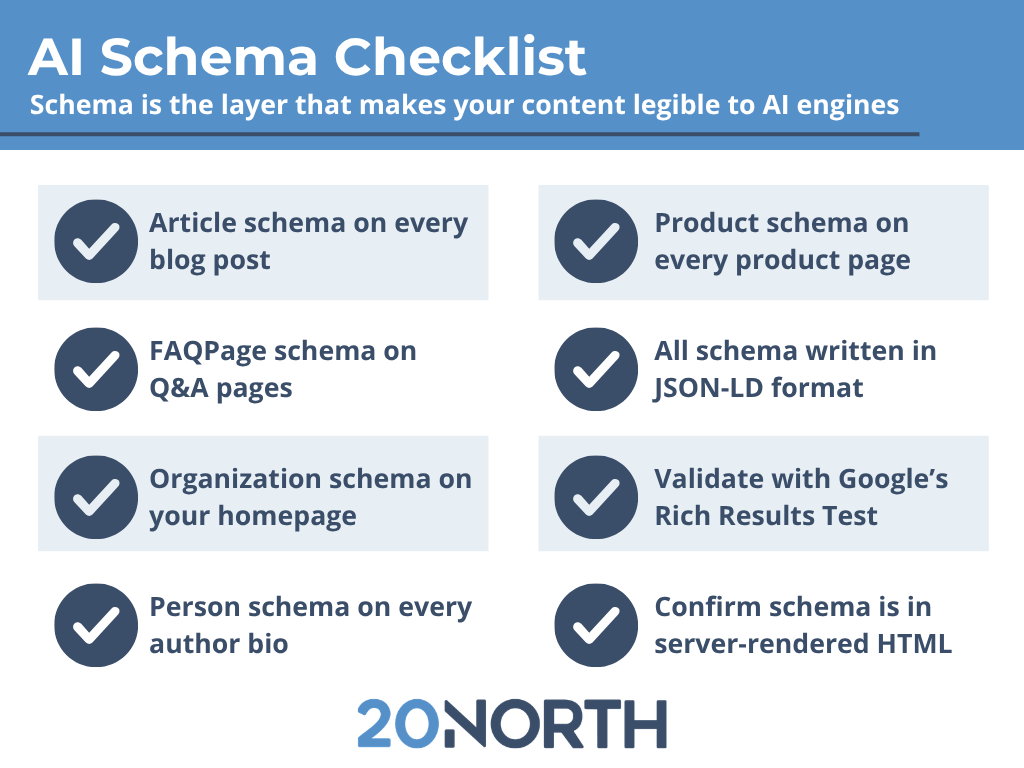
Run through this list to cover the basics of schema markup for AI optimization:
- Article schema on every blog post and editorial page
- FAQPage schema on pages with real Q&A content
- Organization schema on the homepage
- Person schema on every author bio
- Product schema on every product page (for e-commerce)
- All schema written in JSON-LD format
- Every page validated through Google's Rich Results Test
- Schema confirmed visible in the server-rendered HTML
- DateModified updated whenever the page content changes
Schema as Part of a Bigger AI Optimization Strategy
Schema is one piece of an AI optimization strategy. To get cited in AI-generated answers, you also need high-quality content that directly answers user questions, topical authority across related web pages, E-E-A-T signals from real authors, and strong brand mentions across trusted sites. Schema makes all of these signals legible to ai-powered search engines. Without it, AI systems have to guess at meaning, and they often guess wrong.
Schema also overlaps with generative engine optimization (GEO) and answer engine optimization (AEO). All three disciplines depend on giving AI engines clean, structured, trustworthy data they can pull into AI-generated responses.
Putting Schema to Work for AI Visibility
Schema markup for AI optimization is no longer a technical extra. AI-powered search engines depend on structured data to extract, verify, and cite content from your site. Start with the basics:
- Article schema on your blog posts
- FAQPage schema where you have questions
- Organization schema on your homepage
- Person schema on every author
Then, test everything with Google's Rich Results Test and confirm your markup matches your visible content.
If you want help auditing your schema, implementing JSON-LD across your site, and tying it back to a broader generative engine optimization and answer engine optimization strategy, the team at 20North can help. Our AI SEO services cover schema implementation, content optimization, and AI visibility tracking for brands looking for a competitive advantage in AI search.
.png)
.png)
.png)