
.png)
The Short Answer: GEO, or Generative Engine Optimization, is the practice of optimizing your content so AI tools like ChatGPT, Google AI Overviews, and Perplexity use it when generating answers for users. It works alongside traditional search engine optimization to help your brand show up across both regular search results, like Google and Bing, and AI-driven search platforms.
Artificial intelligence is changing how people find information online. Instead of clicking through ten blue links, users ask AI tools for direct answers. That shift created a new digital marketing discipline called Generative Engine Optimization (i.e. GEO). This guide explains what GEO is, how it differs from traditional SEO and AEO, and how to start optimizing your digital content for AI-driven search.
What Does GEO Mean?
Generative Engine Optimization is the work of making your content easy for AI models to find, understand, and cite. Generative engines are AI platforms that produce written responses from a curated dataset of online content. When a user types a question into ChatGPT, Google AI Mode, or Perplexity, the AI engine pulls from sources it considers credible and writes a response that may include facts, paraphrases, or direct quotes from your content.
The goal of GEO is to make your brand one of those sources. Instead of competing for a position on a traditional search engine results page, you compete to be referenced inside the AI-generated response itself.
GEO vs SEO vs AEO
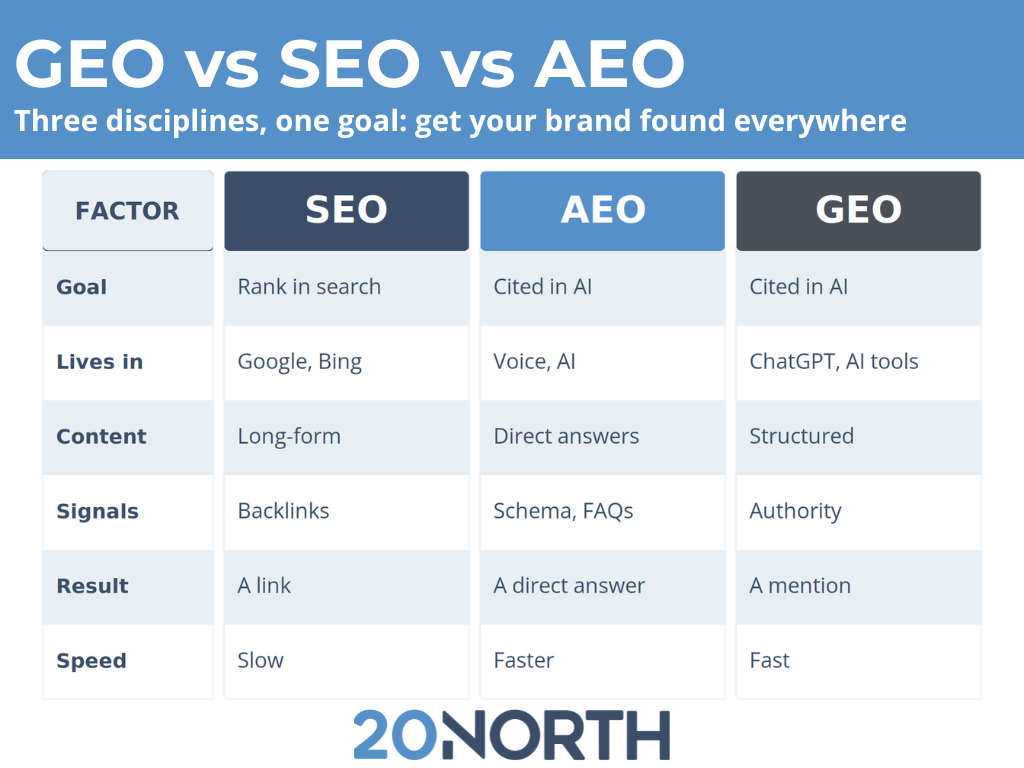
AEO and GEO overlap a lot. AEO focuses on getting cited in short, direct answers. GEO covers a wider generative experience, including longer AI-generated responses, product comparisons, and overviews.
How Generative Engine Optimization Works
Generative AI tools build responses by reading content from across the web, ranking sources, and pulling the most relevant information into a written answer. Large language models power these AI engines and decide which sources to use based on a mix of content quality, structure, and authority signals.
For your content to show up inside an AI-generated answer, AI models need to:
- Find your page in their training data or live search index
- Understand what your content is about
- Decide that your source is credible
- Pull the relevant information into the response
GEO is the work that helps each of these steps go your way. The clearer your content, the stronger your authority signals, and the better your technical setup, the more likely an AI tool will use you when generating an answer.
GEO Best Practices
Strong GEO is a mix of content quality, technical structure, and off-site authority. A few core best practices:
Lead with the answer
Open every page with a clear, concise answer to the main question (typically 40-60 words). AI tools often pull this opening directly into their generated responses.
Use structured content
Break content into short paragraphs, headers, and bullet points. AI models parse structured content faster and are more likely to cite well-organized pages over walls of text.
Add schema markup
Schema markup tags help AI engines understand what each piece of content means. FAQ, Article, How-To, and Product schemas all help. Schema.org is the official reference.
Build topical authority
AI models reward sites that go deep on a topic. Publish multiple related pages, link them together, and treat each topic as a content cluster.
Show E-E-A-T signals
Experience, expertise, authoritativeness, and trust (E-E-A-T) signals matter. Author bios, original data, case studies, and credentials all signal credibility to AI engines and large language models alike.
Earn mentions from external sources
AI models look at how often your brand is mentioned on other trusted sites. Press releases, podcast appearances, guest posts on industry publications, and quotes from industry experts all build the kind of authority that drives AI citations. Mentions on Reddit, LinkedIn, and Wikipedia also help, since AI models look for cross-source agreement before citing a brand.
Use original data and research
When you publish surveys, statistics, or original research, AI tools have something unique to pull from. Curated dataset entries and proprietary data get cited more often than generic opinions from a content creator who reuses common facts.
Format for skimming
AI tools and human readers both prefer short paragraphs, bullets, and clear subheads. The format of your digital content matters as much as what it says.
Why GEO Matters for Your Business
AI-driven search is changing user behavior fast. People who used to type a query into Google and click through results now ask AI tools for direct answers. If your brand does not show up in those AI-generated responses, you lose visibility, even when your traditional search rankings are strong.
GEO matters because:
- AI tools answer more search queries every month
- AI-generated responses often appear before traditional search results
- Brand awareness now happens inside AI answers, not just on search engine results pages
- Decision makers ask AI platforms for vendor recommendations before they ever visit a website
Small businesses and large brands have a real opportunity. Smaller brands can earn AI citations by going deep on a niche topic, while bigger brands can use their existing authority to dominate broader user queries.
Common Misconceptions
A few myths come up around GEO:
- "GEO replaces SEO." It does not. Traditional search is still where most click-through traffic comes from. GEO works alongside SEO, not in place of it.
- "Only big brands can win at GEO." Small brands often win on specific topics where their depth of knowledge beats generic content from larger competitors.
- "GEO is just FAQ pages." FAQ format helps, but GEO covers content structure, schema, source credibility, and brand mentions across the web.
- "You cannot measure GEO." You can. Tools like Profound, Otterly, and Semrush track how often answer engines and generative AI tools cite your brand.
Putting GEO to Work for Your Brand
Generative Engine Optimization is no longer optional. As AI tools handle more search queries, your content needs to show up inside their generated answers as often as it shows up in traditional Google search results. Start with clear, structured content, and then layer in schema markup, build topical authority through related pages and external sources, and track which AI tools cite you.
If you want help building a digital marketing strategy that wins in both traditional search and AI-driven search, the team at 20North can audit your site and build a custom SEO strategy. Our AI SEO services blend GEO best practices with traditional SEO so your brand shows up where your potential customers search.
.png)
.png)
.png)