
.png)
The Short Answer: SEO, search engine optimization, helps your website rank in traditional search engine results, while AEO, answer engine optimization, helps your content get pulled into AI-generated answers from tools like ChatGPT, Google AI Overviews, and Perplexity. They are not replacements for each other. Most brands need both to stay visible across the full search landscape.
Search has changed faster in the last two years than it has in the previous decade. People still type queries into Google, but they also ask ChatGPT, Google Gemini, and other AI tools for direct answers. That shift created a new digital marketing discipline, AEO, that runs alongside the SEO work you may already be doing. This guide breaks down where the two overlap, where they diverge, and how to balance both without doubling your workload.
What SEO Is Built For
Search engine optimization helps your pages rank in traditional search engines like Google and Bing. The goal is a high spot on the search results page, then a click to your site. SEO has been around since the late 1990s and the core levers are well known: keyword research, backlinks, technical health, page speed, and high-quality content built around user intent. Done right, SEO drives steady organic traffic that compounds over time and supports long-term brand visibility.
What AEO Is Built For
Answer engine optimization helps your content get cited in AI-generated responses. When someone asks an AI platform a question, the system pulls from a small set of sources to write its reply. AEO is the work that makes your content one of those sources. Instead of a ranked link, you get a brand mention, a paraphrased fact, or a direct quote inside an AI-generated answer. AEO matters more every day as AI-driven search keeps growing.
AEO vs SEO: The Side-by-Side Differences
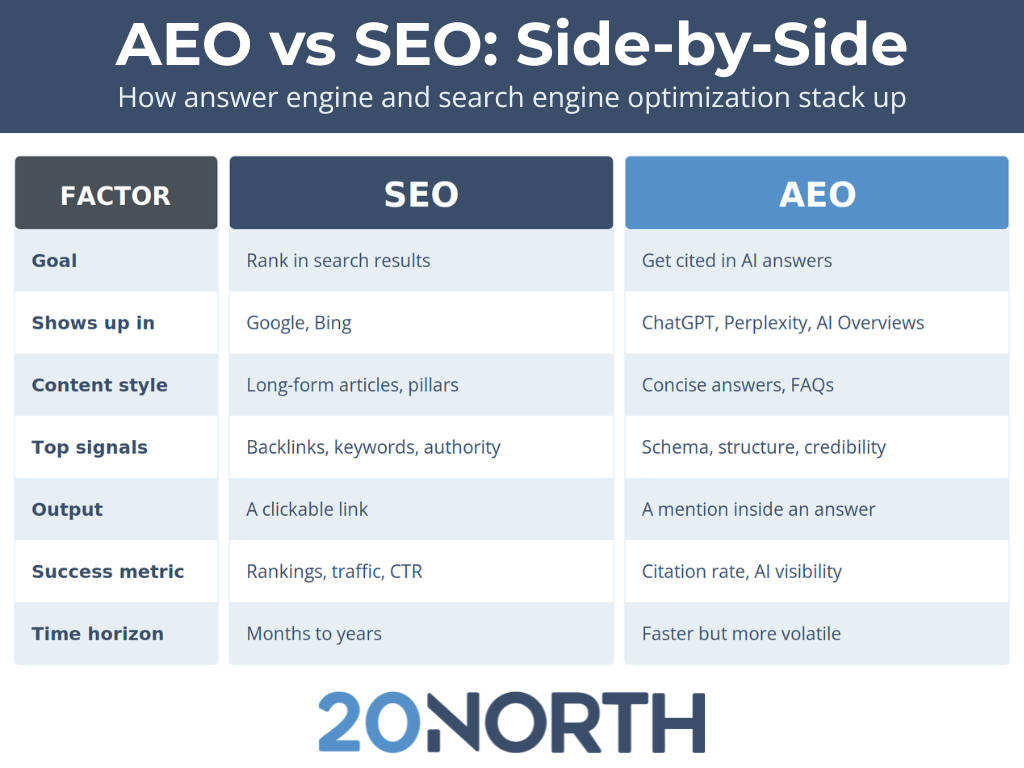
Where AEO and SEO Overlap
A lot of solid SEO work doubles as AEO work with no extra effort. High-quality content, clear writing, and topical authority help you rank in Google search results and get cited by AI models. Both disciplines reward:
- E-E-A-T signals (experience, expertise, authoritativeness, trust)
- Original data, surveys, or first-hand research
- Clean technical structure that search engines and large language models can parse
- Topic depth across related pages on your site
If your SEO foundation is shaky, your AEO performance will be shaky too. Answer engines and traditional search engines read the same web. They just use it differently.
Do You Need Both?
Yes. SEO still drives the bulk of organic traffic that brings potential customers to your site today, but AEO protects your visibility as AI-powered platforms continue to change how people search.
When to lean on SEO
- Your category gets researched through Google more than AI tools (most local services, niche B2B)
- You sell through e-commerce and need product pages to rank
- You rely on long-form blog content to nurture leads
- Most of your traffic comes from informational or transactional Google queries
When to lean on AEO
- Your buyers ask ChatGPT, Gemini, or Perplexity for recommendations
- You compete in a category where AI Overviews appear often (SaaS, finance, B2B services)
- Voice search drives a real share of your traffic
- You want brand mentions inside AI-generated responses, even without clicks
Almost every brand falls somewhere between these. The right mix depends on your industry and your customers' habits.
You may also hear the term generative engine optimization (GEO) used in the same conversation. GEO is closely related to AEO and often used interchangeably. The slight distinction: AEO emphasizes direct, concise answers, while generative engine optimization focuses on content being included in longer AI-generated summaries. For most teams, the tactics overlap heavily.
How to Balance Both in Your Content Strategy
You don't need two separate teams or two content calendars. A few practical moves let SEO and AEO support each other.
Open every page with a direct answer
Lead with a clear answer in 40-60 words, then go deep below. Google rewards this format for featured snippets and AI tools pull from it for instant answers.
Use schema markup wherever it fits
FAQ, How-To, Article, Product, and Organization schemas help both classic search and AI platforms understand your content. Schema.org is the official reference.
Structure content for scanning
Use H2s and H3s, short paragraphs, and bullet points. Human readers and large language models both digest structured content better than walls of text.
Pair keyword research with question research
Map traditional keywords next to the user questions people ask AI tools about your topic. Write so one piece of content satisfies both at once.
Build third-party signals
Mentions on Reddit, LinkedIn, Wikipedia, and trusted publications boost AEO performance because AI models look for cross-source agreement before citing a brand. These signals also support classic SEO authority.
Track both kinds of visibility
Monitor your Google search rankings the way you always have. Run monthly checks in ChatGPT, Gemini, and Perplexity to see if your brand shows up for the user queries that matter most to your business.
Common Misconceptions
A few myths come up often:
- "AEO replaces SEO." It does not. Google still drives most search traffic and AI tools often source from pages that already rank well.
- "AEO is just FAQ pages." AEO covers content structure, schema, source credibility, and brand mentions across the web. FAQs are one piece, not the whole picture.
- "You can't measure AEO." You can. Tools like Profound, Otterly, and Semrush track AI citation specifically.
- "Only big brands can win at AEO." Small and mid-sized brands often have an edge because they can move faster and own niche topics that big brands ignore.
Putting AEO and SEO to Work Together
AEO and SEO are two sides of the same coin. SEO earns the rankings, AEO earns the citations, and the brands winning in 2026 do both. Start with strong SEO fundamentals, layer in AEO formatting and schema markup, and track visibility across both traditional search and AI search engines. The work compounds, and the pages that perform well in Google often get cited by AI tools and see their organic traffic climb.
If you want help building a digital strategy that wins in both classic search and AI-driven search, the team at 20North can audit your current online presence and build a plan that covers both. Our AI SEO services blend traditional SEO with AEO best practices so your content shows up where your potential customers actually search.
Contact 20North today to start showing up across the full search landscape.
.png)
.png)
.png)