

The Short Answer: Shopify is the better e-commerce platform for businesses focused on online sales and scaling, thanks to its robust multi-channel selling tools, massive app ecosystem, and built-in features like abandoned cart recovery and real-time shipping calculations on every plan. Squarespace is a stronger website builder for creatives and small businesses that want a beautiful design with basic selling capabilities, offering polished templates and an intuitive drag-and-drop editor that requires little to no technical skill. The right platform depends on whether your priority is running a full online store or building a content-forward website. The right platform depends on whether your priority is running a full-featured online store or building a visually polished website with light e-commerce built in.
Both Shopify and Squarespace let you sell products online, but they approach e-commerce from different angles. Shopify was built for online retailers from day one, while Squarespace started as a design-focused website platform and added e-commerce features over time.
When determining which platform fits your business, it comes down to analyzing these key aspects:
- Pricing
- Design Capabilities
- E-commerce Features
- Marketing Tools
- Available Integrations
- Business Support
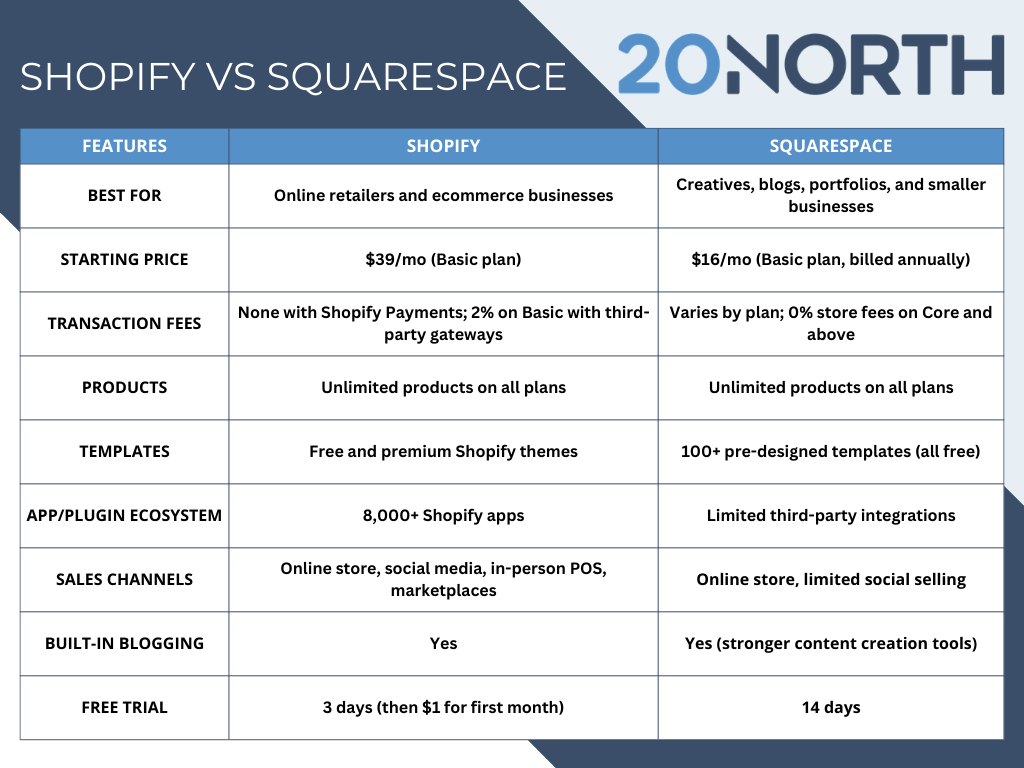
At a Glance: Shopify vs Squarespace Comparison
E-commerce Features
This is where the Shopify vs Squarespace comparison shows the biggest gap.
Shopify's E-commerce
Shopify was built as a dedicated e-commerce platform, and it shows. Every plan includes unlimited products, discount codes, abandoned cart recovery, and gift cards. The Shopify dashboard gives you a centralized view of orders, inventory, customers, and analytics.
Shopify also supports multiple sales channels out of the box. You can sell through your online store, Facebook, Instagram, TikTok, Amazon, Google Shopping, and in-person through Shopify POS. For online retailers looking to reach customers wherever they shop, this multi-channel approach is a major advantage.
Other standout e-commerce features include:
- Shopify Payments (built-in payment gateway with no additional transaction fee)
- Real-time shipping rate calculations (on Advanced plan)
- Automated tax calculations
- Customer accounts and order tracking
- Product variants, collections, and inventory management
Squarespace's E-commerce
Squarespace now allows you to sell unlimited products on all plans, including the Basic plan. However, the e-commerce features scale up as you move through the pricing tiers. On the Basic plan, you will pay a transaction fee on every sale. The Core plan removes store transaction fees and adds customer accounts. The Plus and Advanced plans add features like abandoned cart recovery, real-time shipping rates, and product waitlists.
For smaller businesses selling a limited number of products alongside content, Squarespace handles the basics well. But if your primary goal is running an e-commerce store with a large catalog, multiple payment options, and multi-channel selling, Shopify offers more depth.
Design and Customization
Squarespace Templates
Design is where Squarespace stands out. The platform is known for its polished, pre-designed templates that look professional right out of the box. Every Squarespace template is mobile-responsive, and the drag-and-drop interface makes it easy to customize layouts, fonts, colors, and spacing without writing code. For creatives, photographers, restaurants, and service-based businesses that want a professional online presence without hiring a developer, Squarespace gives you a high-quality starting point.
However, that ease of use comes with trade-offs. The drag-and-drop editor works within a grid and section system, not a freeform canvas, so getting pixel-perfect layouts is not always possible. Templates look great out of the box, but changing the underlying structure, like building custom page layouts or unique navigation patterns, can be difficult without workarounds. Mobile responsiveness is automatic, but you get limited control over how specific elements display across screen sizes.
For businesses looking to scale, the limitations become more noticeable. Managing large numbers of pages, building reusable components, and implementing deeper technical SEO patterns like structured data or templated metadata are all areas where Squarespace can feel restrictive. Advanced customization through custom CSS and JavaScript is available on the Core plan and above, but code injection can conflict with template updates and introduce responsive issues if not managed carefully.
Shopify Themes
Shopify offers both free and premium themes through its theme store. While the designs are clean and professional, they are built with e-commerce in mind, meaning the layouts prioritize product pages, collections, and checkout flows over content-heavy pages.
Shopify's drag and drop editor allows you to customize your Shopify theme without coding, but advanced customization options often require working with Shopify's Liquid template language or hiring a developer. The Shopify store does not offer quite the same level of design polish as Squarespace for non-e-commerce pages, but its templates are optimized for conversions and selling.

Pricing Plans
Shopify Pricing
Shopify offers three main plans for online stores:
- Basic: $39/mo (2.9% + 30¢ per online credit card transaction via Shopify Payments)
- Grow: $105/mo (2.6% + 30¢ per transaction)
- Advanced: $399/mo (2.4% + 30¢ per transaction)
If you use Shopify Payments as your payment gateway, there is no additional transaction fee. If you use a third-party payment gateway, Shopify charges an additional fee of 2% on Basic, 1% on Grow, and 0.6% on Advanced. All plans include unlimited products, 24/7 support, and access to Shopify apps.
Squarespace Pricing
Squarespace recently introduced updated plans:
- Basic: $16/mo billed annually (limited contributors, basic e-commerce, Squarespace Payments transaction fees apply)
- Core: $26/mo billed annually (unlimited contributors, zero store transaction fees, custom code access)
- Plus: $36/mo billed annually (lower digital product fees, more video storage)
- Advanced: $99/mo billed annually (lowest transaction fees, unlimited video hosting)
Squarespace's entry-level pricing is lower than Shopify's, which makes it attractive for smaller businesses and personal websites. However, once you add up the e-commerce features you need (like zero transaction fees and abandoned cart recovery), the cost difference narrows.
Apps and Integrations
Shopify Apps
Shopify's app ecosystem is one of its biggest strengths. The Shopify App Store offers over 8,000 apps covering everything from email marketing and SEO to inventory management, subscription billing, and loyalty programs. If Shopify does not have a built-in feature you need, there is almost certainly a third-party app that fills the gap.
This flexibility is a double-edged sword. Some features that come as built-in tools on other platforms may require paid Shopify apps, which can add to your monthly costs. But the sheer range of third-party integrations means you can build a Shopify store that fits almost any online business model.
Squarespace Integrations
Squarespace takes a more curated approach. The platform includes many built-in features like analytics, basic SEO tools, email campaigns, and social media connections. However, its library of third-party integrations is much smaller than Shopify's.
On the Core plan and above, you can connect with services like Mailchimp, OpenTable, and Zapier. But if you need highly specific tools for inventory management, advanced marketing, or specialized e-commerce workflows, Squarespace's limited integration options can become a bottleneck.

SEO and Marketing Tools
Both platforms offer basic SEO tools like customizable page titles, meta descriptions, URL slugs, and image alt text. However, there are some differences worth noting.
Shopify
Shopify provides built-in SEO features and supports blog posts for content marketing. The platform automatically generates sitemaps and handles canonical tags. For more advanced SEO needs, the app store offers specialized tools for structured data, page speed optimization, and search engine performance tracking.
Shopify also integrates natively with Google Analytics, Google Search Console, and social media advertising platforms, giving you multiple sales channels and marketing tools to drive traffic to your online store.
Squarespace
Squarespace includes built-in SEO tools on all plans and has a strong blogging engine that supports content creation and long-form writing. The platform offers clean URL structures, automatic sitemaps, and mobile-responsive designs that perform well for search engines.
Squarespace also offers built-in email marketing campaigns (as a separate add-on), social media integration, and basic analytics. For smaller businesses that want their marketing tools under one roof without adding third-party apps, Squarespace's built-in features provide a solid foundation.
Customer Support
Shopify
Shopify offers 24/7 support via live chat and email on all plans. The platform also provides an extensive help center, community forums, video tutorials, and Shopify Academy courses. Phone callback support is available as well.
Squarespace
Squarespace provides email and live chat support, but availability varies by plan. The platform also offers a detailed help center, community forum, and video tutorials. Phone support is not available on any plan. For business owners who prefer talking to a support agent on the phone, this could be a factor.
Picking the Right Platform for Your Business
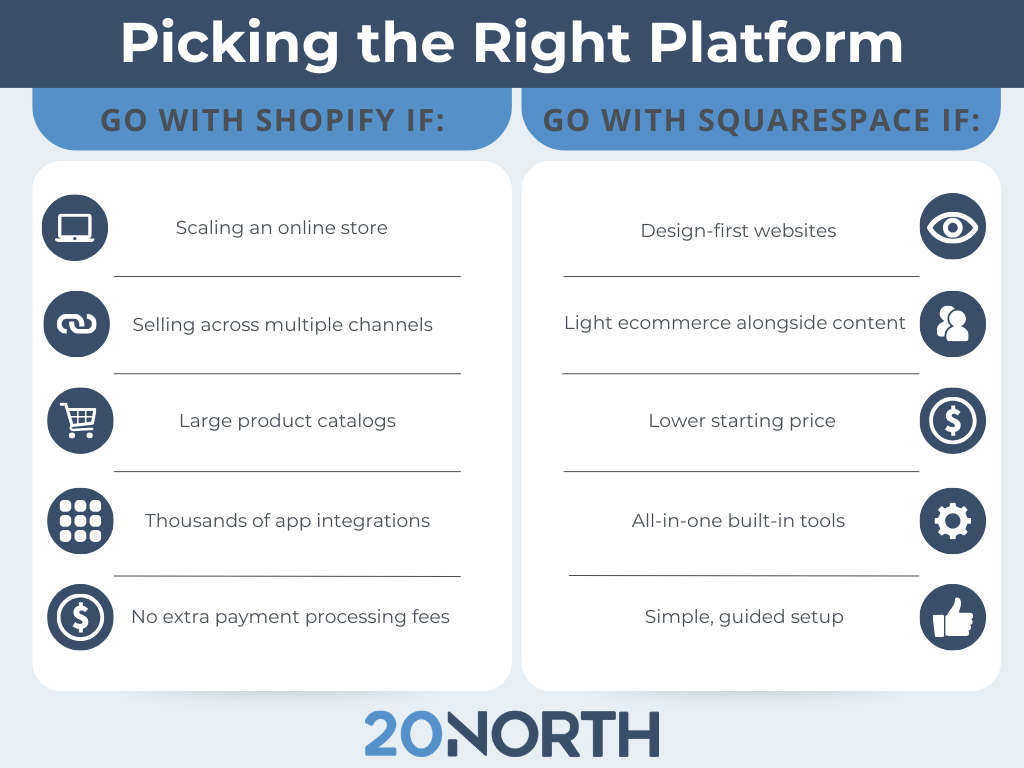
Shopify and Squarespace are both capable platforms, but they serve different purposes. Shopify is the stronger choice for e-commerce businesses that want to sell unlimited products across multiple channels, scale their operations, and tap into a massive app ecosystem. Squarespace is a better fit for smaller businesses, creatives, and service providers who want a stunning website with light e-commerce built in.
How 20North Can Help
Choosing the right platform is just the first step. Getting the most out of it is where the real work begins, and 20North can help.
20North is a Shopify Premium Partner, putting us in the top 1% of Shopify developers worldwide. Combine that with a company founded on SEO expertise, and you get a partner that can build a store that not only looks great but actually gets found. Our team specializes in Shopify SEO, custom web development, conversion rate optimization, and paid media management for online stores. As Shopify experts, we also handle full store migrations for brands moving to the platform.
Ready to get more out of your online store? Contact 20North today to talk with our team about your goals.
.png)
.png)
.png)