
Shopify vs. WordPress: Which Platform Is Right for Your Online Store?

Shopify vs. WordPress: Which Platform Is Right for Your Online Store?
The Short Answer: Shopify is a hosted platform built specifically for ecommerce, while WordPress with the WooCommerce plugin is a content management system that can add store functionality. Shopify excels at selling products. WordPress offers more customization and works better for service-based or lead generation businesses. If your business combines ecommerce with lead generation or service offerings, WordPress is likely your better option since it handles both under one roof.
The ecommerce platform you pick for your online store affects everything from how fast you can launch to how much you can grow. Shopify takes care of web hosting, security, and updates for you. It also handles payment gateway processing and inventory tracking. WordPress started as a blogging platform but grew into a content management system that powers over 40% of all websites. Add the WooCommerce plugin, and it becomes a full ecommerce store.
Understanding the Core Differences
Different Tools for Different Goals
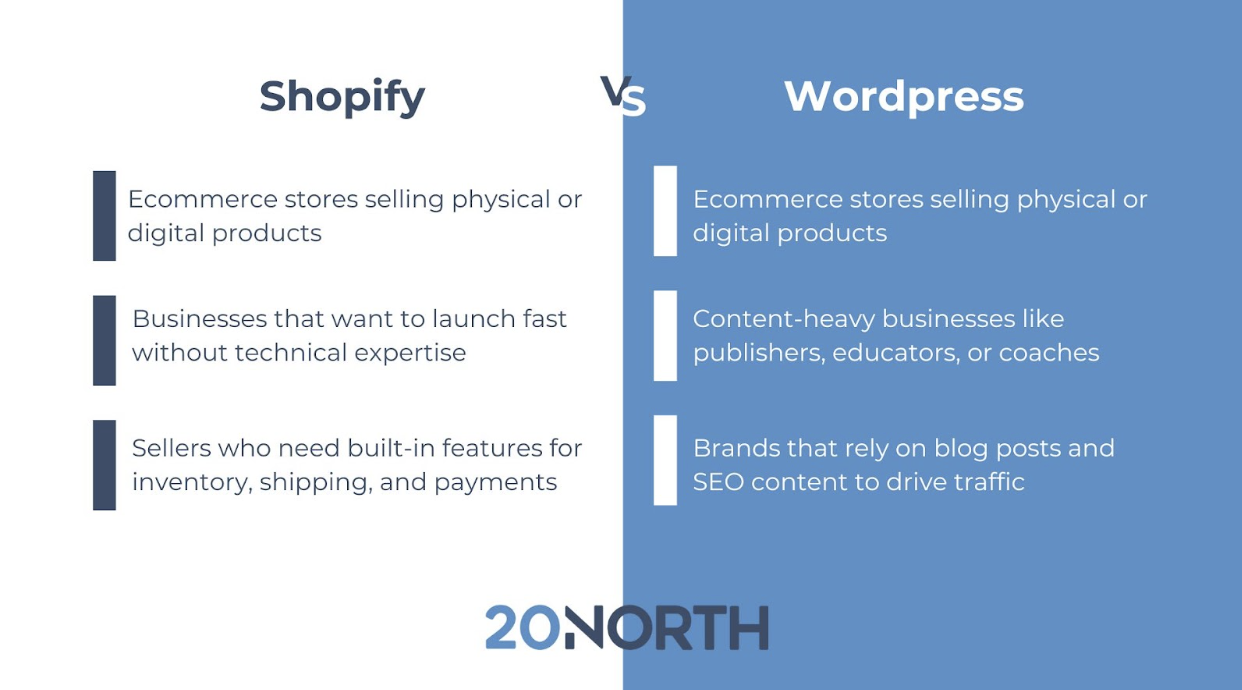
Shopify is a store first. Everything centers on selling products. If your main goal is running an ecommerce store with minimal content needs, Shopify keeps things simple. You can add a basic blog, but content creation isn't its strength.
WordPress is a content hub first. The platform was designed to publish and organize large amounts of content like blog posts, guides, and resources. When you add the WooCommerce plugin, you're layering ecommerce onto a content management system. This makes WordPress ideal for businesses where content drives traffic and sales come second.
Think about it this way:
- Shopify: Best when products are the focus and content supports sales
- WordPress: Best for businesses that need more than a store, like content marketing, lead generation, landing pages, or resource libraries
Who Should Choose Which Platform?
Hosted vs. Self-Hosted
Shopify is a fully hosted platform. Your Shopify store lives on their servers, and they handle security updates, server maintenance, automatic backups, and speed optimization. You pay a monthly fee, and they take care of the technical aspects.
Self-hosted WordPress works differently. You buy web hosting from a separate hosting provider and install WordPress yourself. You or your dev team is responsible for updates, security checks, backups, and speed optimization. This gives you more control, but you need more technical knowledge.
Technical Requirements

Ease of Use and Customization
Shopify is a user-friendly platform. The website builder has drag-and-drop tools that let you move things around, typically without writing code. You can launch a working Shopify store in just a few hours.
WordPress takes longer to learn. The open-source platform requires you to figure out how themes, plugins, and WooCommerce work together.
Content Capabilities
This is where the platforms differ most.
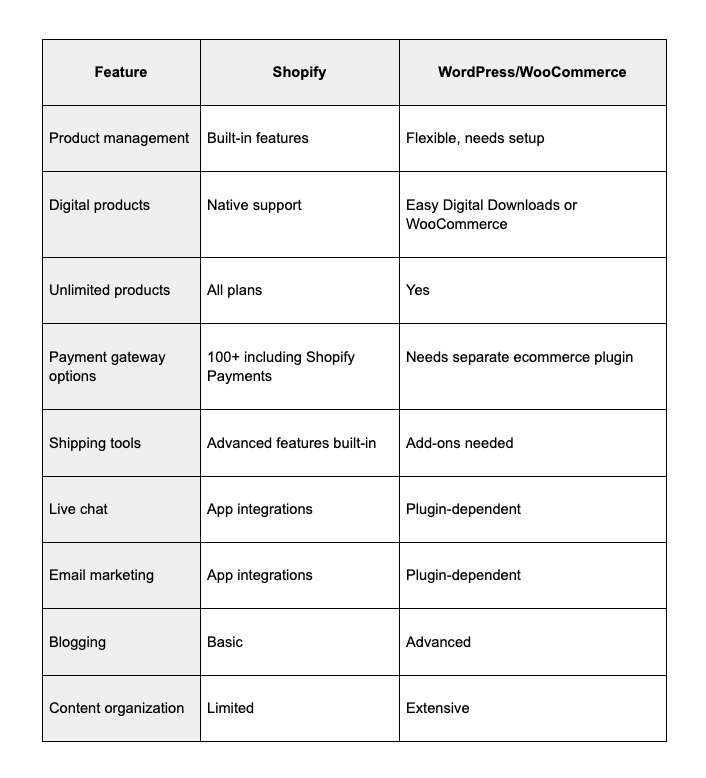
WordPress was built for content creation. You get advanced blog post editing, custom post types, and category systems for organizing large content libraries. SEO plugins optimize every piece of content you publish. If your business relies on publishing articles, guides, or building out comprehensive website pages beyond a basic store, WordPress handles this naturally.
Shopify offers basic blogging with a simple editor and basic categories. For a product-focused ecommerce store with occasional blog posts, it works fine. For a content-driven business, it falls short.
Feature Comparison
Search Engine Visibility
Both platforms can rank well in search engines, but they handle SEO differently.
Shopify has built-in features like automatic sitemaps, editable title tags, clean URL structures, and fast loading speeds. The ecommerce platform takes care of basic technical SEO for you.
WordPress gives you more control through plugins like Yoast or Rank Math. You can tweak schema markup, page speed, XML sitemaps, and internal linking. If your strategy depends on ranking content in search engines to drive sales, WordPress gives you more tools.
Customer Support
Shopify offers 24/7 customer support on all plans through live chat, email, and phone. This comes with your subscription at no extra cost.
WordPress has no official customer support since it's an open-source platform. You contact your hosting provider for server problems, theme makers for design issues, and plugin creators for feature questions. Fixing problems often takes technical knowledge or outside help.
Cost Analysis
Shopify Pricing Plans
Shopify charges a monthly subscription:
- Basic plan: $29/month (good for new stores)
- Shopify: $79/month (better reporting and lower fees)
- Advanced: $299/month (best rates for high-volume sellers)
Transaction fees run from 0.5% to 2% if you use outside payment gateway processors. With Shopify Payments, you skip these fees but still pay credit card rates. Premium theme options cost $150 to $350 as a one-time purchase. Apps range from free to $300+ per month.
WordPress/WooCommerce Pricing
WordPress is free as an open source platform, but you put the pieces together yourself:
- Web hosting: $3/month to $500+ for managed hosting
- Domain name: $10 to $40 per year
- Premium theme: $30 to $200 (one-time)
- SSL certificate: Often included with hosting, or $50 to $00 per year
- Plugins and add-ons: Free to $300+ per year each
Many business owners forget about developer costs. Without technical expertise, you'll probably need to pay someone to set up, customize, and fix problems on your WordPress website.
So What Should I Pick?
Choose Shopify if selling products is your main focus. The hosted platform handles technical stuff for you and offers a smoother user experience for ecommerce store management. If you want a streamlined shopping experience without worrying about content strategy, Shopify delivers.
Choose WordPress if content drives your online business. You'll need technical skills or money for developers, but you get a powerful content management system with ecommerce added on. If you need a full website where the online store is just one piece, WordPress gives you that flexibility.
Neither ecommerce platform is better across the board. Your choice depends on whether you're building a store that sometimes publishes content, or building a content site that sometimes sells products.
If you need help building a digital marketing strategy that gets results for your Shopify store or WordPress site, our team offers full-stack development, SEO, paid media, email marketing, and content strategy. As a Shopify Partner, we have direct access to platform resources, priority support, and early feature releases, which means faster problem-solving and better results for your business.
Ready to grow your ecommerce business? Contact us today for a free consultation.
.png)
.png)
.png)