
What Elements Are Foundational for SEO with AI? It’s a Two-Way Street

At a Glance: Understanding what elements are foundational for SEO with AI requires recognizing how artificial intelligence has transformed both how search engines rank content and how businesses can optimize their digital presence. The foundational elements include high-quality content creation, strategic keyword research, technical optimization, schema markup implementation, and user experience improvements. Using AI-powered tools for these tasks can accelerate your results while also positioning your content to appear in AI-powered search engines and google's ai overviews. Success now requires optimizing for both traditional search engines and the emerging AI search landscape.
The relationship between SEO and artificial intelligence has evolved into a two-way street. Search engine algorithms increasingly rely on ai systems to understand and rank content, while digital marketing professionals use ai-driven tools to improve their optimization efforts. This fundamental shift means that understanding what elements are foundational for SEO with AI isn't just about using new tools. It's about rethinking your entire approach to search engine optimization in an era where AI models influence both sides of the equation. This guide breaks down the foundational elements you need to master and explains why expert guidance often produces better outcomes than going it alone.
The Intersection of AI and SEO
Before diving into specific elements, it's worth understanding how AI affects SEO from multiple angles. AI influences search in three distinct ways: how search engines process and rank content, how marketers optimize their websites, and how users discover information through AI-powered search experiences.
Traditional search engines like Google now use sophisticated ai algorithms to understand natural language, evaluate content quality, and match search intent with relevant results. Meanwhile, generative engine optimization has emerged as a new discipline focused on appearing in AI-generated responses and overviews. Succeeding in this environment requires mastering foundational elements that satisfy both traditional ranking factors and the criteria ai systems use to select sources.

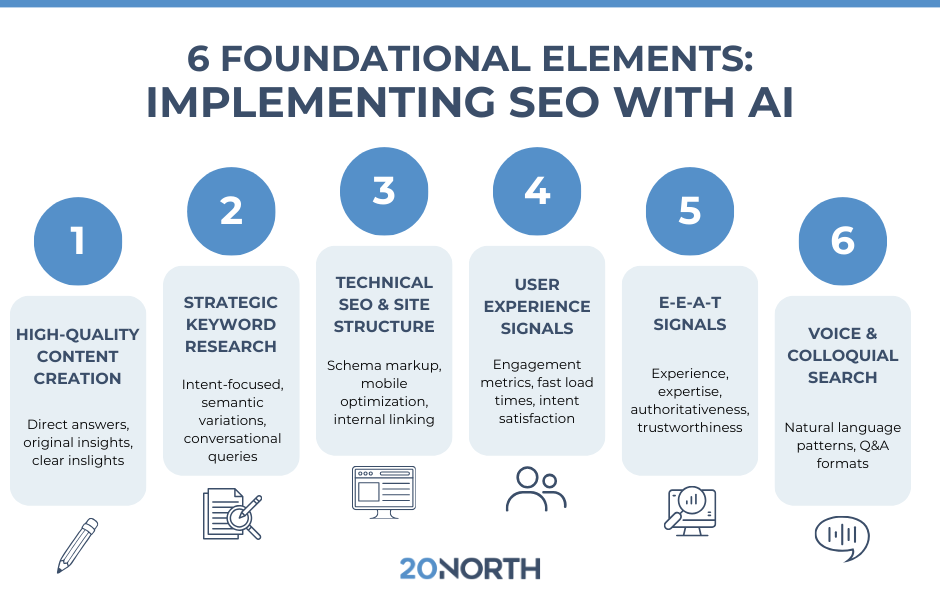
Foundational Element 1: High-Quality Content Creation
Content remains the cornerstone of any seo strategy, but what constitutes high-quality content has evolved alongside ai capabilities.
What AI Systems Look For
AI-powered search engines and Google's AI overviews pull from content that demonstrates expertise, provides clear answers, and offers genuine value to users. These AI systems evaluate content based on helpfulness, accuracy, and how well it addresses user intent.
Characteristics of AI-friendly content include:
- Direct answers to specific questions users ask
- Thorough coverage of topics from multiple angles
- Original insights rather than rehashed information
- Clear structure that makes information easy to extract
- Natural language that reads well to both humans and machines
Using AI Tools for Content Creation
AI-powered tools can assist with content creation in several ways, from generating initial drafts to identifying gaps in existing content. However, the most effective approach uses AI as an assistant rather than a replacement for human expertise.
Use AI tools to brainstorm topics, outline structures, and identify related terms to cover. Then apply human judgment to add original perspectives, verify accuracy, and ensure the content truly serves your target audience. This hybrid approach produces helpful content that performs well with both users and search engine algorithms.
Foundational Element 2: Strategic Keyword Research
Keyword research has evolved beyond finding high-volume terms. Modern keyword research must account for how ai systems understand search intent and the relationships between concepts.
Understanding Search Intent at a Deeper Level
AI algorithms excel at understanding search intent, often interpreting queries based on context rather than just matching keywords. Your keyword research needs to reflect this sophistication.
Modern keyword research should identify:
- Primary keywords that directly match your topic
- Related terms and semantic variations
- Questions your target audience asks
- Long-tail phrases that indicate specific intent
- Conversational queries reflecting voice search patterns
Leveraging AI for Keyword Discovery
AI-driven tools can analyze search patterns, predict trending topics, and identify keyword opportunities that manual research might miss. These tools use natural language processing to understand relationships between terms and suggest keywords based on semantic relevance rather than just search volume.
Predictive analytics capabilities in some AI tools can also help you anticipate emerging search trends, giving you a competitive advantage by creating content before competition intensifies.
Foundational Element 3: Technical SEO and Site Structure
Technical optimization creates the foundation that allows AI systems to effectively crawl, understand, and recommend your content.
Schema Markup Implementation
Schema markup provides structured data that helps search engines understand your content's context and meaning. For AI-powered search, this structured information becomes even more valuable as AI models use it to accurately categorize and cite your content.
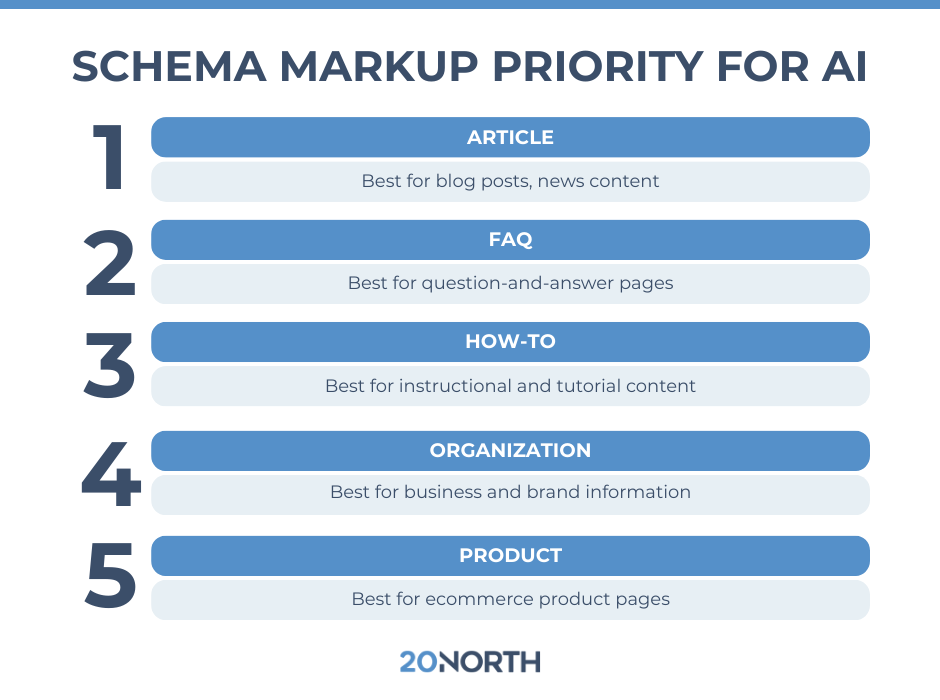
Priority schema types for AI optimization include:
- Article schema for blog posts and news content
- FAQ schema for question-and-answer content
- How-To schema for instructional content
- Organization schema for business information
- Product schema for ecommerce pages
Mobile Optimization
With the majority of searches now occurring on mobile devices, mobile optimization directly affects both user experience and search rankings. AI systems factor mobile-friendliness into their evaluation of content quality and usefulness.
Ensure your site loads quickly on mobile, displays content properly across screen sizes, and provides an intuitive navigation experience regardless of device.
Internal Link Structure
Internal link architecture helps AI systems understand the relationships between your content and the hierarchy of information on your site. A logical internal link structure guides both users and crawlers through your content in meaningful ways.
Create topic clusters with pillar pages linking to related content, and ensure important pages receive appropriate internal link equity from relevant sources throughout your site.
Foundational Element 4: User Experience Signals
AI algorithms increasingly incorporate user engagement signals into their ranking decisions. How users interact with your content provides feedback about its quality and relevance.
Engagement Metrics That Matter
Search engines track how users behave after clicking through to your site. High bounce rates, short time on page, and quick returns to search results signal that content didn't satisfy user intent.
Improve user engagement by:
- Delivering on the promise of your title and meta description
- Providing immediately valuable information above the fold
- Using formatting that makes content easy to scan
- Including multimedia elements that enhance understanding
- Ensuring fast page load times that don't frustrate users
Optimizing for User Intent
Understanding and satisfying user intent is perhaps the most important factor in modern SEO. AI systems have become sophisticated at matching queries with content that truly addresses what users seek.
Analyze the search results for your target keywords to understand what type of content currently ranks. Are users looking for quick answers, detailed guides, product comparisons, or something else? Align your content format and depth with what the search intent demands.
Foundational Element 5: E-E-A-T Signals
Google's E-E-A-T framework (Experience, Expertise, Authoritativeness, and Trustworthiness) guides how ai systems evaluate content quality. These signals help determine whether your content deserves visibility in search results and ai-generated overviews.
Demonstrating Experience and Expertise
AI models look for signals that content comes from genuine experts with real experience. This means including author information, credentials, and evidence of firsthand knowledge in your content.
Ways to strengthen E-E-A-T signals:
- Include detailed author bios with relevant credentials
- Reference original research, data, or case studies
- Share specific examples from direct experience
- Link to authoritative external sources
- Keep content updated with current information
Building Authority and Trust
Authority develops over time through consistent publication of quality content, backlinks from respected sources, and positive brand mentions across the web. Trust signals include secure site infrastructure, clear contact information, and transparent business practices.
Foundational Element 6: Adapting to Voice and Conversational Search
Voice search and conversational ai interfaces are changing how people discover information. Optimizing for these formats requires understanding how natural language queries differ from typed searches.
Conversational Query Optimization
Voice searches tend to be longer and more conversational than typed queries. Users ask complete questions rather than typing fragmented keywords. Your content should address these natural language patterns.
Include question-and-answer formats in your content, use conversational headers, and provide concise answers that work well when read aloud or displayed in voice search results.
Why Partner with an AI SEO Agency
The foundational elements outlined above require ongoing attention, technical expertise, and strategic coordination. Many businesses find that partnering with specialists in AI SEO produces better results than attempting to manage these complexities internally.
Technical Expertise: AI SEO involves understanding both traditional search engine optimization and the newer requirements of ai-powered search engines. Agencies stay current on how ai algorithms evolve and adjust strategies in real time.
Tool Investment: Effective AI SEO requires access to multiple ai-powered tools for keyword research, content optimization, technical analysis, and performance tracking. Agencies invest in these tools and know how to use them effectively.
Strategic Integration: The foundational elements work together as a system. Agencies understand how to coordinate content, technical, and off-page efforts into a unified strategy that serves both traditional and ai search.
Time Efficiency: Learning the nuances of AI SEO takes considerable time. Agencies bring existing expertise, letting you benefit from optimized strategies without the learning curve.
Ongoing Adaptation: The search landscape continues evolving as ai capabilities expand. Agencies commit to monitoring changes and adapting client strategies proactively rather than reactively.
Measurable Accountability: Professional agencies track performance metrics and demonstrate ROI. This accountability helps you understand what's working and where to focus resources.

Build Your AI SEO Foundation with 20North
Ready to master the foundational elements of SEO with AI? 20North Digital Marketing specializes in AI SEO strategies that position your business for success in both traditional search results and emerging ai-powered search experiences.
Our team understands what elements are foundational for SEO with AI and how to implement them effectively for your specific industry and goals. We combine technical expertise with proven content strategies to help your business capture visibility across the evolving search landscape.
Don't let the complexity of AI SEO hold your business back. Contact 20North today to discover how our AI SEO services can strengthen your digital presence, improve your search rankings, and prepare your content for the future of search.
.png)
.png)
.png)