
.png)
The Short Answer: Shopify gives you a solid foundation out of the box with built-in HTTPS, mobile-friendly themes, and automatic XML sitemaps, but the platform alone will not rank your store. A Shopify SEO checklist walks you through every part of your store that affects organic traffic: technical foundations, on-page optimization, content, site structure, and tracking.
Working through these items in order helps your store rank higher in Google search results, reach more potential customers, and drive organic search visibility. This Shopify SEO checklist breaks down the actions that move the needle, organized so you can tackle them one section at a time without missing anything important.
How to Use This Checklist
Run through the sections in order. The first time will take the longest. After that, treat it as a monthly or quarterly review so nothing slips through the cracks and everything is current. Each section builds on the one before it, so a strong technical foundation makes your on-page work pay off more.
Technical Foundation Checklist
Start here. If search engines cannot crawl your store properly, nothing else matters.
- Connect your custom domain (avoid the default .myshopify.com URL)
- Verify your store in Google Search Console
- Install Google Analytics 4 and confirm tracking is firing
- Submit your sitemap.xml file in Google Search Console
- Confirm your robots.txt file is not blocking important pages
- Set canonical tags correctly to avoid duplicate content from Shopify's /collections/ and /products/ URL structure
- Check Core Web Vitals scores in Search Console and run a PageSpeed Insights audit
- Resize and compress high-quality images so they do not slow your pages
- Pick a Shopify theme built for speed (Dawn, Spotlight, and similar lightweight themes work well)
- Audit your Shopify SEO apps and remove anything you do not actively use (app bloat slows your site)
Keyword Research Checklist
Strong SEO starts with knowing what your customers actually search for. Map relevant keywords to your store before you do any on-page work.
- Build a keyword list using a free tool like Google Keyword Planner, or paid tools like Semrush and Ahrefs
- Group keywords by intent: informational (blog topics), commercial (comparison pages), and transactional (product pages)
- Identify long-tail keywords with lower competition for newer stores
- Map every priority keyword to a specific page on your site
- Track your target keyword rankings monthly
On-Page Optimization Checklist
This is where most stores leave traffic on the table. Work through each page type separately.
Product Pages
- Write a unique title tag for every product (do not use only the product name)
- Write a meta description under 160 characters that includes a call to action
- Include the main keyword in the H1 (product title)
- Write original product descriptions (no manufacturer copy)
- Add descriptive alt text to every product image
- Use Product schema markup for star ratings, prices, and availability
- Cross-link to related products and the parent collection page
Collection Pages
- Add 2-3 sentences of above-the-fold copy explaining the category
- Include relevant keywords in title tags and meta descriptions
- Use a clean H1 that matches the collection's target keyword
- Add internal links from collection page copy to subcategory or product pages
- Keep URL slugs short and keyword-focused
Blog Posts
- Target one primary keyword per blog post
- Use H2s and H3s to break up the content
- Add internal links to related products, collections, and other blog posts
- Include an author bio and date for trust signals
Content Strategy Checklist
Content drives long-tail traffic and supports your product pages. A consistent posting cadence beats one-off bursts.
- Publish blog posts that answer real customer questions
- Create buyer's guides for your top product categories
- Build comparison pages (e.g., "Brand A vs Brand B")
- Refresh older blog posts every 6-12 months
- Repurpose product reviews into testimonial pages
Site Structure and Internal Linking Checklist
Search engines and shoppers both need to find your pages easily. A clean site structure makes both happen.
- Keep your navigation flat (three clicks or fewer to any product)
- Group related products into well-named collections
- Add breadcrumb navigation on every product and category page
- Internally link every blog post to at least one product or collection
- Internally link product pages to related collections and complementary products
- Audit your site every quarter for orphan pages (pages with no internal links pointing to them)
Off-Page SEO Checklist
Authority signals from outside your site help your store rank in organic search.
- Earn high-quality backlinks from industry publications, suppliers, and bloggers
- List your store in relevant industry directories
- Run a digital PR campaign around new product launches or original data
- Build relationships with creators in your niche for honest reviews
- Monitor brand mentions and request links when your brand is mentioned without one
Tracking and Monitoring Checklist
You cannot improve what you do not measure. Build a simple weekly and monthly review habit.
- Check Google Search Console weekly for indexing issues and search performance
- Review your top-performing pages in Google Analytics monthly
- Track keyword rankings for your top 25-50 terms
- Watch organic traffic trends month over month
- Set up alerts for major drops in traffic or rankings
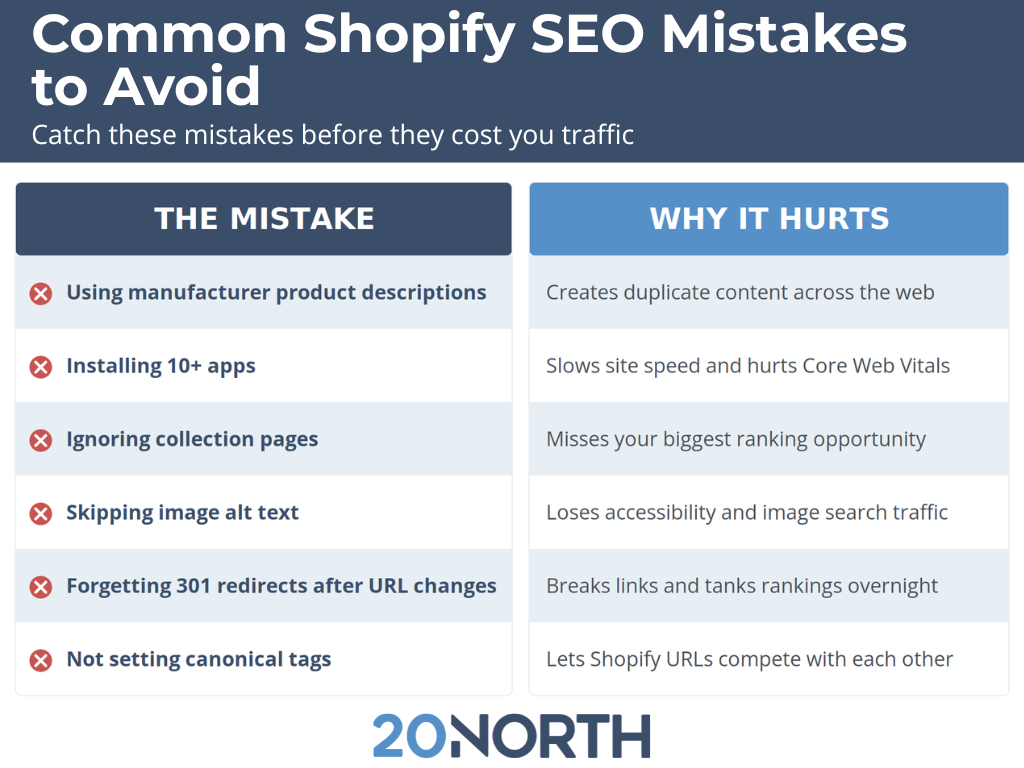
Common Shopify SEO Mistakes to Avoid
Putting Your Shopify SEO Checklist to Work
A Shopify SEO checklist is only useful if you actually work through it. Start with the technical foundations, move into on-page optimization, layer in content, and build a tracking habit. The stores winning organic search are the ones treating SEO as ongoing work, not a one-time setup.
If you want help running through this checklist or want a partner who handles Shopify SEO every day, the team at 20North can audit your site and build a custom SEO strategy. As a Shopify Premier Partner, 20North combines technical SEO with content strategy and conversion-focused design.
Learn more about our Shopify SEO services or contact our team to get started.
.png)
.png)
.png)