

Will AI Replace SEO?
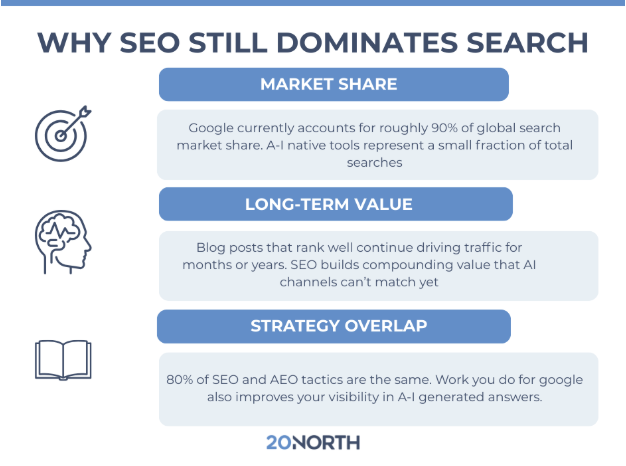
The Short Answer: No. While AI-powered search engines like ChatGPT, Perplexity, and Google's AI Overviews are changing how some people find information, traditional search engines still dominate. According to StatCounter, Google currently accounts for roughly 90% of global search market share, with other search engines like Bing and Yahoo making up most of the remaining volume. AI-native search tools still represent a small fraction of total searches.
The rise of AI answer engines has sparked a new term in digital marketing: Answer Engine Optimization (AEO), sometimes called generative engine optimization. Some marketers worry they need to abandon search engine optimization entirely and pivot to this new approach. But the data tells a different story, and understanding the relationship between SEO and AEO will help you make smarter decisions about where to invest your marketing efforts.
The Current Search Landscape
Despite the hype around AI chatbots and answer engines, traditional search behavior hasn't dramatically shifted. People still turn to Google Search for the vast majority of their online queries, from product research to local business searches to informational lookups. For any SEO professional watching these trends, the message is clear: traditional search isn't going away.
Where AI Models Fit In
AI search tools have carved out a niche, particularly for complex questions that benefit from synthesized, conversational responses. Generative AI excels at providing an ai-generated summary of complex topics, saving users time when they need quick answers. But for most everyday searches, like finding a nearby restaurant or comparing products, users still default to traditional search engines. The target audience for most businesses still discovers brands through Google, not through AI chatbots.
Projected Growth
Gartner predicts that by 2026, traditional search engine volume will drop 25% as users turn to AI chatbots and virtual agents. That's notable growth for AI, but traditional search engines will still handle the majority of queries. Even with this projected shift, businesses that invest in strong SEO foundations will maintain visibility across both channels. Every SEO specialist knows that these fundamentals have weathered algorithm changes before, and they'll weather this shift too.
SEO and AEO: More Overlap Than You Think

Here's what many marketers miss when panicking about AI disrupting SEO: there's roughly an 80% overlap between SEO and AEO strategies. The tactics that help you rank well in Google also help you appear in AI-generated answers.
Why the Strategies Align
AI algorithms are built using similar training data and signals as search engine algorithms. They're looking for the same indicators of quality, relevance, and authority. When an AI model generates an answer, it pulls from web content that demonstrates expertise, provides clear information, and comes from trustworthy sources.
This means the work you're already doing for SEO directly benefits your visibility in AI answer engines:
- Clear, well-structured content helps both Google and AI models understand your expertise
- Authoritative backlinks signal credibility to search algorithms and AI training systems alike
- Technical SEO fundamentals like schema markup improve discoverability across all platforms
- Understanding user intent allows you to create relevant content that serves both channels
What AEO Adds
The 20% difference between SEO and AEO strategies mostly involves formatting and content structure. AI models favor content that directly answers questions in a conversational format. This means adjusting your content optimization approach to include clear question-and-answer sections in your blog posts, concise summaries that AI can easily extract, and information structured in ways that lend themselves to being quoted.
These adjustments enhance your SEO efforts rather than replace them. Content optimized for AI answers typically performs well in traditional search too, making this a powerful tool for maximizing visibility across all channels.
Why SEO Still Matters Most
With traditional search engines handling the vast majority of queries, SEO remains the foundation of any digital visibility strategy. Optimizing for search engines reaches far more potential customers than focusing exclusively on AI answer engines.
The Compounding Effect
SEO builds long-term value that compounds over time. Blog posts that rank well in Google continue driving traffic for months or years after publication. Technical optimizations improve your entire site's performance. Backlinks accumulated over time strengthen your domain authority across all search contexts, including AI.
Abandoning SEO to chase AEO would mean giving up proven traffic sources for a channel that currently represents a smaller share of search volume. Smart marketers understand that building a strong online presence through traditional search creates the foundation for success in emerging channels.
Local and Transactional Searches
AI answer engines handle informational queries reasonably well, but they struggle with local and transactional intent. When someone searches for "plumber near me" or "buy running shoes," they want actionable results with maps, reviews, and prices. Traditional search engines deliver this far better than conversational AI.
Your online presence in local search results directly impacts foot traffic and phone calls in ways that AI chatbots simply can't replicate yet. For service businesses and retailers, SEO remains the primary driver of customer acquisition.
The Role of Human Creativity
One area where SEO continues to thrive is in content creation that requires human creativity and strategic thinking. While AI can help automate repetitive tasks like keyword research and data analysis, the creative strategy behind successful content still requires human insight.
A skilled content creator understands how to craft narratives that resonate with readers while satisfying search engine algorithms. They know how to identify gaps in existing content and create high quality content that fills those gaps better than competitors. This blend of creativity and technical knowledge is something AI tools assist with but don't replace.
Best Practices for a Dual Strategy

Rather than choosing between SEO and AEO, smart marketers optimize for both simultaneously. Since the strategies overlap so heavily, following best practices for one channel naturally benefits the other.
Start with SEO Fundamentals
Build your strategy on proven SEO practices: keyword research, high quality content, technical optimization, and link building. These fundamentals drive results in traditional search and lay the groundwork for AI visibility. Focus on creating content that genuinely helps your target audience solve problems or answer questions.
Implement proper schema markup to help search engines understand your content structure. This same structured data helps AI models parse your information more effectively, making it easier for them to cite your content in responses. Technical SEO isn't glamorous, but it remains the backbone of discoverability across all platforms.
Layer in AEO Enhancements
Once your SEO foundation is solid, add AEO-specific elements. Structure key pages with clear Q&A formats. Write content that directly addresses common questions in your industry. Consider how AI-powered search processes information differently than traditional search.
These tools look for content that can be synthesized into direct answers, so format your expertise in ways that lend themselves to being quoted. This might mean adding summary sections to longer articles or including key takeaways that AI can easily reference. The goal is making your content useful for both human readers and AI systems.
Content Optimization for Both Channels
Your content optimization strategy should address both traditional search and AI discovery:
- Write comprehensive content that thoroughly covers topics while remaining scannable
- Include clear definitions and explanations that AI can quote directly
- Use headers that match the questions your audience actually asks
- Provide specific, actionable information rather than vague generalities
- Update existing content regularly to maintain freshness signals
The goal is creating relevant content that serves users regardless of how they discover it. Whether someone finds you through Google Search or through an AI chatbot, they should encounter helpful, authoritative information that positions your brand as a trusted resource.
Monitor Performance Across Channels
Track your visibility in both traditional search results and AI-generated answers. Tools are emerging to help measure AEO performance alongside standard SEO metrics. Understanding where your traffic comes from helps you adjust your strategy over time and allocate resources effectively.

The Bottom Line
AI answer engines are a growing part of the search landscape, but they're not replacing traditional search anytime soon. With Google and other search engines handling the vast majority of queries today, SEO remains the dominant strategy for online visibility.
The good news is you don't have to choose. SEO and AEO strategies overlap by roughly 80%, meaning the work you do for one benefits the other. Focus on creating high-quality content, building authority, and maintaining strong technical fundamentals. These efforts pay dividends across both traditional search and AI-powered discovery.
The future of search isn't about AI versus traditional engines. It's about understanding how both channels work together and positioning your brand to succeed in either context. Businesses that invest in solid SEO foundations while adapting their content creation for AI discoverability will have the strongest online presence in the years ahead.
Partner with 20North for AI-Enhanced SEO
Navigating the intersection of artificial intelligence and search optimization requires both technical knowledge and strategic experience. At 20North, we use AI-powered tools while maintaining human oversight, giving you access to data-driven insights without losing the strategic direction that separates good campaigns from great ones. If you're ready to explore how AI-enhanced SEO strategies can support your business goals and deliver measurable results, reach out to our team to discuss a tailored approach that combines the best of both worlds.
.png)
.png)
.png)