
.png)
The short answer: AI is changing how users discover information, compare products, and evaluate services, but Google Search remains a central driver of website traffic and revenue. Businesses now need a search strategy that supports both traditional Google search results and AI-generated answers.
For years, SEO focused on ranking a webpage high enough in a search engine results page to earn a click. In recent years, people have increasingly used AI tools to ask longer questions, request product recommendations, compare options, and receive direct answers before visiting a website.
SEO remains the foundation because your content must be crawlable, indexed, and eligible to appear in Google Search before it can be surfaced in AI-powered search features; AEO builds on that foundation by making your information clear, direct, and easy for answer engines to understand and cite.
How They Differ
Both AI and Google Search represent two increasingly connected ways people research questions, products, and services. Google uses artificial intelligence throughout its search ecosystem, and Google Search increasingly includes AI-powered features such as AI Overviews and AI Mode.
The more useful comparison is between traditional search behavior and generative AI search behavior. Traditional information retrieval is centered on finding and ranking relevant documents or webpages for a search query. AI search can synthesize information from multiple sources, identify relationships between questions, and create an AI-generated summary that responds directly to user intent.
Google Search gives users access to the open web, while Google’s AI features, including AI Overviews and AI Mode, provide generated responses with links that help users explore supporting sources directly.
How Google AI Overviews Differ From AI Mode
AI Overviews are generated summaries that may appear within Google search results for certain queries. They are designed to provide a quick explanation and link users to relevant webpages. AI Mode is a more conversational Google search experience. It supports complex, multi-part questions and follow-up prompts, allowing users to explore a subject in a format that feels closer to an AI chatbot.
Google states that AI Mode uses a process called query fan-out. Instead of relying on one search query, it can issue multiple related searches across subtopics before producing a response.
Why Search Behavior Is Changing
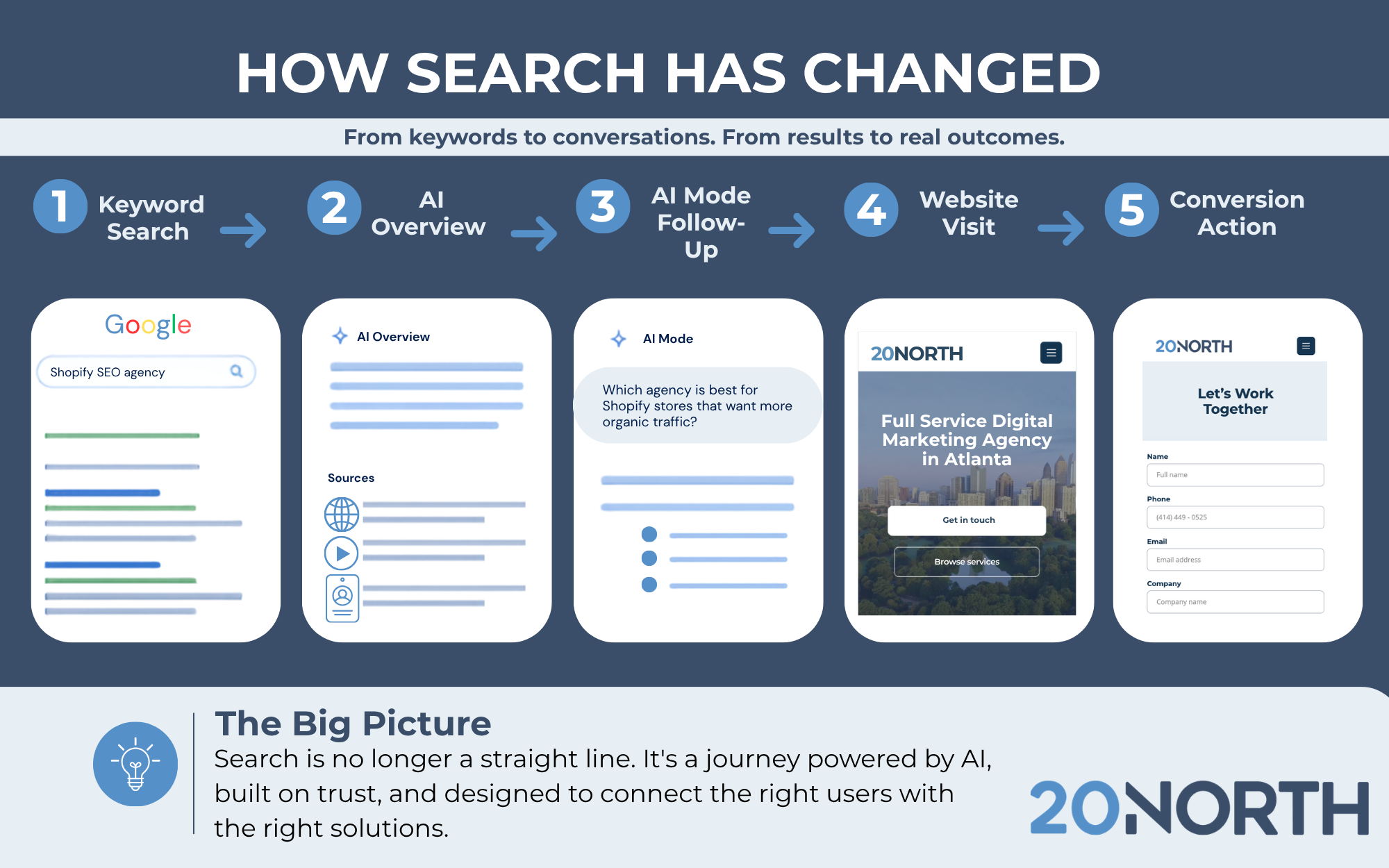
AI usage has grown because users can ask questions in the same way they would ask a knowledgeable person. Instead of searching “Shopify SEO agency,” a business owner might ask, “Which agency can help a Shopify store improve organic traffic and appear in AI-generated answers?” This type of search query signals a specific need. The user may want to understand pricing, service scope, technical capabilities, industry experience, expected outcomes, and how SEO connects to revenue.
The Effect on Organic Traffic
One concern is that AI-generated answers may increase zero-click searches. If an AI summary answers a basic question directly on the search results page, a user may not need to click a website. That concern is valid for simple informational queries, but businesses can still earn meaningful visibility when their content is cited, when users need deeper context, or when a searcher is ready to compare options, request a quote, view product details, or make a purchase.
Pages that offer original research, specific expertise, pricing context, product information, decision criteria, and clear next steps remain valuable. An AI overview may answer “what is technical SEO,” but it cannot replace a detailed service page, product collection, interactive tool, case study, or tailored recommendation.
Is AI Accurate, and Is AI Reliable?
AI can be useful for summarizing information, generating ideas, identifying patterns, and helping users research a topic, but it can also make mistakes. AI models may provide outdated information, misunderstand a complex question, omit important caveats, or generate claims that require additional verification. That is why AI-generated answers should not be the only source a person uses for major purchasing, legal, financial, healthcare, or business decisions.
For content creators, this raises the bar. Websites that publish accurate, specific, and verifiable information are better positioned to earn trust from users and visibility from AI search engines.
Build content AI can trust
A reliable page should include:
- Clear authorship and demonstrated subject-matter experience.
- Up-to-date facts, product details, pricing, and recommendations.
- Links to reputable primary sources, government agencies, research organizations, and official documentation.
- Original data, examples, customer insights, or case studies where possible.
- Clear explanations of limitations and tradeoffs.
- Consistent reviews and updates as information changes.
Google’s guidance for AI features does not require special markup or a separate “AI content” version of your website. Instead, it emphasizes the same fundamentals that help content appear in Google Search: pages must be indexed, eligible for snippets, and useful to people.
How to optimize for AI Mode Google
A strong Google AI Mode and SEO strategy begins with traditional SEO. If Google cannot crawl, index, and understand your website, AI search visibility will be difficult to earn.
For businesses, this means prioritizing page quality, technical health, topical relevance, and user experience before chasing every new AI tool or platform.
1. Lead with a direct answer
Start pages and sections with a concise answer to the question being addressed. Follow the answer with evidence, examples, and deeper explanation.
For example, a service page targeting “how to choose an AI search agency” should clearly explain the selection criteria before describing the agency’s services.
2. Match user intent, not just keywords
Searchers do not always use one exact phrase. They may ask questions about costs, comparisons, implementation, benefits, risks, or the best option for a certain business model.
Build pages around the actual decision your audience is making. For an e-commerce brand, that could include questions about platform migration, SEO, paid advertising, email marketing, conversion rate optimization, and product discovery.
3. Use clear structure
AI systems and users both benefit from content that is easy to scan. Use:
- Descriptive H2 and H3 headings.
- Short paragraphs.
- Tables for comparisons.
- Bullets for steps and criteria.
- Internal links to related service pages and resources.
- Clear calls to action where a reader may need help.
A well-structured page makes it easier for a search engine to identify what each section means and how it addresses a search query.
4. Improve technical SEO
Technical SEO remains a major part of AI visibility.
Prioritize:
- Crawlable internal links.
- Fast-loading and mobile-friendly pages.
- Clean page titles and meta descriptions.
- Logical site architecture.
- Canonical tags where needed.
- Structured data that accurately describes the page.
- XML sitemaps and properly configured robots.txt files.
- Indexation monitoring through Google Search Console.
A detailed SEO audit can identify technical issues that interfere with crawling, indexing, visibility, and conversions.
5. Develop topical authority
AI search engines are more likely to find useful context when a website covers a subject from multiple relevant angles. Create connected resources around high-priority customer questions, then use internal links to connect educational articles, service pages, case studies, and conversion pages.
Supporting that work with Shopify SEO services helps create a stronger foundation for both organic search and AI search visibility.
SEO, AEO, and Generative Engine Optimization
Traditional SEO still provides the framework for search visibility, but brands also need to consider how their content appears in AI-generated answers, conversational search experiences, and other evolving search formats.
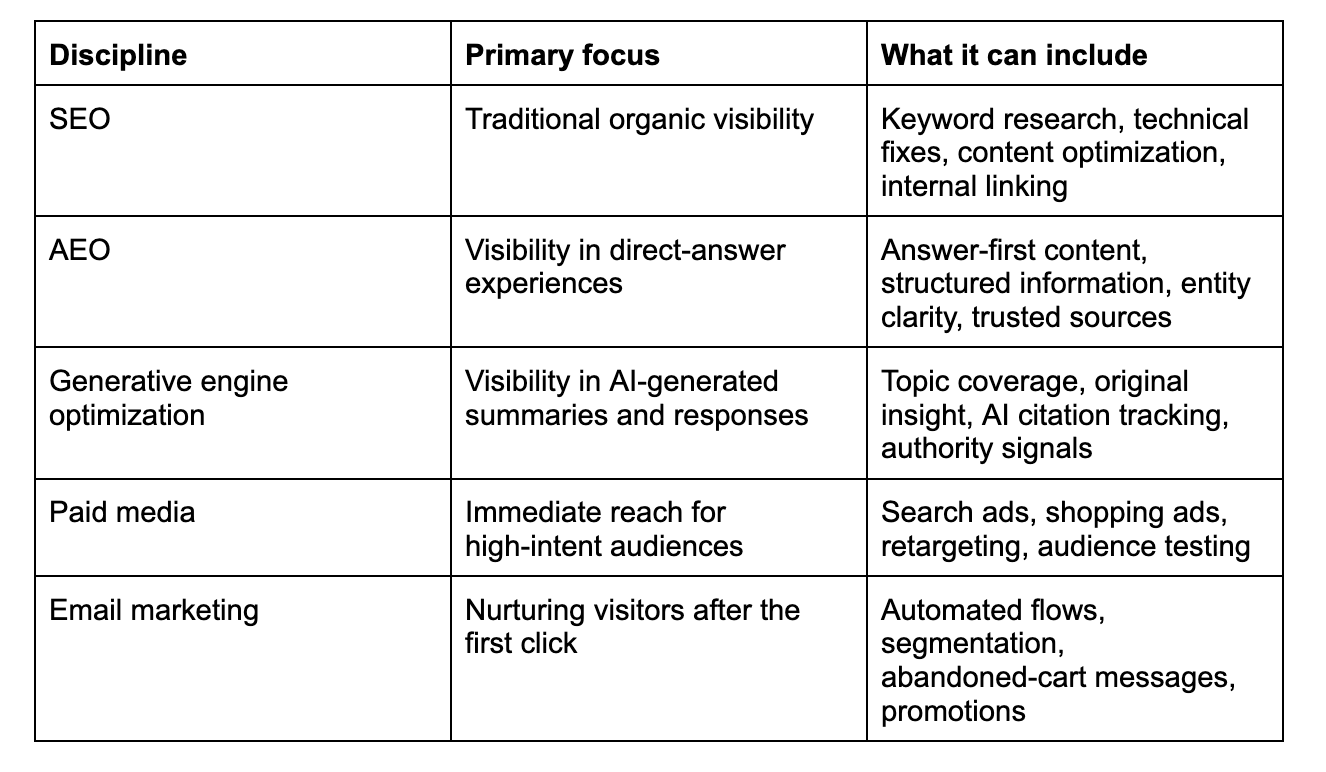
The most effective strategy connects these disciplines instead of treating each one as separate. Organic content can help your brand earn discovery, while paid media captures immediate demand and email marketing re-engages prospects after they leave the site. Together with web development that reduces friction across the user journey, these channels create a more connected path from initial search to conversion.
20North’s full-service digital marketing team supports that integrated approach through SEO, paid media, website development, and email marketing.
AI Search Strategy for E-commerce Brands
AI search is changing how shoppers research and compare products, often through detailed questions about price, materials, use cases, shipping speed, product compatibility, and reviews. For e-commerce brands, that makes clear, useful product and collection page content even more important. Pages should explain who a product is for, the problem it solves, what sets it apart, and what customers should know before purchasing.
Supporting that visibility takes more than prompt writing or AI-generated content. An effective AI search strategy depends on the website behind the content, including technical SEO, page experience, trusted information, structured data, meaningful internal linking, and measurement tied to revenue and business outcomes. 20North’s AI SEO services combine generative engine optimization and answer engine optimization with the SEO practices that help e-commerce brands earn visibility across Google Search and AI-powered search experiences.
E-Commerce Priorities for AI Search
- Write clear, original product descriptions instead of relying on manufacturer copy.
- Build collection pages around shopper needs and category intent.
- Include specifications, compatibility details, FAQs, care instructions, and comparisons where appropriate.
- Use accurate product structured data.
- Add helpful images, videos, and descriptive alt text.
- Improve site speed and mobile usability.
- Create content that supports commercial research, such as buying guides and comparison pages.
- Connect product, category, and educational pages through intentional internal linking.
For businesses on Shopify, web development services and Shopify Plus development can help improve site structure, performance, usability, and the technical foundation that supports SEO.
What Businesses Should Do Next
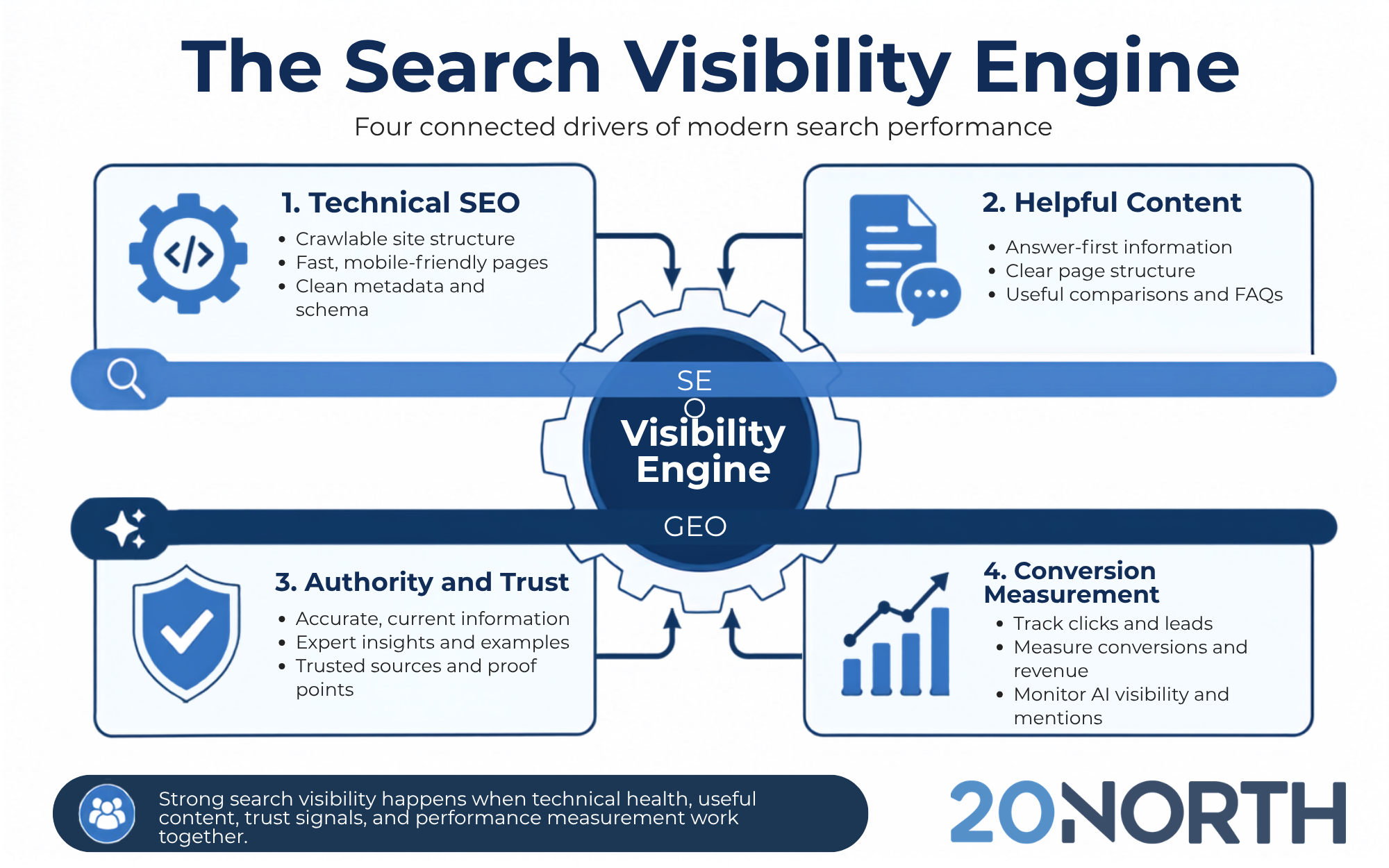
AI-powered experiences and Google Search increasingly work together to shape how qualified customers find answers, research options, and discover brands. The goal is to build visibility across that connected search journey.
Start with these steps:
- Audit your current organic visibility, technical SEO, and high-value content.
- Identify which important keywords and questions trigger AI Overviews, AI Mode, or other AI-generated answers.
- Update pages that earn impressions but have weak click-through rates or conversion performance.
- Create answer-first content that addresses customer questions, objections, comparisons, and buying decisions.
- Add expert insights, original examples, and reputable external sources.
- Improve internal linking between content, product pages, service pages, and conversion paths.
- Track organic traffic, leads, revenue, assisted conversions, AI citations, and brand mentions.
- Coordinate SEO with paid media, email marketing, and web development so every channel supports business growth.
Website rankings may get you onto the track, but technical health, useful content, site speed, authority, and conversion experience determine ifyou finish ahead of the competition.
Build Visibility Across the Connected Search Journey
20North helps e-commerce, service, and SaaS companies build data-driven strategies for search visibility and revenue growth. Our SEO services and AI SEO capabilities help businesses strengthen their presence across organic search, answer engines, and emerging AI search experiences.
If you want to understand where your website stands and identify the highest-impact opportunities, contact 20North to build an SEO and AI visibility strategy aligned with your growth goals.
.png)
.png)
.png)