

At a Glance: Answer Engine Optimization (AEO) is the practice of creating content so AI platforms like ChatGPT, Perplexity, and Google AI Overviews can cite your brand as a trusted answer source. Modern answer engines and AI answer engines leverage advanced technologies to deliver direct, contextually relevant responses. Unlike traditional Search Engine Optimization, which targets clicks, AEO targets credibility. The best AEO techniques combine answer-first content, structured data, strong E-E-A-T signals, and consistent brand authority across platforms. Visitors arriving through AI search convert at 4.4 times the rate of standard organic traffic (Semrush, 2025), making AEO one of the highest-leverage strategies available today.
Search behavior has shifted. Users no longer just type keywords into search engines and scan lists of links. Modern answer engines now provide direct answers to user queries, with more than half of search interactions ending without a click. Zero-click behavior continues to rise. Similarweb reporting indicates that in some verticals, searches ending without a click increased from 56% in 2024 to nearly 69% by May 2025, highlighting how AI summaries and SERP features are reshaping traffic patterns (Similarweb 2026). This is the environment that Answer Engine Optimization was built for.
Platforms like ChatGPT, Perplexity, and Google AI Overviews have become primary research tools, especially for purchase decisions. If your content is not structured to be cited by these systems, you are losing the conversation entirely. Answer engines favor content that is quick to load, original, valuable, and tailored to user needs. Marketing teams must adapt to AEO to remain competitive. At 20North Marketing, our AI SEO services are built around exactly this challenge. Here is what AEO actually requires, and how to do it well.
What Is Answer Engine Optimization?
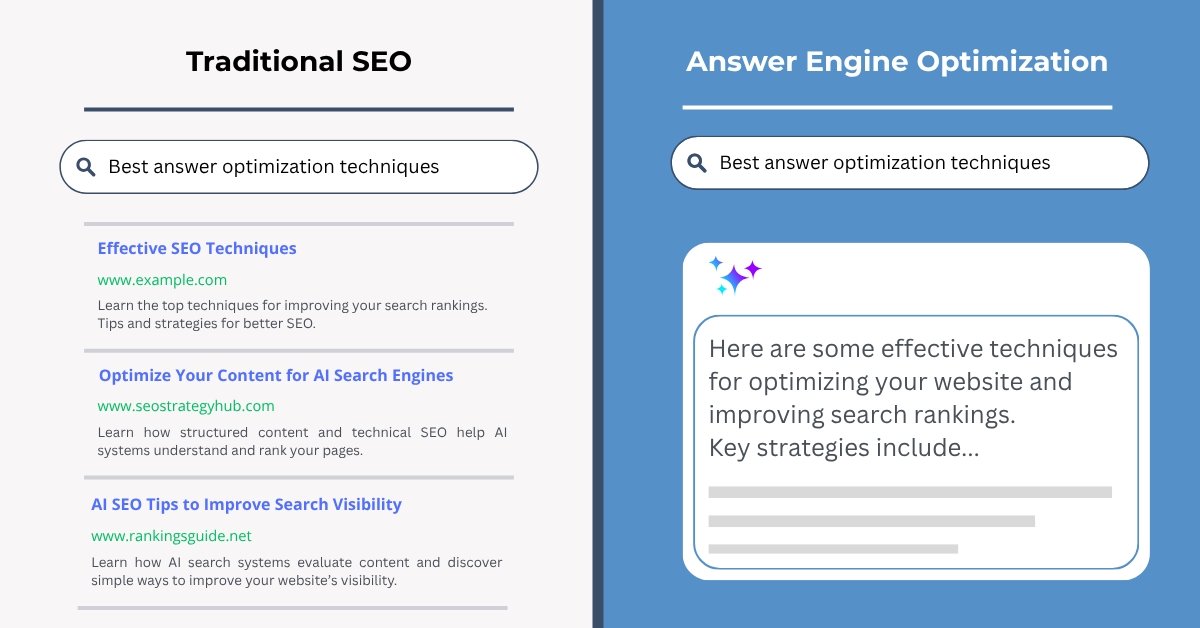
Answer Engine Optimization is the practice of making your content extractable, credible, and citable by AI-powered platforms. Traditional SEO optimizes for ranking in organic search results, while AEO optimizes for being selected as the answer inside AI responses. The key differences lie in objectives, strategies, and outcomes. AEO focuses on answer selection and AI citations, while traditional SEO targets rankings and clicks.
Success metrics differ: traditional SEO measures rankings and clicks; AEO measures citations, AI mentions, brand share of voice, and the quality of traffic arriving via AI systems.
This shift reflects a broader change in how visibility is earned in search environments shaped by artificial intelligence. Instead of competing solely for page position, brands are now competing to become the trusted source that answer engines surface directly within results. Being cited in AI-generated responses increases exposure at the exact moment users are researching solutions, evaluating options, or forming purchase intent.
As a result, marketers must evaluate performance through both visibility and influence. Appearing as a cited source or referenced brand can strengthen credibility, improve recall, and guide users toward future engagement even when immediate clicks do not occur. This makes metrics like citation frequency and share of voice valuable indicators of long-term search authority and market presence.
According to Semrush’s 2025 AI Search Study, AI search visitors convert at 4.4 times the average rate of traditional organic search visitors. AEO helps brands appear in featured snippets, knowledge panels, and voice searches, and helps content get picked as the direct answer by AI voice assistants like Siri. It is also a crucial part of modern marketing strategies.
Here is how AEO compares to traditional SEO:
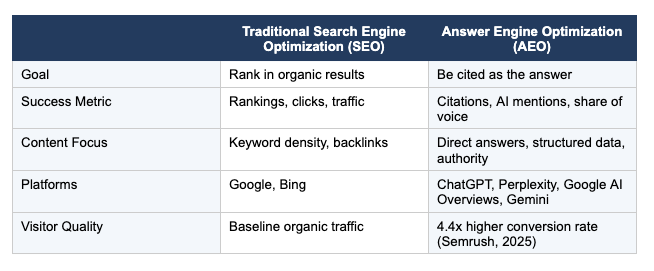
AEO is not a replacement for SEO but builds on it. Over 92% of AI Overview citations come from pages already ranking in the top 10 organic results. Domain authority remains critical for both SEO and AEO, influencing how well your site is indexed and trusted by AI systems. AEO layers structural and content signals that make pages worth citing. How your content appears in AI-generated answers depends on how well it is structured and optimized for direct, answer-ready extraction. For businesses looking to implement these techniques effectively, consulting with experts at 20North Marketing can accelerate your success.
Understanding User Behavior in AI Search
User behavior is central to successful Answer Engine Optimization. AI-powered search platforms have fundamentally changed how people seek and consume information. Users now expect immediate, accurate answers delivered directly within search interfaces, often without clicking through to a website.
This shift toward zero-click search environments means brands must structure content not only to rank, but to be selected and displayed by AI systems. Optimizing for user intent, device context, and preferred content formats increases the likelihood that content will be extracted and cited in AI-generated responses.
Key Factors That Shape Interaction with Answer Engines
- User Intent – Informational and conversational queries are most likely to trigger AI-generated answers, while high-intent transactional searches may still drive site visits. Understanding the underlying goal of a query helps determine how directly content should resolve the question.
- Device Usage – Voice search behavior on mobile devices and smart speakers often prioritizes concise, single-answer responses. Desktop users typically conduct more complex research queries that require structured, multi-layered explanations.
- Content Format Preferences – AI systems frequently surface content from structured formats such as answer summaries, featured snippets, FAQ sections, and clearly segmented paragraphs. These formats improve extractability and visibility even when users do not click.
How to Align Content With AI Search Behavior
- Provide direct answers at the start of key sections or pages.
- Implement structured data and schema markup to improve machine readability.
- Write in natural, conversational language that mirrors real user queries.
- Monitor performance using tools such as Google Search Console, Semrush, and analytics platforms.
Aligning content strategy with evolving user behavior strengthens both traditional SEO performance and AI citation visibility. Brands that anticipate how users interact with answer engines are more likely to earn placement in AI-generated responses and maintain long-term search relevance.
The Best Answer Engine Optimization Techniques
1. Structure Content Around Direct Answers
AI systems extract answers efficiently from content that resolves queries clearly. Each content section should open with a concise answer, followed by supporting context. Content structured as direct answer paragraphs and bullet points improves visibility in AI responses. Including citations, quotes, and statistics boosts visibility by 30-40% in AI search results.
Aim to write a 50 to 70-word summary at the top of each section that can stand alone as a direct answer. This structure works across blog posts, service pages, landing pages, and product descriptions. Working with experienced AEO specialists can help you craft content that meets these criteria effectively.
2. Target Question-Based, Long-Tail Keywords
Informational and conversational queries are the most likely to trigger AI-generated responses. Research shows that over 88% of searches that activate AI summaries have informational intent, particularly when users ask complex or question-based queries that benefit from synthesized explanations. Shift keyword strategies toward long-tail phrases that reflect how users ask questions, such as “how to build a content marketing strategy for a SaaS brand.” Understanding user intent, especially informational intent, is crucial for alignment.
3. Implement Schema Markup Thoroughly
Schema markup provides machine-readable context, signaling what your content is and why it should be trusted. Key schema types for AEO include FAQPage, HowTo, Article with author and organization entities, Product, and LocalBusiness schemas. Implementing structured data can be complex.
4. Build E-E-A-T Into Every Page
Experience, Expertise, Authoritativeness, and Trustworthiness (E-E-A-T) signals remain a foundational part of traditional SEO and now play an important role in AI search visibility as well. AI systems are more likely to cite content that demonstrates clear expertise and credibility through elements like author bylines with credentials, cited sources, original data, and consistent brand mentions across reputable third-party platforms. Maintaining a strong Google Business Profile and building authority across the wider web reinforces these signals. In today’s search landscape, off-site reputation and on-site expertise work together to influence both organic rankings and the likelihood of being referenced in AI-generated responses.
5. Optimize Across AI Platforms, Not Just Google
Google AI Overviews, ChatGPT, Perplexity, and others have distinct behaviors. Google favors high-ranking, helpful content; Perplexity rewards recency and citations; ChatGPT values consistent brand presence across multiple sources. Large language model optimization complements AEO by structuring content for better extraction.
Each AI platform evaluates credibility signals differently, which means brands must build visibility across multiple content environments rather than relying solely on their primary website. Consistent messaging, topic authority, and brand mentions across blogs, media coverage, forums, and social platforms help reinforce trust signals that large language models use when determining which sources to cite. A diversified content presence improves the probability of being surfaced in AI-generated answers across ecosystems.Your content strategy should extend beyond your site to include thought leadership, industry communities, and review platforms. Regularly update content to maintain freshness, a key citation factor.
6. Use Internal Linking to Signal Topical Authority
Strong internal linking helps AI crawlers understand your expertise scope. Linking related content with descriptive anchor text signals authority and improves navigation, reinforcing behavioral signals of expertise.
7. Keep Content Current
Research analyzing millions of AI citations shows that AI systems tend to favor fresher content when selecting sources (Ahrefs). Studies from Ahrefs found that pages cited in AI responses are, on average, significantly more recently published or updated than those appearing in traditional organic search results. Because citation visibility can decline over time, regularly reviewing and refreshing high-performing content helps maintain both SEO rankings and AI search visibility.
8. Cover Related Questions Within Each Piece
Address follow-up questions users have after the primary query. Use topic clustering to demonstrate comprehensive coverage and genuine expertise, increasing chances of multiple AI citations.
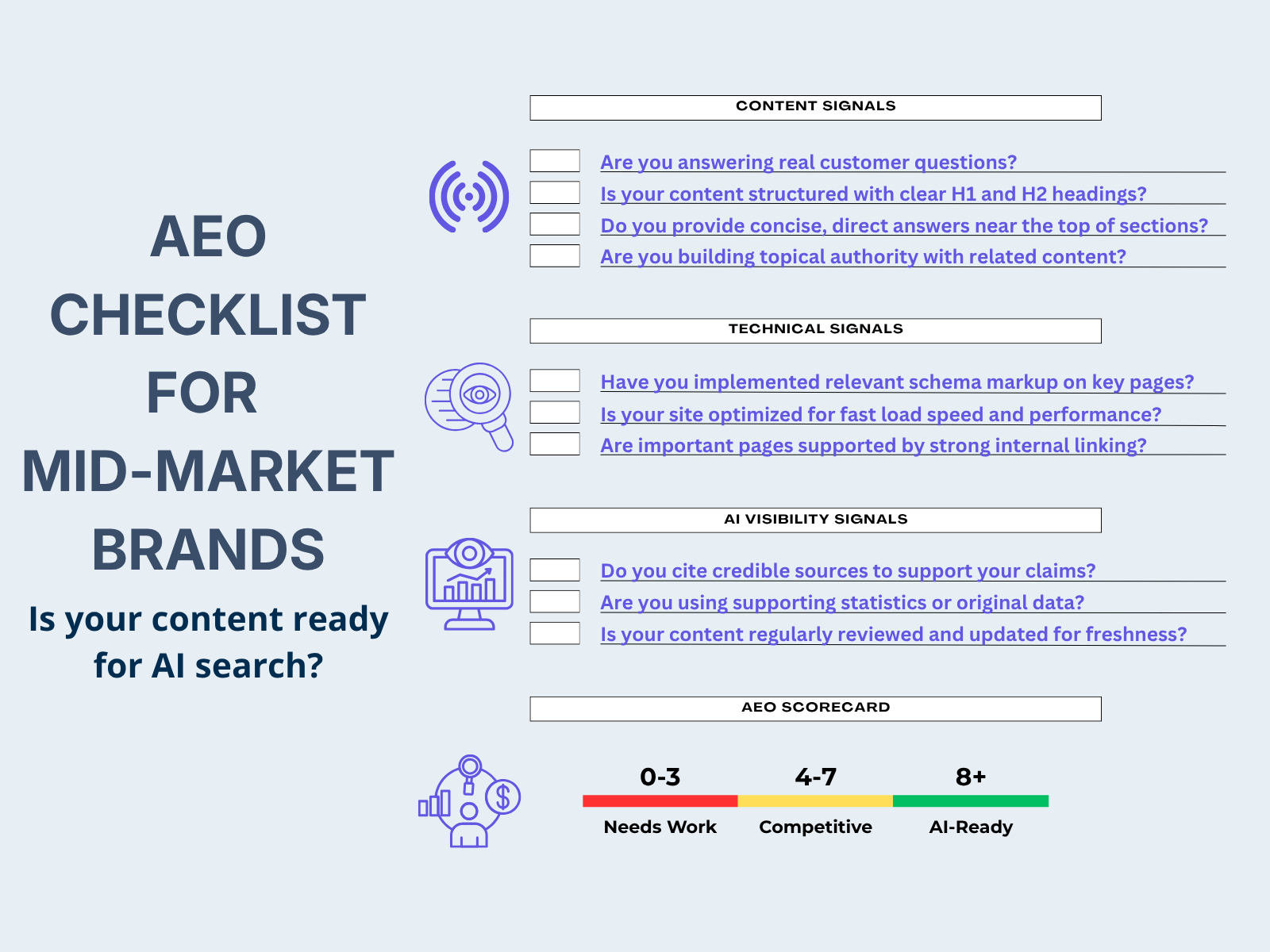
Tracking AEO Performance
Tracking Answer Engine Optimization performance is essential. Brands cannot improve visibility in AI-generated responses without understanding where they currently stand. Unlike traditional SEO, where rankings and click-through rates provide clear indicators of success, AEO performance requires monitoring citation visibility, brand presence in AI responses, and the quality of traffic arriving from AI-driven search experiences.
AI search reporting tools are continuing to evolve, but marketers can already gain meaningful insights by combining multiple data sources. Google Search Console now provides reporting related to AI Overviews impressions and clicks, helping teams understand how often their content is surfaced in AI-enhanced search results. Third-party platforms such as Semrush and Ahrefs also offer emerging tools for tracking AI share of voice, brand mentions, and competitive visibility within AI search environments.
Key performance indicators for AEO include:
- AI citation frequency and brand mention volume
- Share of voice within AI-generated answers for priority topics
- Referral traffic from AI platforms and AI-enhanced search results
- Engagement and conversion rates of AI-driven visitors
- Organic traffic trends on pages specifically optimized for AEO
Establishing a consistent review cycle allows teams to identify declining citation visibility, refresh content proactively, improve schema implementation, and strengthen authority signals. Because AI models continuously adapt and content freshness influences citation likelihood, Answer Engine Optimization should be treated as an ongoing optimization process rather than a one-time initiative.
Organizations that invest in structured AEO tracking are better positioned to maintain visibility as AI search evolves and competitive landscapes shift.
Start Optimizing for AI Models
Brands that succeed in AI-driven search environments take a proactive approach. They structure content for clarity, build credible authority signals across the web, and continuously adapt to how answer engines evaluate and surface information. As AI search becomes a primary discovery channel for research and purchase decisions, visibility in AI-generated responses is no longer optional. It is a competitive advantage.
For local and regional businesses, optimizing structured data, reviews, service content, and location signals can significantly increase visibility for high-intent queries surfaced through AI platforms. For national or B2B brands, developing comprehensive topic authority and consistent brand mentions across trusted sources improves the likelihood of being cited as a preferred answer. In both cases, combining technical SEO, high-quality content strategy, and AI-aligned optimization creates stronger long-term search performance.
Implementing AEO effectively requires more than updating blog formatting or adding schema markup. It involves aligning content strategy, analytics tracking, authority development, and platform-specific optimization into a unified approach. Businesses that treat AEO as part of a broader digital growth strategy are better positioned to earn sustained visibility as AI search ecosystems continue to evolve.
Finding the Right AEO Partner
The right Answer Engine Optimization partner depends on your organization’s goals, resources, and how AI search fits into your broader marketing strategy. Some businesses need tactical support to improve content structure and technical implementation, while others benefit from a fully integrated strategy that connects AI visibility to revenue performance.
At 20North Marketing, we take a holistic approach to AI SEO. Our team actively monitors how AI platforms surface content, tracks citation visibility for client brands, and tests strategies that improve discoverability across evolving search environments. We integrate AEO into comprehensive digital marketing programs that include SEO, paid media, analytics, email marketing, and web development. This ensures AI visibility contributes to measurable growth rather than existing as an isolated initiative.
If you want to understand where your brand stands in the emerging answer layer and how to improve your position, connect with the team at 20North Marketing. We can help you build an AI-aligned search strategy that strengthens authority, increases qualified traffic, and creates a sustainable competitive advantage.
.png)
.png)
.png)