
.png)
The Short Answer: The most helpful practice is writing clear, detailed prompts that give the AI model context, a goal, and any rules to follow. Good prompting steers the model toward useful outputs, and it works best as an iterative process where you refine the prompt until the results fit your needs.
When people ask about training AI models with prompts, they usually mean guiding a model to give better answers. They are not talking about building the model itself. That skill is called prompt engineering. A large language model already learned from huge amounts of training data, so your prompt does not change the model. It shapes the response for one task. Getting this right saves time and gives you content you can actually use. This blog post walks through the practices that lead to better results, plus how to keep sensitive information safe while you work. We use these methods every day, so we will keep it practical.
At a Glance
- What prompting does: it guides a model's response for one task, and does not retrain the model.
- What works: clear goals, context, examples, a defined role, and explicit instructions.
- How to improve: treat it as an iterative process and refine based on the output.
- What to protect: keep confidential information out of prompts and watch for prompt injection.
What "Training AI Models with Prompts" Really Means
A generative AI tool like Claude or another large language model runs on a neural network that was trained long before you typed anything. Your prompt is the input data for a single request. It does not add to the model's training data or change how the AI system works for other people.
So "training with prompts" is really about steering. You give the AI context and explicit instructions, and the model produces a final output that matches. The clearer your prompt, the closer the AI's response lands to what you wanted. This is why prompt design matters so much for content creation and other daily tasks.
Why Better Prompts Are Worth the Effort
Strong prompts turn artificial intelligence into a real work tool. The potential benefits show up fast: quicker drafts, cleaner research, and fewer rounds of edits. Effective prompts also make AI a solid educational tool, since you can ask a model to explain a topic at the level you need. Teams that write good AI prompts get consistent output across people and projects. Generative artificial intelligence rewards clear direction, so the effort you put into prompt design pays back every time you reuse a prompt. If you want to compare options, our guide to the best AI tools for SEO is a good place to start.
Best Practices for Prompting AI Models
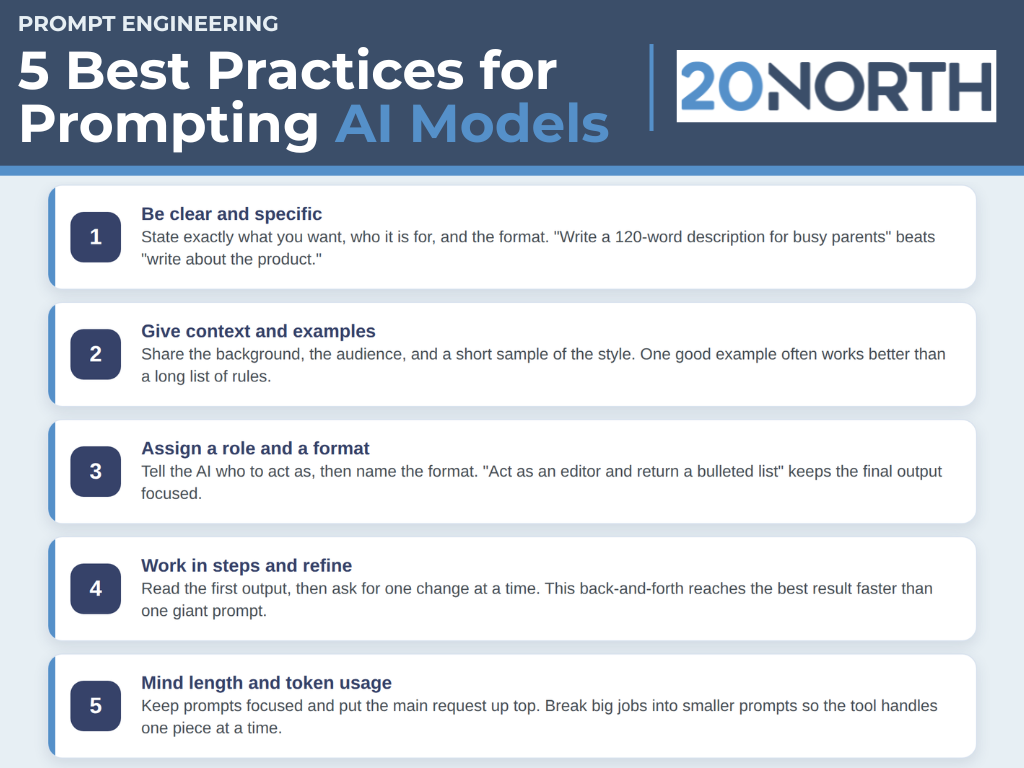
These practices apply to almost any AI tool and any task. Each one gives the model more of what it needs to help you.
Be Clear and Specific
Vague prompts get vague answers. Detailed prompts get useful outputs. State exactly what you want, who it is for, and how long it should be. If you have specific needs like a tone or a format, say so up front. Explicit instructions beat hints every time. The model cannot read your mind, so spell out anything that matters to the result.
Give Context and Examples
Context helps the model understand the job. Share the background, the audience, and a short example of the style you want. A generative AI system uses that input data to match your intent. One or two examples often improve results more than a longer set of rules. The more relevant detail you give, the less the model has to guess, and the fewer edits you make later.
Assign a Role and a Format
Telling the AI its role focuses the answer. Ask it to act as an editor, a researcher, or a support agent, then name the format you want back, such as a table, a list, or a short summary. Defining the AI's role and the shape of the final output keeps different tasks organized.
Work in Steps and Refine
Prompting is an iterative process. Start with a first prompt, read the output, then adjust. Ask the model to fix one thing at a time. This back-and-forth is one of the most effective ways to reach the best results, and it usually beats trying to write one perfect prompt.
Mind Length and Token Usage
Longer prompts cost more token usage and can bury the main request. Keep prompts focused. Put the most important instruction near the top. If a task is large, break it into smaller prompts so the AI application handles one piece at a time. Shorter, focused prompts are also cheaper and faster, which adds up when a whole team prompts every day.
Pro Tip: Save your best prompts in a shared document. When a prompt gives great results, note what made it work. Over time your team builds a library that makes AI use faster and more consistent.
Keep Prompts Safe: Privacy and Security
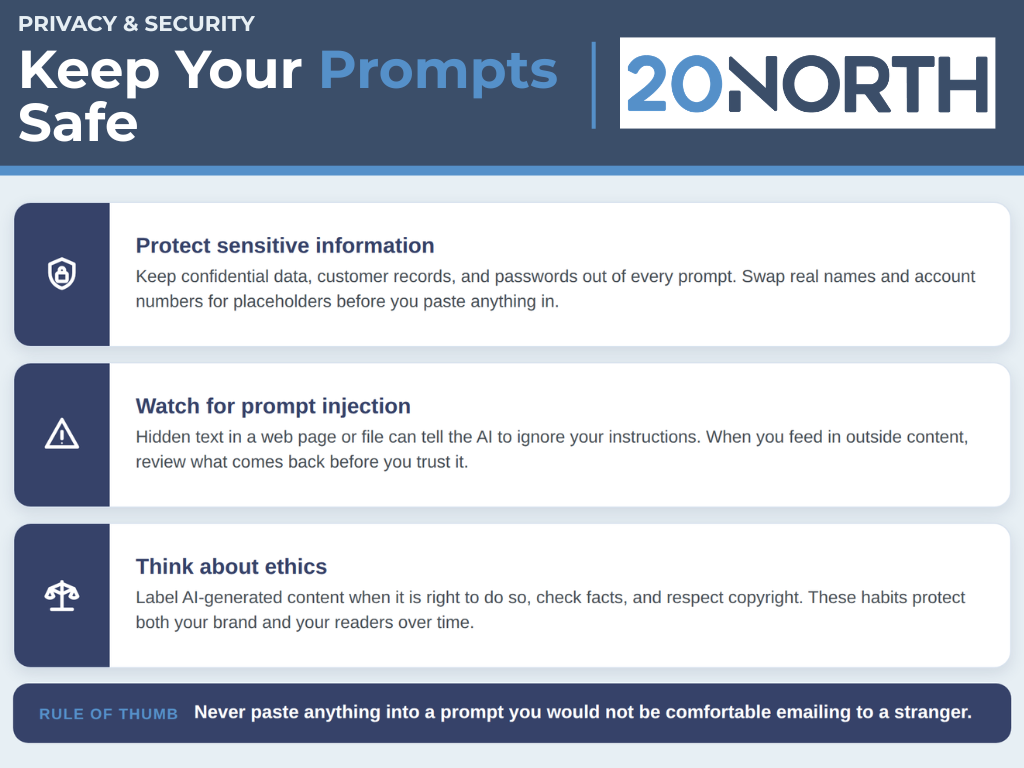
Good prompting also means safe prompting. Some tools may keep your inputs, and policies differ by provider, so treat every prompt as if someone could read it later. A few simple habits keep your team out of trouble without slowing anyone down.
Protect Sensitive Information
Do not paste confidential information, customer records, or passwords into a prompt. For data protection, remove names and account numbers first. These privacy risks are simple to avoid once your team has a rule for what stays out.
Watch for Prompt Injection
A prompt injection attack happens when hidden text in a web page or document tells the AI to ignore your instructions. If you feed outside content into a tool, review what comes back. Prompt injection is a real reason to check AI-generated content before you publish it.
Think About Ethics
AI ethics matter for any business. Label AI-generated content when it is right to do so, check facts, and respect copyright. These ethical considerations protect your brand and your readers. The same care that keeps your content accurate also supports your AI visibility in search, because search engines and AI tools favor reliable sources. The OWASP Top 10 for large language model applications is a useful reference for teams that want to go deeper on AI security.
Want AI to work harder for your marketing? 20North helps businesses use AI tools for content and search the right way. See our AI SEO services or talk to our team about a plan for your business.
Getting Better Results From Your Prompts
Good prompting is a skill any team can learn. Clear, detailed prompts with context and a defined role give the best results, and treating prompt design as an iterative process gets you there faster. Keep confidential information out of your prompts, watch for prompt injection, and check AI-generated content before it goes live. These practices pull more of the AI's potential into your daily work without extra risk. As generative AI becomes a normal part of marketing across the industry, the teams that prompt well will move faster than the ones that guess. At 20North, we help businesses put AI to work for content and search. Explore our AI SEO services or reach out to our team to get started.
.png)
.png)
.png)