
.png)
E-Commerce Analytics Tools: How to Measure Marketing Results
The short answer: E-commerce analytics tools help brands connect marketing activity to revenue by tracking where customers come from, what they do on an online store, and which campaigns lead to purchases. The right measurement setup turns scattered data from SEO, Google Ads, email, paid social, and Shopify into decisions your team can act on.
For many e-commerce teams, the hard part is not a lack of data. It is having too many dashboards, inconsistent attribution, incomplete tracking, and no shared definition of success. A useful e-commerce analytics tool should help you see the customer journey then identify the marketing efforts worth expanding, improving, or pausing.
Google Analytics can capture shopping behavior through e-commerce events, including product views, cart activity, checkout actions, and purchases. Shopify also provides built-in reporting for sales, customers, inventory, and channel performance. Together, those platforms can form a practical starting point for many e-commerce brands.
What Are E-Commerce Analytics Tools?
E-commerce analytics tools collect data from your website, sales channels, advertising platforms, email platform, and customer database. Their purpose is to show how people discover your brand, move through the site, purchase, and return.
For an e-commerce business, analytics is more than checking daily revenue. It is a way to answer questions such as:
- Which marketing channels generate the most profitable customers?
- Which landing pages attract traffic but fail to convert?
- What products are frequently viewed but rarely added to cart?
- How does email influence repeat purchases and customer lifetime value?
- Which Google Ads campaigns drive revenue rather than just clicks?
- Where do customers leave the checkout process?
- Which SEO pages contribute to sales over time?
The best e-commerce analytics setup connects these answers to business goals. If your goal is profitable growth, a dashboard focused only on website traffic will not be enough. You also need visibility into conversion rate, average order value, acquisition cost, customer behavior, and lifetime value.
The Metrics That Matter Most
Every brand should tailor its key metrics to its margins, buying cycle, and growth goals. The following measures give most e-commerce teams a strong foundation.
- Website Traffic
- Conversion Rate
- Average Order Value
- Customer Acquisition Cost
- Customer Lifetime Value
- Return on Ad Spend
- Add-to-Cart Rate
- Checkout Completion Rate
- Revenue by Channel
- Repeat Purchase Rate
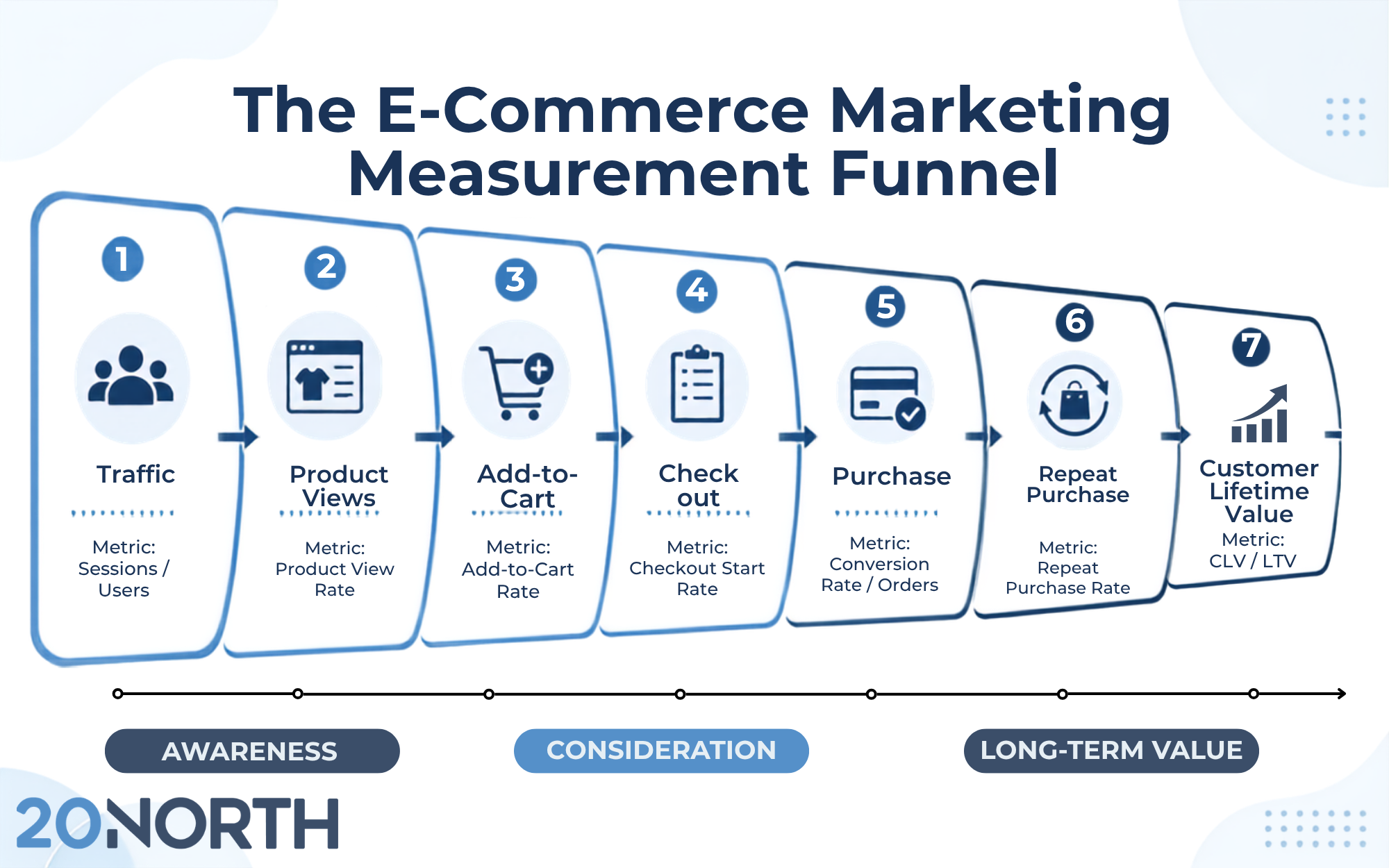
A clear measurement plan gives your team a consistent way to connect marketing activity with revenue outcomes. Buying more data analytics tools will not solve unclear goals or unreliable tracking. Start by establishing a measurement framework that everyone on the team can use.
Define the Business Objective
A marketing campaign should have a defined job. That might mean acquiring first-time customers, increasing average order value, improving repeat purchase rate, clearing inventory, or growing organic visibility for a high-margin product category.
Each objective needs a primary metric and supporting metrics.
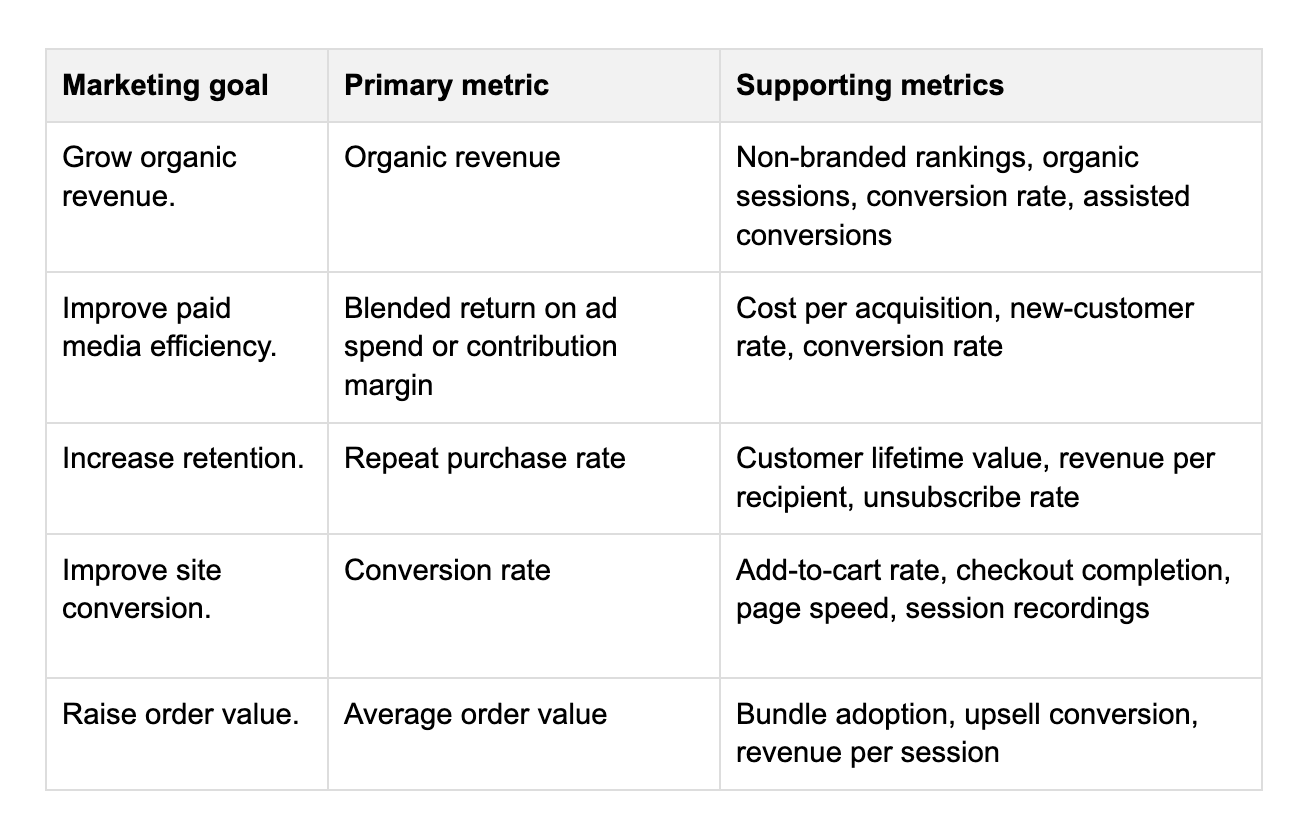
This step prevents teams from overvaluing vanity metrics. A paid campaign can generate strong click-through rates while attracting visitors who never become customers. Similarly, an SEO content page may generate modest traffic but create meaningful revenue if it attracts high-intent searchers.
Create Shared Definitions
Before comparing performance across platforms, agree on what each metric means.
For example:
- Does conversion rate include all sessions or only qualified sessions?
- Is revenue gross sales, net sales, or revenue after refunds?
- Is customer acquisition cost based on media spend only, or does it include agency, creative, and production costs?
- What attribution window is being used for email, Google Ads, and Meta Ads?
- How are new and returning customers identified?
Without these definitions, two reports can present different answers to the same question.
Core E-commerce Analytics Tools
Most brands do not need every platform available. They need the right tool for each layer of measurement, along with clean connections between systems.
Shopify Analytics
For Shopify merchants, Shopify Analytics is often the first data source to review. It provides store-level reporting for sales, customers, orders, inventory, and marketing performance. Shopify’s reporting interface also allows users to explore and customize reports around particular metrics and dimensions.
Shopify analytics is particularly useful for:
- Daily sales and order trends
- Sales by product, collection, or location
- Customer cohorts and returning-customer activity
- Average order value
- Inventory and product performance
- Channel-level marketing reports
Google Analytics 4
Google Analytics is a foundational web analytics service for tracking website traffic, user behavior, marketing-channel performance, and ecommerce events. A properly configured GA4 property can capture the path from product view to purchase, helping teams assess product popularity, promotions, and revenue-driving activity.
For e-commerce teams, confirm that these events are being collected accurately:
- view_item
- view_item_list
- select_item
- add_to_cart
- view_cart
- begin_checkout
- add_payment_info
- purchase
When you track the full funnel, you can see whether conversion problems begin on product pages, in the cart, during shipping selection, or at payment.
Advertising Platform Analytics
Google Ads, Meta Ads, TikTok, and other advertising platforms each report their own view of campaign results. These platforms are useful for campaign-level management because they show spend, impressions, clicks, audience performance, creative results, and platform-attributed conversions.
Ad-platform reporting should not be treated as the only source of truth. Each platform has an incentive to claim credit for conversions, and a customer may interact with multiple marketing channels before purchasing. Use ad-platform data to optimize within the platform. Use Shopify, Google Analytics, and a broader performance view to judge the business impact of your total marketing effort.
For brands investing in paid search, a disciplined Google Ads management approach should connect campaign reporting to product margin, new-customer acquisition, landing-page performance, and total revenue rather than judging success by clicks.
Email and Customer Data Platforms
Email platforms can show campaign revenue, flow performance, segment behavior, and repeat customer activity. For brands with a long buying cycle or frequent replenishment purchases, this data is especially valuable.
Measure email beyond opens and clicks:
- Revenue per recipient
- Conversion rate by audience segment
- Repeat-purchase timing
- Win-back conversion
- Customer lifetime value by acquisition source
A well-managed email marketing program can use this information to send better-timed messages, improve segmentation, and build retention after a customer’s first order.
Behavior and CRO Tools
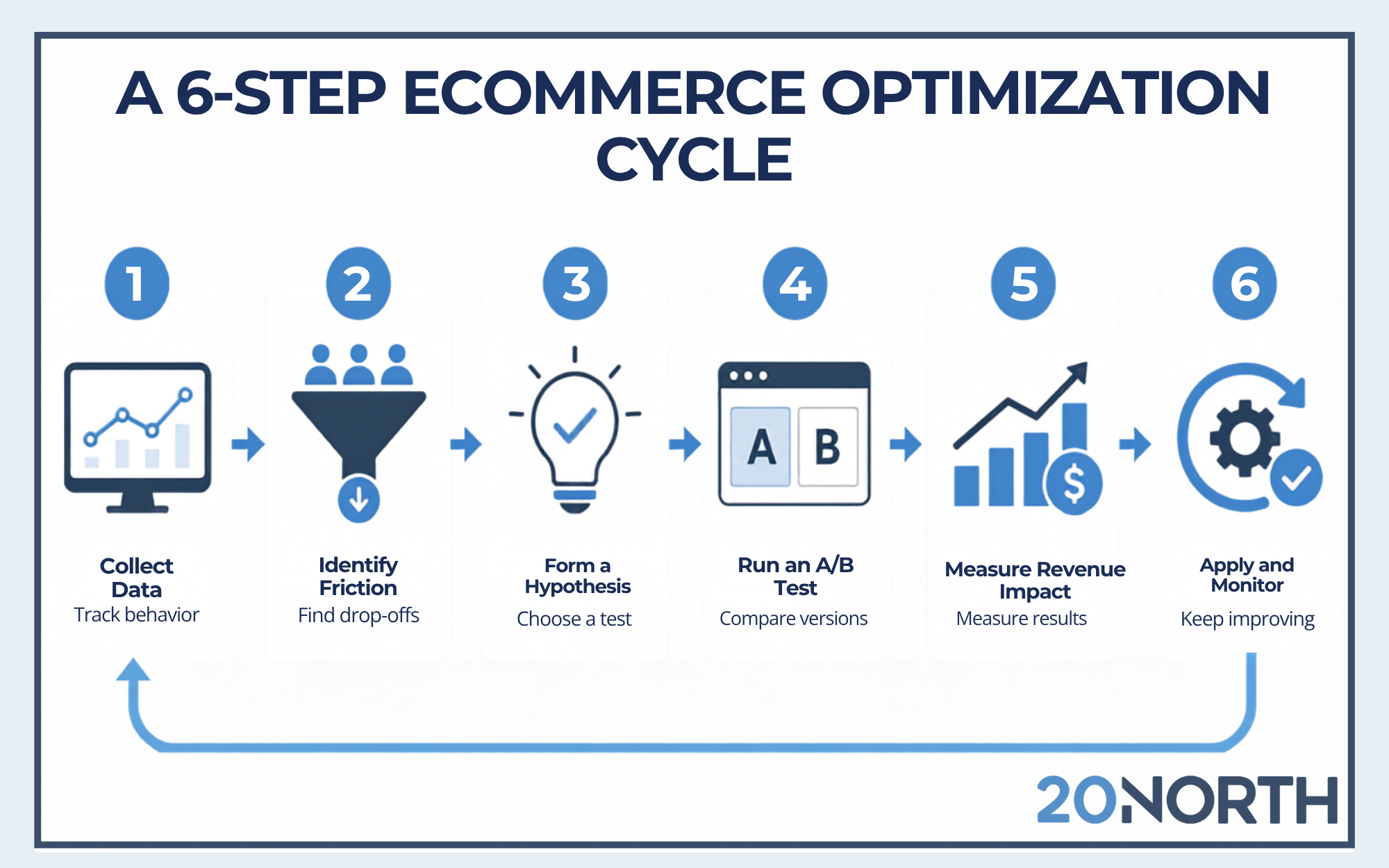
Conversion rate optimization, or CRO, uses data and testing to improve the percentage of visitors who take a desired action. CRO is a structured process for finding and reducing friction in the customer journey.
CRO tools help answer questions that sales reports cannot:
- Are visitors seeing the product details they need?
- Are mobile users struggling with navigation?
- Does ecommerce site search return relevant products?
- Are shoppers abandoning a form field or shipping step?
- Do customers understand delivery timing, returns, and product options?
- Which version of a product page produces a higher conversion rate?
Session recordings can be useful, but they should be interpreted carefully. A few recordings may surface a hypothesis, not prove a conclusion. Validate findings with enough data, then run an A/B test where practical.
Advanced Attribution and Data Tools
As brands grow, they may add advanced tools such as customer data platforms, predictive analytics tools, or a data warehouse.
These platforms may be appropriate when your e-commerce business has:
- Significant spend across several paid channels
- Complex attribution needs
- Multiple storefronts or markets
- A large product catalog
- Subscription or high-repeat-purchase behavior
- A need to combine ecommerce, finance, fulfillment, and customer-support data
- Large volumes of historical data
The right analytics tools depend on the questions your team needs answered. An advanced analytics platform can be helpful, but it cannot correct inaccurate source data or poor campaign tagging.
How to Measure Marketing Results by Channel
SEO and Search Engine Commerce
Search engine commerce refers to the work of making your products discoverable when people search for category terms, product attributes, brand comparisons, and purchase-focused queries. Organic search is often evaluated too narrowly through rankings and traffic.
A stronger SEO measurement model includes:
- Organic revenue and conversion rate
- Non-branded versus branded traffic
- Revenue by landing page
- Product and collection page performance
- Visibility for high-intent category terms
- Search impressions and click-through rate
- Assisted conversions from informational content
- Internal site-search behavior
For Shopify merchants, effective SEO also requires well-structured collection pages, indexable product pages, useful content, fast page experiences, and accurate technical foundations. Shopify SEO services focus on product pages, collection pages, URLs, schema markup, metadata, and content strategy to help turn search visibility into online sales.
Paid Media
Paid media results should be analyzed at more than one level:
- Platform level: Which campaigns, audiences, creative assets, and keywords drive results?
- Site level: Do paid visitors convert at a healthy rate after they reach the site?
- Business level: Is the program producing profitable new customers and sustainable revenue?
Review landing pages alongside ad data. If an ad earns clicks but the landing page has a poor conversion rate, the issue may be page speed, mobile usability, product information, price positioning, or a disconnect between the ad and the offer.
High-performing Google Ads search terms and product categories often reveal language that buyers use, which can guide organic content, collection-page optimization, and e-commerce site search improvements.
Email Marketing
Email should be measured as a retention and revenue channel, not merely a campaign calendar.
Track performance across:
- Welcome series
- Browse-abandonment flows
- Cart-abandonment flows
- Post-purchase flows
- Product-replenishment messages
- Win-back sequences
- Promotional campaigns
- VIP or high-value customer segments
Compare first-time buyers and returning customers. If a campaign creates revenue but depends entirely on discounting, it may hurt margin or train customers to wait for promotions. Segment-level reporting helps reveal whether email is producing healthy, repeatable revenue.
Web Development and User Experience
Website development affects every marketing channel. Even strong ads, SEO, and email campaigns can underperform if a site is slow, difficult to navigate, or confusing on mobile.
Monitor:
- Core conversion funnel events
- Mobile versus desktop conversion rate
- Product-page engagement
- Site speed and page-load behavior
- Ecommerce site search usage and search-exit rate
- Error pages and broken links
- Checkout errors
- Form completion rate
- Performance of new landing pages
A web development partner should build with both user experience and search visibility in mind, connecting technical decisions to measurable business outcomes.
A Practical CRO Checklist
Use this CRO checklist before making major changes to your store or campaigns:
- Verify that Google Analytics, Shopify, Google Ads, and email-platform revenue are tracking consistently.
- Test product views, add-to-cart events, checkout steps, and purchase events using a real customer journey.
- Review conversion rate by device, channel, landing page, and new versus returning visitor.
- Identify product pages with high traffic but low add-to-cart rates.
- Review cart abandonment and checkout completion for unexpected drop-offs.
- Watch session recordings and heatmaps for recurring friction, especially on mobile.
- Audit site search terms to identify products customers expect to find.
- Test one clear hypothesis at a time through A/B testing.
- Measure the impact on revenue, average order value, and conversion rate rather than judging only clicks.
- Document findings so future campaigns and development work build on prior learning.
Get More From Your E-commerce Data
E-commerce analytics tools work best when SEO, paid media, email, and web development teams use the same business goals and measurement standards. That shared view makes it easier to identify where revenue is being created, where the customer journey is breaking down, and where the next investment should go.
20North Marketing helps e-commerce brands connect digital marketing activity to measurable growth through SEO, paid media, email marketing, and web development. As a Shopify Premier Partner, the team can help brands assess tracking, improve channel performance, and make data-driven decisions that support revenue growth. Ready to turn your e-commerce data into smarter marketing decisions? Contact 20North Marketing to build a strategy across SEO, paid media, email, and web development.
.png)
.png)
.png)