
.png)
The Short Answer: Generative AI creates new content like product descriptions and images when you prompt it. Agentic AI goes further and takes action, completing multi-step tasks on its own with minimal human oversight. One writes and designs, the other does the work.
Generative AI vs agentic AI is one of the most useful comparisons for online store owners right now. Both run on artificial intelligence, but they serve a different purpose. Generative AI helps you make content faster. Agentic AI can run a task end to end, like handling a customer service request or reordering stock. Knowing which one fits a job saves money and avoids headaches. In this guide, we explain how each works, the main differences, how E-Commerce brands use them, and how to decide what your store needs. We work with online stores every day, so we will keep it plain.
At a Glance
- Generative AI: makes new content from a prompt, such as text, images, or code.
- Agentic AI: plans and completes tasks on its own using tools and data.
- The link: agentic systems often use a generative model as one part of the job.
- For stores: use generative AI to create, and agentic AI to act.
What Is Generative AI?
Generative AI is a type of artificial intelligence that produces new content. It learns patterns from huge amounts of training data, then uses that pattern recognition to write text, make images, or draft code. Most tools you know, like a large language model that answers questions, are built on a generative model. It can produce a first draft in seconds, which is why marketing teams reach for it first.
Generative AI is reactive. It waits for user input, then responds. Ask it for ten product titles and it writes ten titles. It uses natural language processing to understand your request and content generation to fill it. It is a powerful tool for content creation, but it does not act on its own. You can read AWS's overview of generative AI for more background.
What Is Agentic AI?
Agentic AI takes the next step. An AI agent goes beyond answering. It plans, makes decisions, and completes tasks with little human intervention. An agentic system can break a goal into steps, call external tools, pull from data sources, and check its own work along the way. Because it can act, an agentic AI system needs clear rules and limits so it stays inside what you allow.
The difference is autonomy. Traditional AI and generative models wait for you. Autonomous AI agents take autonomous action toward a specific goal. Give an agentic AI system a job like "process this return," and it can look up the order, apply the policy, issue the refund, and email the customer. This is why agentic workflows suit multi-step workflows that used to need a person. IBM's guide to agentic AI vs generative AI breaks down the technical side well.
Generative AI vs Agentic AI: The Main Differences
Both build on machine learning and neural networks, but they work in different ways. Generative AI creates content and waits for your prompt, while agentic AI takes action and runs multi-step work on its own.
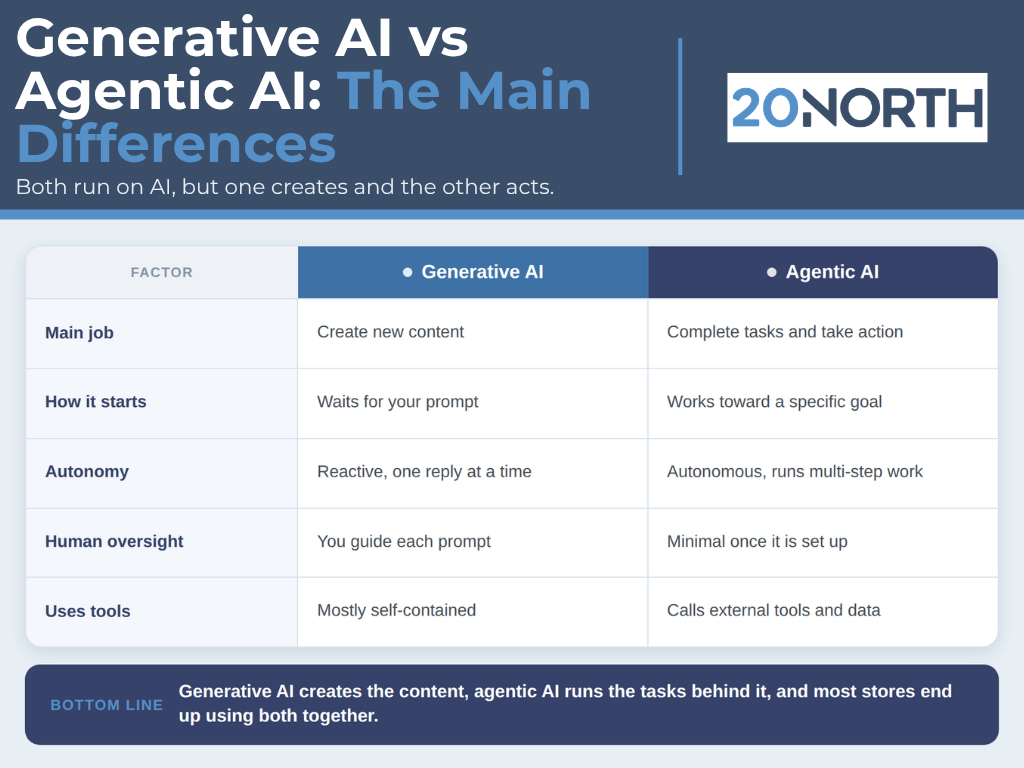
They also work together. An agentic system often uses a generative model to write a reply, plus retrieval-augmented generation to pull real facts before it acts. One creates, the other decides and does. This pairing is where much of the value sits, since the agent handles the busywork while the generative model supplies the words.
How E-Commerce Brands Use Each AI
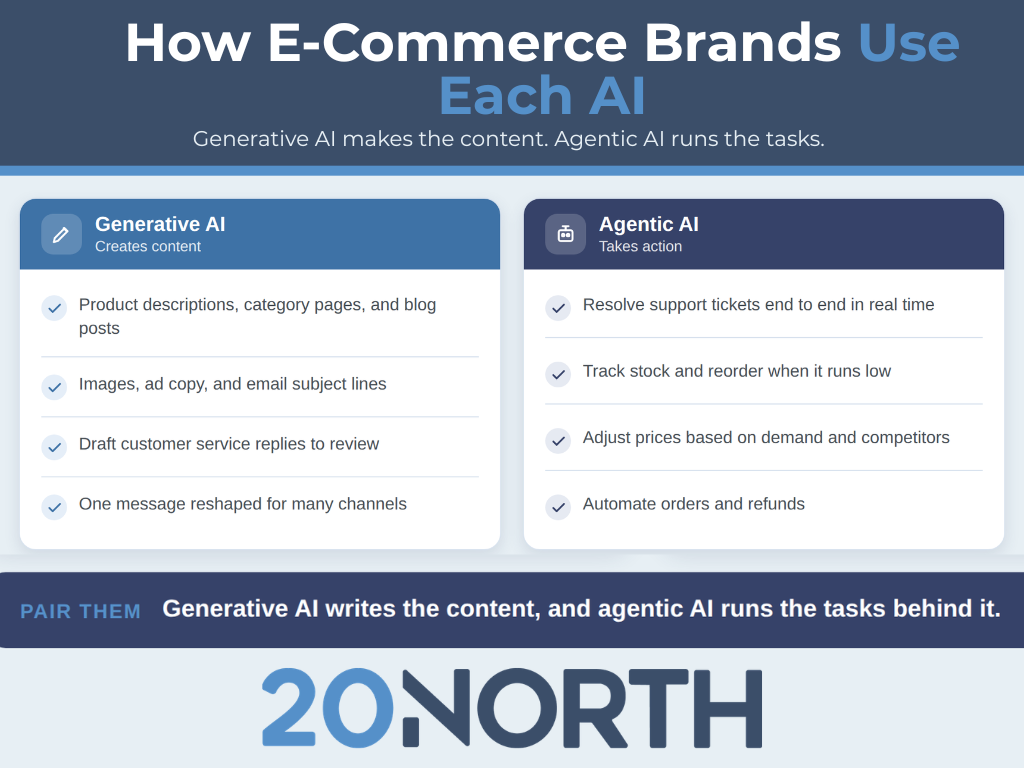
Both types of AI have a clear place in an online store. The right choice depends on the use case.
Generative AI in E-Commerce
Generative AI tools shine at making content at scale. Common jobs include:
- Writing product descriptions, category pages, and blog posts.
- Creating images, ad copy, and email subject lines.
- Drafting customer service replies for a person to review.
- Turning one message into versions for different channels.
These tasks still need a human to guide and approve the new content, which keeps quality and brand voice on track. A quick review also catches the odd mistake before it reaches a shopper.
Agentic AI in E-Commerce
Agentic AI fits jobs that have steps and rules. Common jobs include:
- Resolving customer service tickets end to end in real time.
- Tracking stock and reordering when it runs low.
- Adjusting prices based on demand and competitor data.
- Running robotic process automation for orders and refunds.
These autonomous systems can handle complex tasks that once tied up your team, which frees people for work that needs judgment. The trade-off is setup time and testing, since an agent that acts on its own has to be trusted with real orders and real money.
Pro Tip: Start with one narrow task before you hand an agent the whole store. Pick a repeatable job like return requests, set clear rules, and keep a person checking the results for the first few weeks.
Agentic AI Beyond the Store
Agentic AI is spreading across industries, so the ideas here are not limited to retail. Teams use autonomous agents for customer service, human resources tasks like screening applications, software development, and security operations that watch for threats. In each case, the AI handles decision making and takes action, then reports back to a person. Seeing how other fields use these agents makes it easier to spot where they fit in your own store. The pattern stays the same everywhere: create with one, act with the other.
Which One Does Your Store Need?
Most stores need both, just for different jobs. Use this quick guide.
- Choose generative AI when you need more content, faster: product copy, images, and campaigns.
- Choose agentic AI when you need a task done without a person doing every step.
- Combine them when a job needs both writing and action, such as an agent that drafts and sends a personalized win-back email.
The two often run side by side. A generative tool writes your product feed, and an agent keeps prices and stock in line behind it. Starting with one clear job for each makes the rollout easier to manage.
The same skills that go into generative and agentic AI also power search. As shoppers ask AI models to recommend products, your store needs content that these systems can read and trust. That work sits close to what agentic and generative tools already do, and it decides whether you show up in an AI answer. Getting named by these systems is quickly becoming its own sales channel.
Want AI to grow your store? 20North helps E-Commerce brands use AI for content and search the right way. See our AI SEO services or talk to our team about a plan for your store.
Put Generative and Agentic AI to Work With 20North
Generative AI and agentic AI are not rivals. Generative AI creates the content your store runs on, and agentic AI completes the tasks behind it. Generative AI reacts to your prompts, while agentic AI takes action toward a goal on its own. Most online stores get the best results by using generative tools for content and agentic tools for repeatable work, then keeping a person in the loop. As AI keeps shaping the future of E-Commerce, the brands that use each tool for the right job will move faster. At 20North, we help stores put AI to work for content and search. Explore our AI SEO services or reach out to our team to get started.
.png)
.png)
.png)