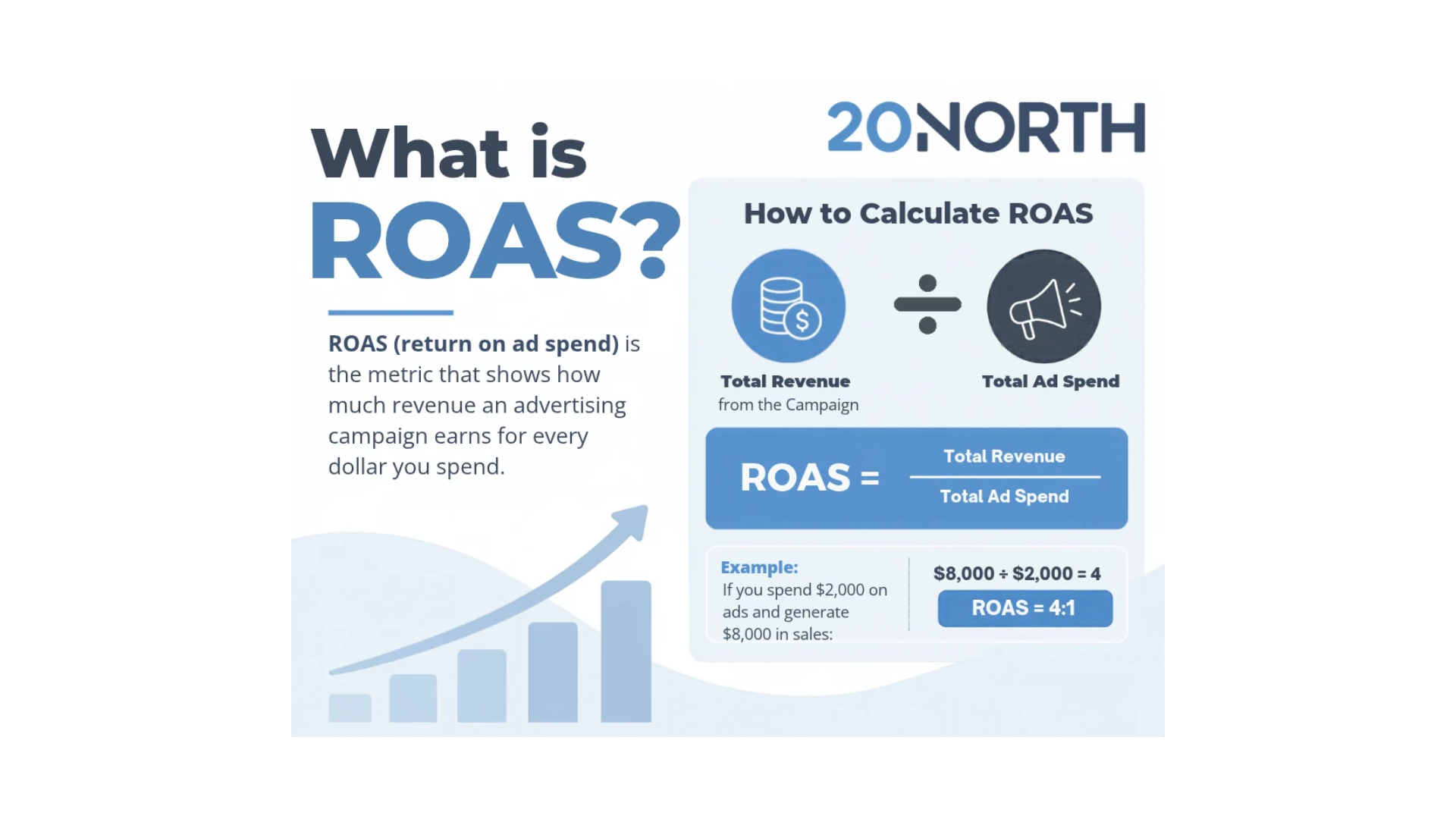
The Short Answer: ROAS, or return on ad spend, is the marketing metric that shows how much revenue an advertising campaign earns for every dollar of ad spend. The ROAS formula is simple: divide total revenue from a campaign by its total ad spend. A higher ROAS means your advertising is working harder for the money you put into it.
Every dollar you put into digital advertising should come back with more dollars behind it. ROAS is how you find out if that is happening. It turns a pile of spend and sales data into one number you can act on, and a clean ROAS calculation can tell you which campaigns to scale, which to fix, and which to cut.
What Is ROAS?
ROAS is a marketing metric that measures the revenue generated by an advertising campaign against what you spent to run it. People express it as a ratio, such as 4:1, or as a percentage, such as 400%. Either way, the ROAS ratio answers the question for every dollar of ad spend, how many dollars came back?
ROAS is often confused with return on investment, but ROI accounts for your full cost of doing business while ROAS looks only at advertising costs and the revenue tied to them. That narrower focus makes ROAS a faster read on how your digital advertising is performing right now, which is why it pairs well with your profit margin when you want the complete picture.
How to Calculate ROAS
The ROAS Formula
The ROAS formula is straightforward:
ROAS = Total Revenue from the Campaign ÷ Total Ad Spend
Total revenue is the sales your ad campaign produced. Total ad spend is everything you paid to run it. You can run the calculation by hand or let a ROAS calculator inside your ad platform do it for you.
A ROAS Calculation Example
Say you spend $2,000 on a Google Ads campaign and it brings in $8,000 in sales. Your ROAS calculation is $8,000 divided by $2,000, which equals 4, or a ROAS of 4:1. For every dollar of ad spend, the campaign returned four dollars in revenue.
Account for the Costs Behind the Number
A clean ROAS depends on counting the total cost of a campaign, not just the media budget. Platform fees, transaction fees, creative production, and shipping costs all eat into the money you actually keep. Two campaigns can share the same ad revenue and the same headline ROAS while one earns a profit and the other loses money once those additional costs are added in. Fold them into your numbers so the metric reflects reality.
Why ROAS Is Important
ROAS connects your marketing efforts to revenue, which is why it sits at the center of most paid media reporting. For e-commerce businesses especially, it is the headline number. It tells you which advertising campaign is pulling its weight and which one is draining the budget, so you can move money toward the work that pays.
Google Ads can be a strong revenue channel when it is managed well. Google estimates that businesses earn an average of $2 in revenue for every $1 they spend on Google Ads, and disciplined campaigns can push well past that. Tracking ROAS is how you know whether you are beating the average or falling behind it.
ROAS also makes it easy to compare one ad platform against another on equal footing. A high ROAS on one channel and a low ROAS on another is a clear signal about where your next dollar should go. Keep in mind that a single metric cannot capture everything. Some campaigns build brand awareness that pays off later, so read ROAS alongside your other goals rather than on its own.
What Counts as a Good ROAS?
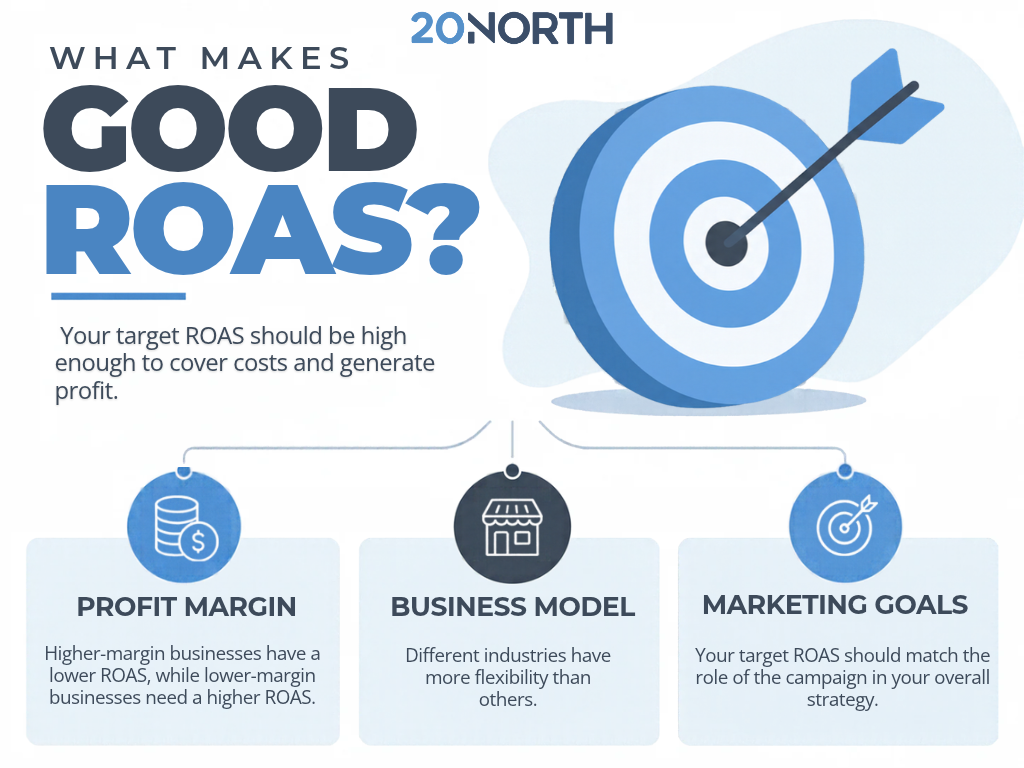
There is no universal answer. A good ROAS depends on your profit margin, your business model, and the role a campaign plays in your marketing strategy. A high-margin software company can thrive on a lower ROAS than an e-commerce business selling physical goods with thin margins.
Break-Even ROAS
Your break even ROAS is the point where revenue from a campaign equals its total cost. If your profit margin is 25%, you need roughly a 4:1 return just to break even, which makes 4:1 your minimum ROAS. Anything below that loses money, and anything above it starts to turn a profit. Knowing this number keeps you from celebrating a campaign that looks healthy but is actually underwater.
Target ROAS
Once you know your break-even point, you can set a target ROAS that reflects the profit you want, not just the profit you need. Many advertisers aim well above break-even to leave room for additional costs and growth. As you scale spending, watch your marginal ROAS, the return on the next dollar added, because it often dips below your average ROAS once a campaign reaches its most efficient audience.
How to Improve Your ROAS
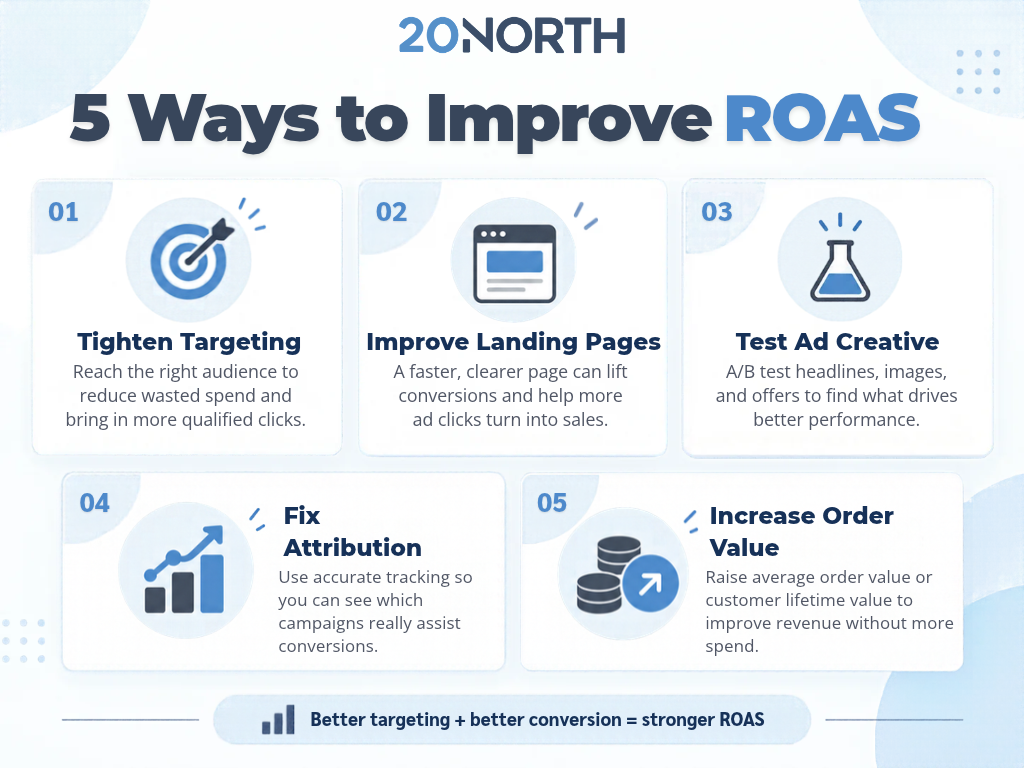
A low ROAS rarely means your advertising effort is wasted. More often it points to a fixable gap between the click and the sale.
A low ROAS rarely means your advertising effort is wasted, and these moves close the most common gaps between the click and the sale:
- Tightening your targeting reaches the right target audience, which means fewer wasted impressions and more qualified clicks that convert into revenue.
- Sending clicks to a faster, clearer landing page earns more of the sales those clicks are worth, lifting both your conversion rate and your ROAS.
- Running methodical A/B testing on copy, creative, and offers shows you what actually moves performance instead of what you assume will.
- Building a sound attribution model credits the right touchpoints, so a campaign that assists conversions is not written off as a weak performer.
- Raising average order value and customer lifetime value makes each potential customer worth more, which pulls your ROAS up without touching ad spend.
Smart bidding tools now use predictive analytics to adjust bids toward your target in real time, and pairing paid media with SEO and content marketing lowers your blended cost per sale over time.
Putting ROAS to Work
ROAS ties advertising spend to the revenue it creates, and a consistent ROAS calculation turns guesswork into a plan you can defend. It pulls the whole picture into one number, including the ad spend you put in, the revenue that comes back, and whether a campaign is worth scaling. The number is only as strong as the strategy behind it, including the audiences you target, the pages you send clicks to, and the margins you measure against.
20North is a full-service digital marketing agency in Atlanta that helps growing businesses get more from every advertising dollar. Our paid media team builds and manages marketing campaigns around the metrics that matter, including ROAS. That work is backed by SEO, email marketing, and web development, so every channel pulls toward the same revenue goals. We track performance, test what is working, and refine campaigns to keep your return climbing over time.
Reach out today for a free audit and see where your ad spend could be working harder.