
.png)
The Short Answer: An AI visibility audit measures how often your brand appears in AI-generated responses, how accurately those answers describe you, and which sources AI platforms cite when they mention you. To run one, test a set of customer questions in tools like ChatGPT, Gemini, and Google AI Overviews. Log every answer, spot where your brand is missing or wrong, and turn those gaps into an action plan.
More people now ask an AI engine for recommendations before they open a website, and most of them are asking questions they used to type into a search bar. That shift makes your SEO work more valuable, because AI platforms build their answers from pages that search engines already crawl, index, and rank. Strong performance in traditional search is what earns you a seat inside AI-generated responses, and the brands cited most often tend to be the ones with the deepest SEO foundation behind them.
An AI visibility audit measures the second layer of brand visibility that sits on top of that work, showing how your pages get used when someone asks an AI tool instead of running a search.
What Is an AI Visibility Audit?
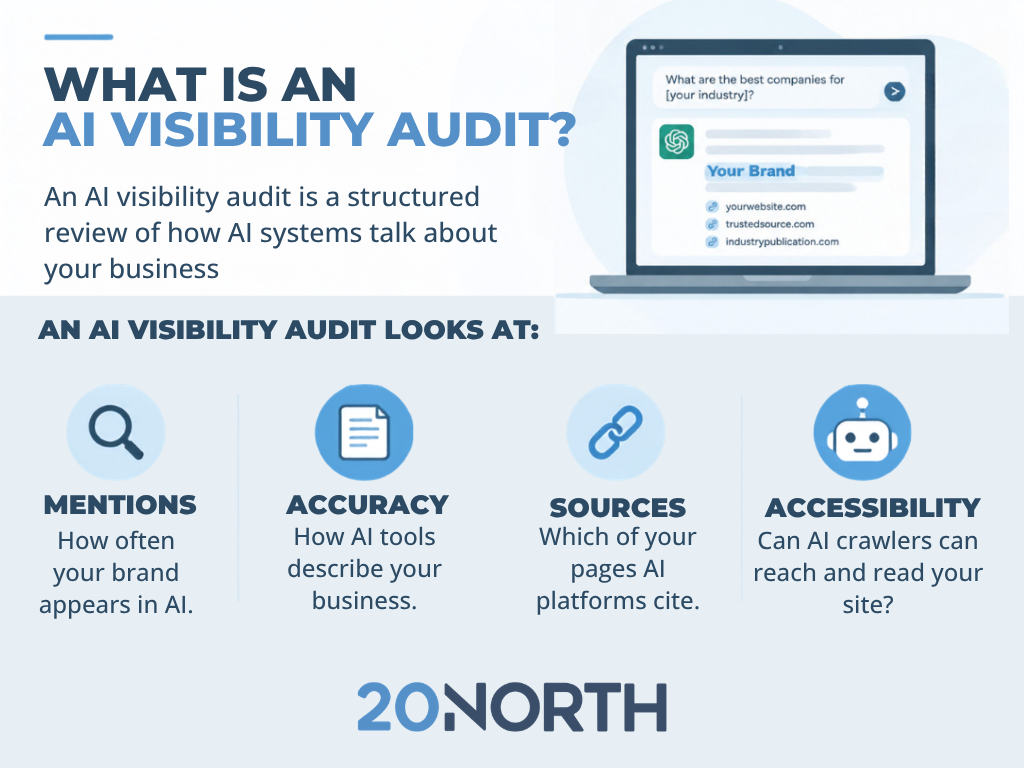
An AI visibility audit is a structured review of how AI systems talk about your business. It looks at how often your brand is mentioned, what the AI answer says about you, and which pages or third-party sources the model relies on. An audit will also check if AI crawlers can reach your site at all.
Think of it as the generative engine optimization version of a technical SEO audit. A standard audit shows how search engines crawl and rank your pages, while an AI visibility audit shows how an answer engine interprets your brand and if it trusts you enough to recommend you. The two platforms work best together, which is why answer engine optimization and SEO share a majority of the same foundation.
Why AI Visibility Matters for Your Business
AI-powered search reaches a very large audience. In its Q2 2026 earnings remarks, Google reported that AI Mode has passed 1 billion monthly active users and that the Gemini app has about 950 million monthly active users.
These tools have changed how people click. A Pew Research Center analysis found that Google users who saw an AI summary clicked a traditional result in 8% of visits, compared with 15% of visits for users who did not see one. When fewer people click through, the brands named inside the AI answer get more of the attention. For a business owner, that attention can turn into qualified leads before a prospect reaches your website.
How to Run an AI Visibility Audit
1. Define Your Goals and Competitors
Start by deciding the questions you need the audit to answer. Most brands want to learn three things: how often AI tools recommend them, how accurate those answers are, and how they compare with competitors. Write down the products, services, and locations you want to measure, along with three to five competitors, making sure to include your closest competitor in each category.
Scope looks different by industry. Consumer brands often focus on product pages and "best of" prompts. A B2B technology company might test comparison prompts against named competitors, along with questions about pricing and integrations. A local service company will care most about city-level recommendations.
2. Build a Prompt Set From Questions Customers Actually Ask
Your prompts should mirror the real questions customers ask. Pull ideas from sales calls, support tickets, reviews, site search data, and Google Search Console queries. A content strategist on your team can then sort them into four groups:
- Brand prompts: Ask about your company by name.
- Category prompts: Ask for the best options in your space.
- Comparison prompts: Place you next to a named competitor.
- Problem prompts: Describe a need without naming any brand.
Aim for 30 to 50 prompts to start, and prioritize topics with strong prompt volume and clear buying intent. Tools that estimate prompt data are still maturing, so use them alongside search demand and customer conversations. Our roundup of the best AI SEO tools covers platforms that can track these prompts over time.
3. Test Your Brand Across AI Platforms
Run each prompt on the AI platforms your target audience uses. At a minimum, include ChatGPT, Gemini, Google AI Overviews, Google AI Mode, Perplexity, and Microsoft Copilot. Use a logged-out or private browser session so your personal history does not shape the results.
AI responses change between sessions, so run each prompt two or three times and note any differences. Some generative AI tools pull live web results, while others lean more on their AI training data. Knowing which is which helps you decide if the fix is fresh content or longer-term authority work.
4. Record Mentions, Citations, and Accuracy
Log every result in a spreadsheet. For each prompt and platform, capture these details:.
- Brand mentions
- Competitors named in the same response
- Cited URLs
- Accuracy of your pricing, services, and location details
- The overall tone of the mention
Pay close attention to third-party sources. An AI search engine often pulls from review sites, industry publications, directories, and forums. If those sources show up for competitors and not for you, you likely have a gap in third-party validation.
5. Check Technical Access for AI Crawlers
An AI tool cannot recommend content it cannot read. Review your robots.txt file and confirm you are not blocking AI crawlers such as OAI-SearchBot and GPTBot. OpenAI's crawler documentation explains what each bot does and how to allow it.
Next, check that key pages load their main content in the HTML instead of hiding it behind heavy JavaScript. Add schema markup for AI search, so AI systems can connect your brand, products, and reviews. Many sites also publish an llms.txt file that points AI tools toward their most useful pages.
6. Score the Results and Build Your Action Plan
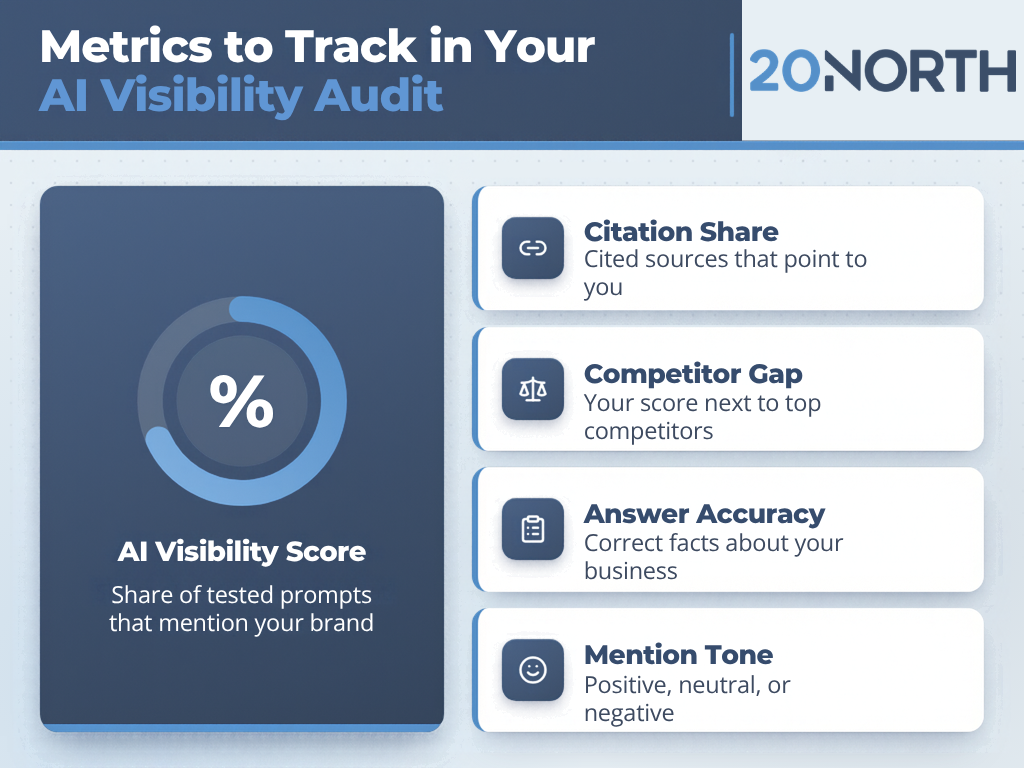
Turn your log into two headline numbers. Your AI visibility score is the percentage of prompts where your brand appears. Your citation share is the percentage of all cited sources that point to your site or to coverage about you. Compare both numbers with your closest competitor to see where you lead and where you trail.
Organize your findings into a detailed report with clear priorities:
- Content gaps: Publish a blog post or service page that directly answers questions AI tools could not answer about you.
- Accuracy fixes: Update outdated facts on your website, business listings, and key directories.
- Authority gaps: Use public relations, a press release, expert commentary, and review requests to earn mentions on trusted sites.
- Trust signals: Add author bios, case studies, reviews, and clear contact details.
Our guide to building brand authority for AI search covers growing authority in AI search in more depth.
How Often Should You Run an AI Visibility Audit?
Run a full audit once to set your baseline, then repeat it every quarter. AI models update often, and a competitor's new content can shift results quickly. Between full audits, track a smaller group of priority prompts each month. Our article on how to track your brand's visibility in AI search walks through a simple monthly routine.
Get a Clear Picture of Your AI Visibility With 20North
An AI visibility audit shows how AI platforms see your brand and what it will take to earn more recommendations. Repeat the process every quarter by building prompts around real questions customers ask and testing them across major AI platforms. This work supports AI search and traditional search at the same time, and it fits into a broader digital marketing strategy.
20North is a full-service digital marketing agency based in Atlanta, Georgia. We work with growing businesses that want more traffic, more conversions, and better quality leads. Our services cover SEO, paid media, email marketing, web development, and conversion rate optimization. Our AI SEO services help brands measure and grow their presence across ChatGPT, Gemini, Google AI Overviews, and other AI-powered search experiences.
Want to know where your brand stands in AI search? Request an AI SEO audit or contact our team to see where your brand stands.
.png)
.png)
.png)