
.png)
The Short Answer: The best SEO tool stack starts free. Google Search Console, Google Analytics, Google Business Profile, and PageSpeed Insights cover keyword rankings, organic traffic, local visibility, and site speed at no cost. Add one paid platform for keyword research and competitor analysis, plus a crawler for technical audits, and you have everything most sites need.
There are many SEO tools on the market today, so it can be difficult to decide which ones to use. These are the ones our team uses every day to drive SEO results for 20North clients, grouped by the job they actually do rather than by price tag.
Start With the Free Tools
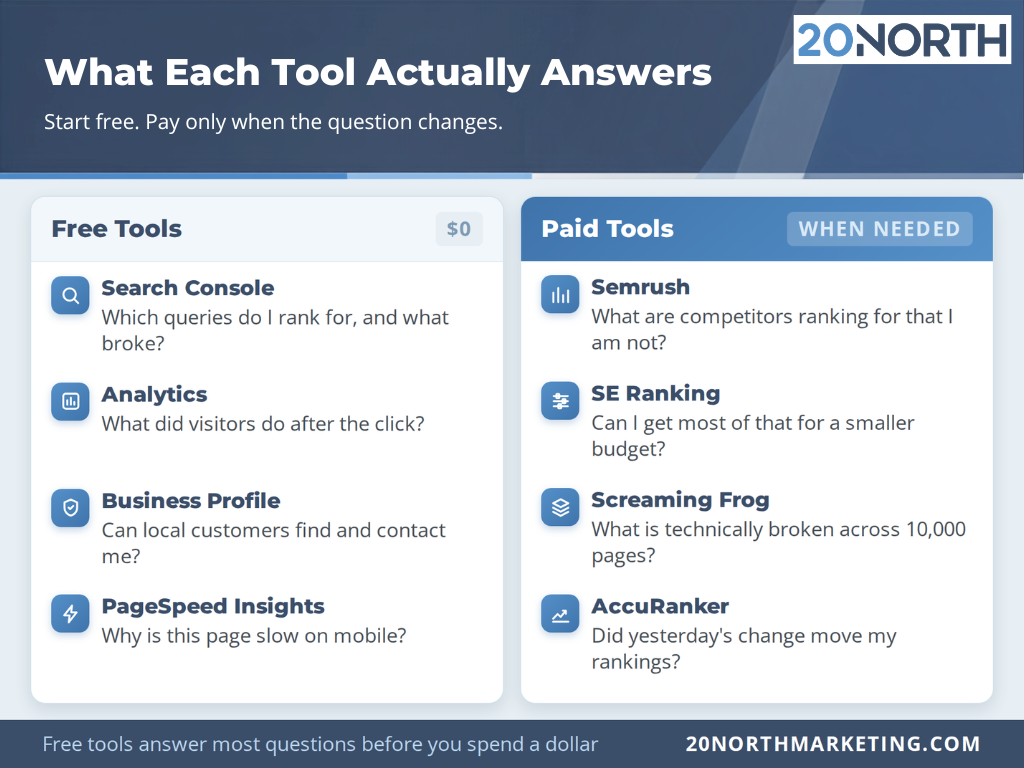
Most small business owners overbuy software before they have used what Google already gives them. These four cost nothing and answer most of the questions a paid platform would.
Google Search Console
Google Search Console is a search-engine focused tool that shows how your site performs in Google search. It helps you monitor, maintain, and troubleshoot your presence in search results, and it reports the queries people used, your keyword rankings, click-through rates, and any indexing or technical issues Google found while crawling.
This is the single most useful free tool in SEO because the data comes straight from the search engine rather than from a third-party estimate. Check it weekly for pages that lost impressions, queries you rank for on page two, and coverage errors that quietly pull pages out of the index.
Google Analytics
Google Analytics is a free tracking service that works by adding a code snippet to your website. It tracks which channels drive the most traffic and gives you insight into the audience visiting your site, including their location, devices, and behavior once they land.
Search Console tells you what happened in Google search. Analytics tells you what happened after the click. You need both, and how people behave after landing feeds directly into user experience and conversion rate optimization work.
Google Business Profile
Google Business Profile, formerly Google My Business, is a free tool that helps businesses manage how they appear across Google Search and Maps. It lets customers find key information about your business like hours, address, phone number, and the services you provide.
For any local business, this is the highest-return hour of SEO work available. We covered the reasons in our post on why Google Business Profile matters.
Google PageSpeed Insights
Google PageSpeed Insights lets you test the speed of a web page quickly. Enter a URL, hit Analyze, and you get a score for desktop and mobile along with a report on what is slowing the page down. Since page speed affects both user experience and search ranking, this is worth running on your top pages every quarter. Our breakdown of what kills website speed covers the fixes.
Google Keyword Planner
Google Keyword Planner sits inside Google Ads and is free to use. It gives search volume ranges and keyword ideas pulled from Google's own data. The ranges are broad without an active ad spend, but for a small business starting keyword research it is a reasonable first stop.
Keyword Research and Competitive Analysis
Free tools tell you how you are doing. Paid platforms tell you what your competitors are doing and where the content gaps are.
Semrush
Semrush is the platform our team spends the most time in. It is an all-in-one system for discovering marketing insights and improving the online visibility of your website, with reports across SEO, PPC, keyword research, competitive research, content marketing, and campaign management. Most tools do one of those jobs well. Semrush does enough of them well to stand in for three or four separate subscriptions.
The competitor analysis is the part we lean on most. Seeing which keywords a rival ranks for is faster than guessing at your own content strategy, and the gap reports surface topics you have no page for yet. That is where most content marketing plans should start.
Database depth is what separates it from cheaper options. Pull a competitor's organic keywords and you get years of history, position changes, and the pages earning those rankings. That turns a vague sense that a rival is beating you into a specific list of pages to build. Semrush has also moved fast on AI search visibility, so you can watch how your brand shows up in AI answers in the same place you track keyword rankings.
SE Ranking
SE Ranking covers similar ground at a lower price, with rank tracking, site audit, keyword research, and competitor analysis in one place. The learning curve is gentler, which makes it a fair pick for in-house teams on a tight budget.
The tradeoff is depth. The keyword and backlink databases are smaller, so competitive research on established rivals turns up less to work with. If budget decides it, SE Ranking does the job. If you can stretch, Semrush is where we would put the money.
Ahrefs Webmaster Tools
Ahrefs Webmaster Tools is the free tier of Ahrefs. Verify your site and you get a site audit and a look at your own backlink profile and organic keywords at no cost. You cannot research competitor domains on the free version, but for auditing your own site it is one of the better free tools available.
Technical SEO Audits
Screaming Frog
Screaming Frog is an SEO Spider tool that crawls your website the way a search engine does. The free version crawls up to 500 URLs, and a license removes that limit and unlocks JavaScript rendering, scheduling, and API integrations. A crawl surfaces broken links, redirect chains, duplicate content, missing meta descriptions, and hundreds of other technical issues.
The interface shows a lot at once and the value depends on knowing which columns matter. Start with four reports: response codes for broken pages, page titles for missing or duplicated metas, directives for pages accidentally set to noindex, and canonicals for duplicate content. No other tool at the price gives you this level of detail on technical SEO audits, which is why it sits in almost every professional stack, but the learning curve is real. If you would rather hand that off, our SEO audit service covers it.
Content Optimization
Yoast SEO
Yoast SEO is a WordPress plugin that helps your pages meet technical SEO standards without touching code. It handles meta titles and descriptions, canonical tags, XML sitemaps, and structured data, and it scores the readability of each blog post as you write.
Treat the green light as a floor rather than a goal. Yoast checks mechanics. It cannot tell you if your content answers the question better than the pages already ranking, which is the actual job of on-page optimization. Running an e-commerce store on Shopify instead? Much of this is built into the platform, as we covered in our Shopify SEO review.
Rank Tracking
AccuRanker
AccuRanker is a rank tracker that lets you search, index, and export keyword rankings on demand. It refreshes faster than most competitors, which matters when you are validating a change you made yesterday rather than waiting a week for a weekly crawl.
Rank tracking has become less straightforward as results personalize by location and device, so treat position data as directional. Pair it with Search Console impressions for the fuller picture, which we walk through in our guide to the SEO KPIs that matter.
Tracking AI Overviews
Search results now include Google's AI Overviews and AI Mode, and until recently there was no clean way to see how often your pages appeared inside them. That changed in June 2026, when Google launched dedicated generative AI performance reports in Search Console showing impressions from AI Overviews, AI Mode, and generative AI features in Discover.
The launch version reports impressions only, with no click or query data yet, so read it as a visibility report rather than a performance one. Still, it means the free tool you already use now covers AI search visibility. For tools built specifically for this, see our roundup of the best AI SEO tools and our guide to tracking brand visibility in AI search. Optimizing for it is a related but separate job, which we cover in product page optimization for AI Overviews and will AI replace SEO.
Building Your Stack
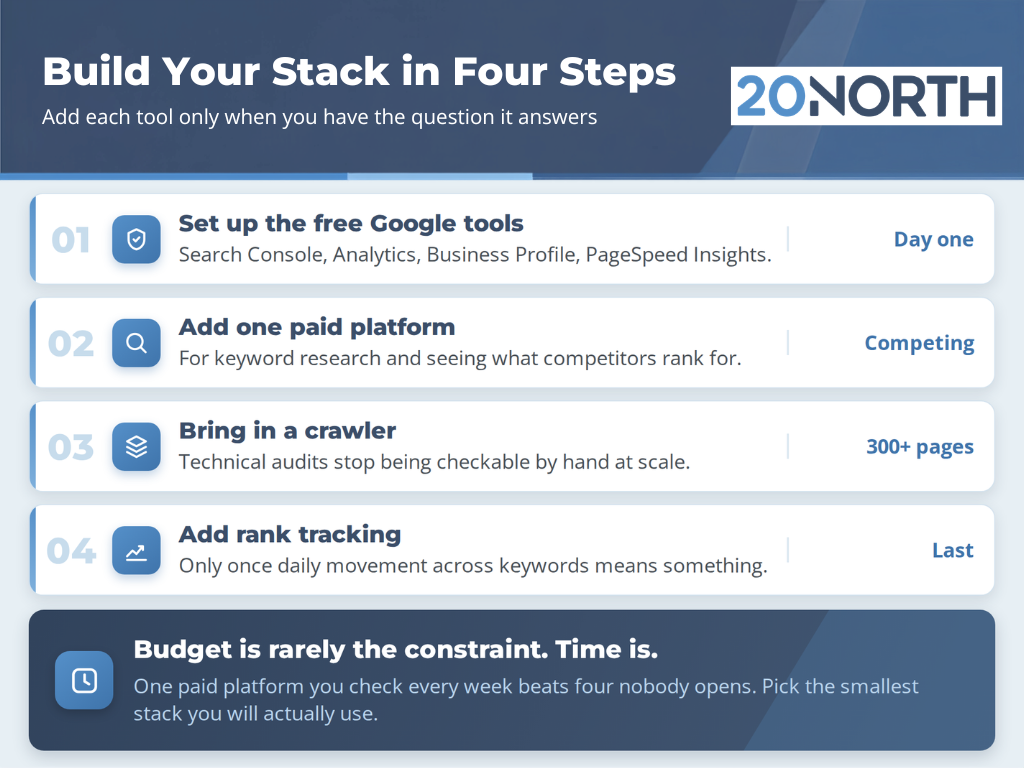
Additional features sell software, but the tools you actually open every week are what matter. A practical order:
- Set up Search Console, Analytics, and Google Business Profile first. They are free, and they answer most questions.
- Add one paid platform once you are competing for keywords rather than just tracking them.
- Bring in a crawler when your site outgrows what you can check by hand, usually past a few hundred pages.
- Add rank tracking last, once you have enough keyword rankings to make daily movement meaningful.
Budget is rarely the real constraint. Time is. A small business with one paid platform and a habit of checking it beats a business paying for four tools nobody opens. Pick the smallest stack you will actually use, then add to it when a specific question comes up that your current tools cannot answer.
Artificial intelligence has been added to nearly every platform on this list, mostly for content briefs and clustering. It speeds up the work but it still needs someone who can read the data and turn it into a plan.
Getting More From Your SEO Tools With 20North
Tools surface actionable insights. They do not decide what to do about them, and a dashboard full of red flags helps nobody without someone to prioritize the fixes.
20North's team pairs these platforms with real strategy across search engine optimization, technical audits, keyword research, and AI SEO, so your site earns rankings in traditional search results and in AI answers. See it in our case studies, including how Roam grew its page-one keyword footprint by 130%.
Start with a free SEO audit, browse our full range of digital marketing services, or contact us today for a free consultation.
.png)
.png)
.png)